The Crucifixion with the Virgin, Saint John, Saint Jerome, and Saint Mary Magdalene by Perugino, Pietro
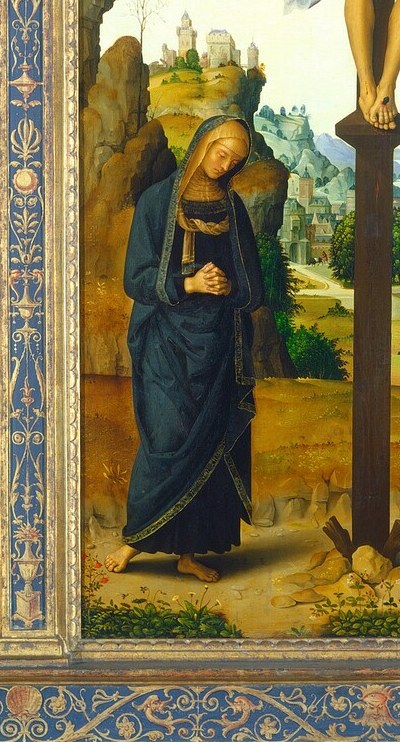
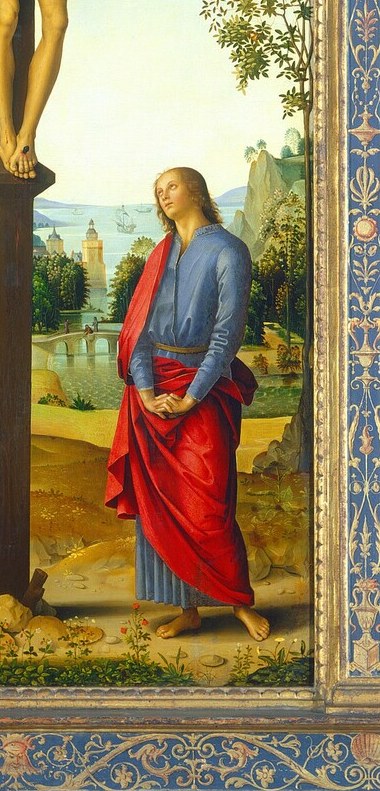
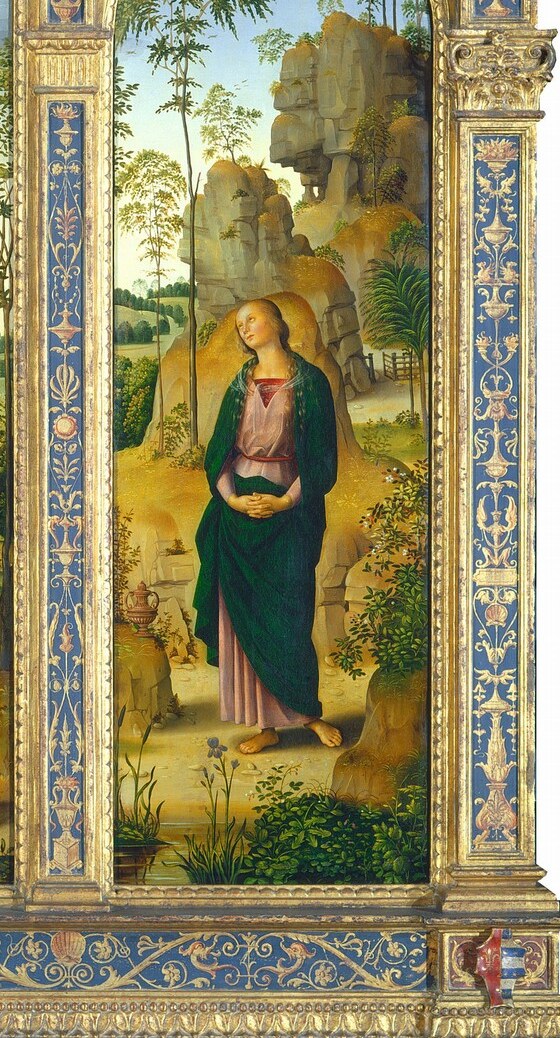
This is Pietro Perugino's 'The Crucifixion with the Virgin, Saint John, Saint Jerome, and Saint Mary Magdalene,' painted around 1485 and now at the National Gallery of Art. It is a painting shaped as much by geopolitics as by devotion.
Look closely at the base of the cross. The small detail of a human skull there is not random; it is Adam's skull, placed at Golgotha by tradition so that Christ's blood would physically redeem the first sin. The entire theological argument of the altarpiece is condensed into this one overlooked object. Every other element, from Mary Magdalene's courtly Florentine dress to Saint Jerome's self-punishing stone, orbits this central idea.
The painting's journey is a microcosm of modern European history. Commissioned for a Dominican church in San Gimignano, it was looted by Napoleon's troops in the 1790s. It then passed into the hands of a Russian ambassador in Rome who purchased it believing it to be a Raphael. For decades it hung in the Hermitage Museum, until Joseph Stalin, seeking foreign currency during the first Five-Year Plan, secretly sold it, along with other masterpieces, to Andrew Mellon.
The shock for Soviet curators was immense. They had no say in the matter. These were not just pictures; they were the nation's cultural patrimony, traded away for industrial equipment. When the National Gallery of Art opened in 1937, built around Mellon's collection, this serene Umbrian landscape had quietly become an American public treasure.
#arthistory #perugino #renaissanceart
Details

Transcript
A crucifixion, serene and perfectly balanced. Painted in the 1480s, at the height of the Italian Renaissance. Look at the base of the cross. A skull. Adam's skull. Theology made visible in bone. Centuries later, Napoleon's troops seized it from an Italian church. It was bought by a Russian prince who thought he was getting a Raphael. The Hermitage was its home. Then, in 1931, Stalin needed money. He sold it, in secret, to an American buyer.