Allegory of the Planets and Continents by Giovanni Battista Tiepolo
This is Tiepolo's oil sketch for what became the largest fresco in the world. 'Allegory of the Planets and Continents' (1752) now hangs in the Metropolitan Museum of Art, but it was painted as a working plan for a staircase ceiling in the Würzburg Residenz, Germany, a single painted surface covering over 600 square meters.
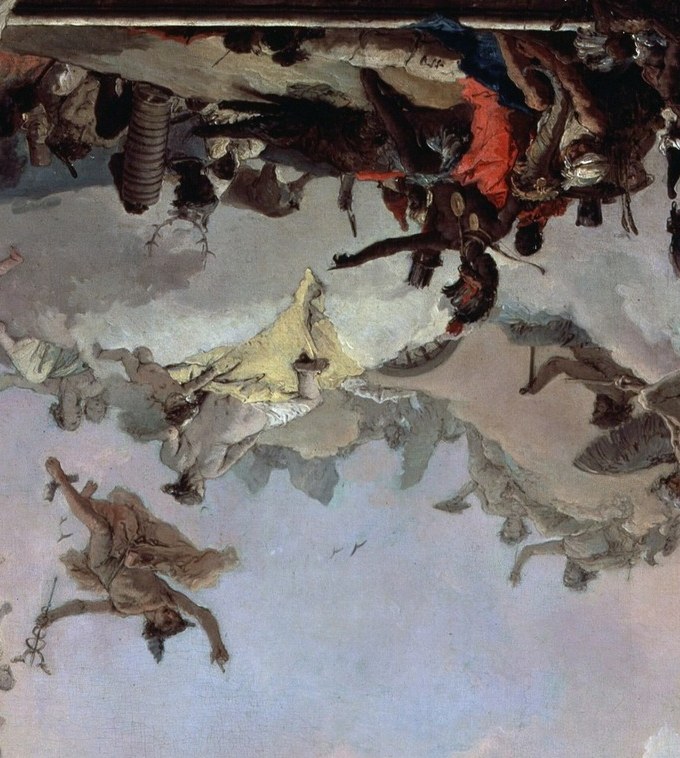
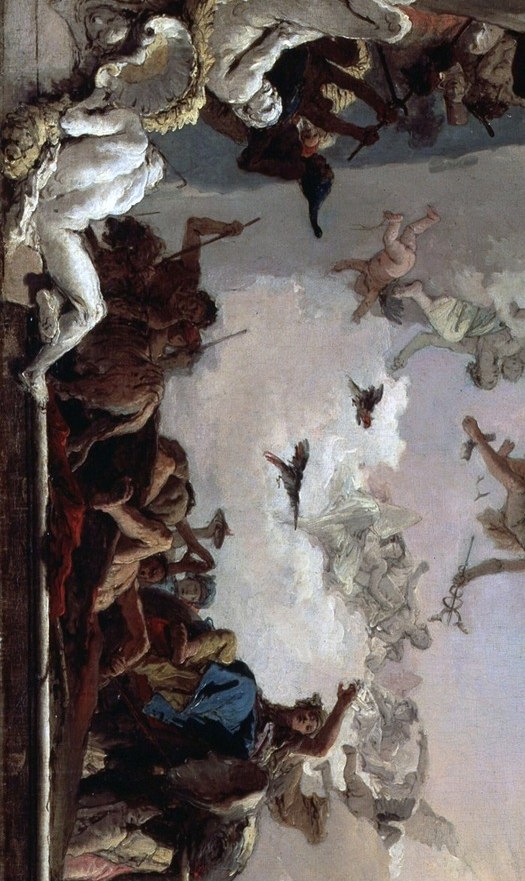
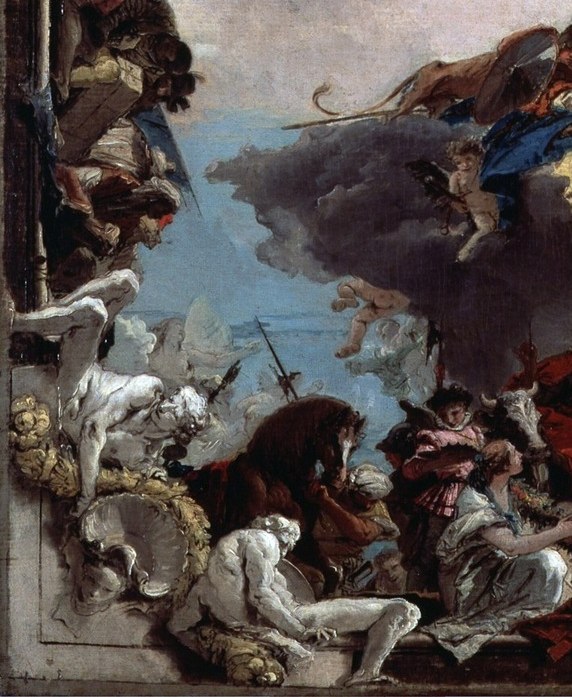
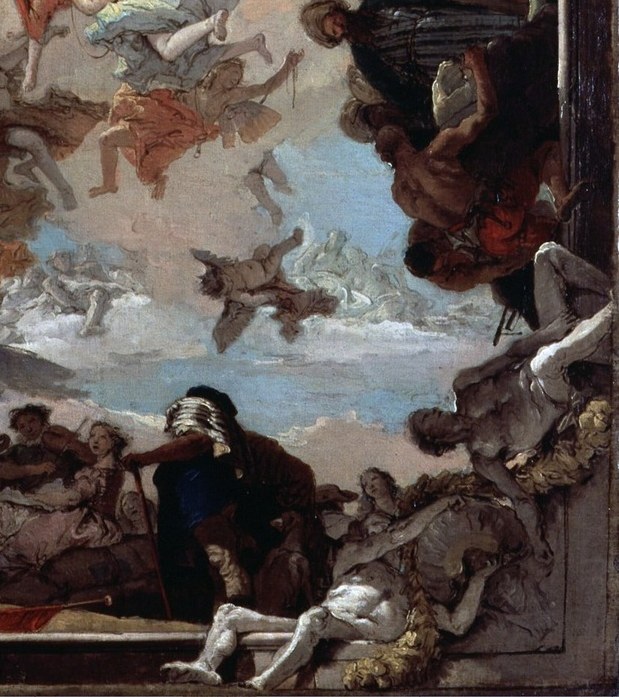
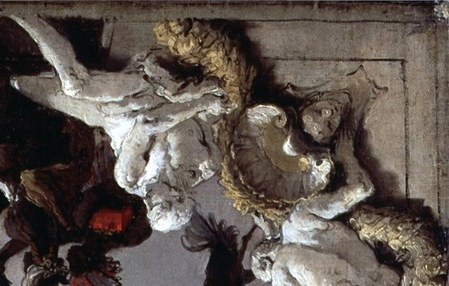
Look at the four corners. Each one holds a personified continent, Africa, America, Europe, Asia, with the attributes an 18th-century Venetian would have considered definitive: an exotic animal, a crown, a horse. The hierarchy is visible at a glance. Above them, the planets circle in mythological form: Apollo as the sun at centre, Saturn brooding in shadow, Mercury soaring on wings.
Tiepolo designed this entire cosmology on a modest canvas before climbing the scaffolding in Würzburg. The finished fresco reverses some continents and adds portraits of the patron, the architect Balthasar Neumann, and Tiepolo himself with his two sons, details absent from this sketch. This version was rediscovered only in 1954, glued to the ceiling of a corridor in a London hotel once owned by the actor David Garrick.
The painting is both a masterclass in Baroque illusionism and a complete map of how educated Europe pictured the universe. Every figure carries a code.
Details
Transcript
At the top of the world, the sun god Apollo. This is not a portrait of a god. It is a diagram of the solar system. Opposite him in heavy shadow, devouring time itself: Saturn. Now look at the four corners of the canvas. A figured allegory for Africa: a continent reduced to a single coded body. And opposite, with crown and white horse, Europe, seated above the rest. This entire world order was painted as a plan for the largest fresco on earth. Over 600 square meters, on a single staircase ceiling in Würzburg.