Untitled by Katsushika Hokusai
Hokusai's untitled drinking scene, painted around 1804 and now held by the Metropolitan Museum of Art, is a masterclass in comic caricature and social observation. Rendered in quick, confident ink and pale color on paper, the painting captures a fleeting, unguarded moment of human excess with a wit that feels startlingly modern.
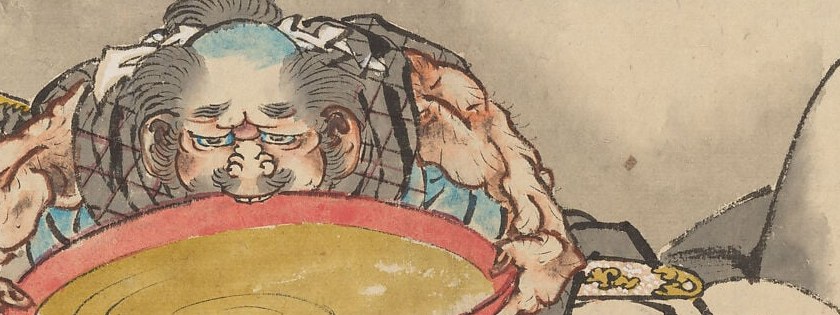
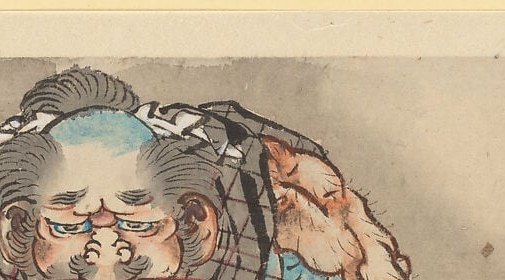
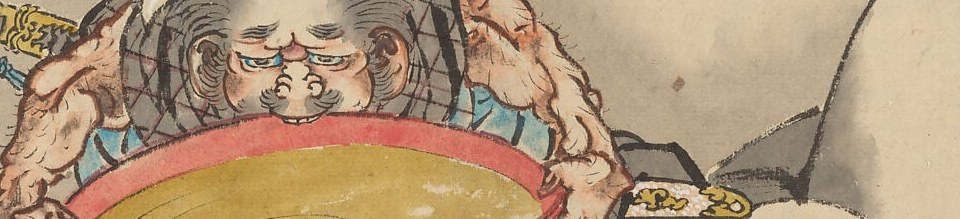
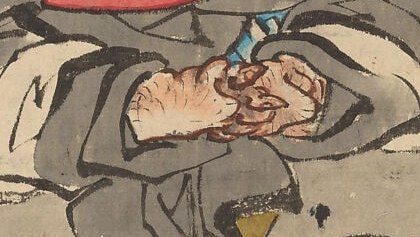
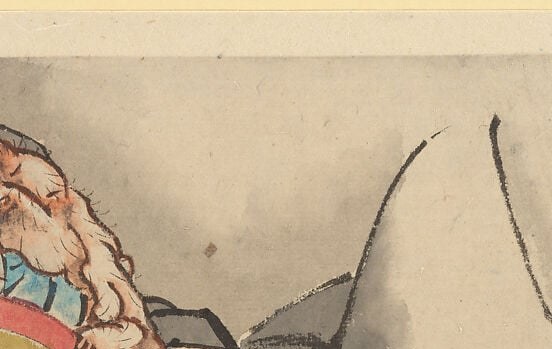
The composition is dominated by an enormous circular red lacquer basin, its flat surface anchoring the scene. Behind it looms the main figure, a spherical, bald-headed man whose swollen face is a mask of pure, greedy delight. His small hands grip the rim with a childlike possessiveness. In stark contrast, a second, much smaller figure peers up from the bottom of the frame, his dark robes and upward gaze establishing an immediate hierarchy. It is a visual joke about scale, power, and appetite: the powerful man, a warrior who has set his sword aside, is reduced to a grotesque clown by the simple promise of more wine.
Hokusai was roughly 44 years old when he made this work, decades before his famous Thirty-Six Views of Mount Fuji. He was already a master of capturing Edo's fleeting pleasures, the floating world, with a sharp, affectionate eye. This piece uses spare, brilliant diagonals (a sword, a staff) to inject energy into a static composition, while a deliberate void of grey emptiness on the upper right makes the crowded, comic left feel even more dynamic.
It is a painting of a man who looks like the thing he drinks from: round, full, and ready to be emptied. What do you make of the figure crouching in the shadows below?
Details
Transcript
It starts with the vessel. A huge red lacquer basin, big enough to bathe in. Now look at the face behind it. A swollen, gleaming mask of pure drunken appetite. Those hands grip the rim with possessive eagerness. And below, a second face peers up from the shadows. The size difference is the whole joke. A warrior, his sword set aside, reduced to a clown by thirst.