Sunrise by George Inness
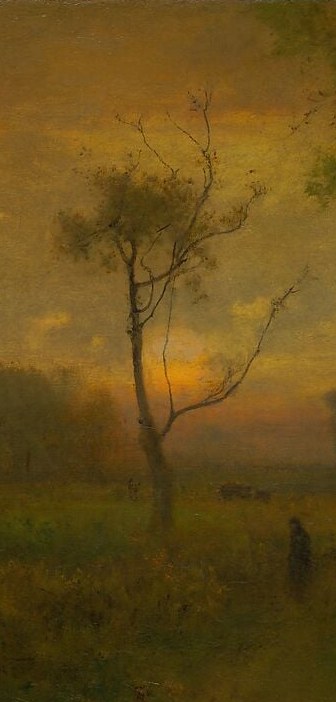
George Inness painted *Sunrise* in 1887, and it holds a secret in plain sight, or rather, in the dark. Now in the collection of the National Gallery of Art in Washington, D.C., this work comes from the artist's mature period, when his landscapes became less about place and more about presence. Influenced by the spiritual philosophy of Emanuel Swedenborg, Inness believed the natural world was a threshold to the divine. This is not a postcard of a pretty morning; it is an invitation to look through the light into something deeper.
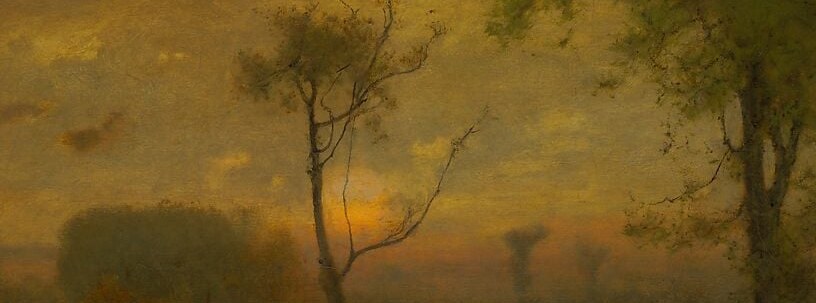
Scan the horizon first. See how Inness dissolves the line between earth and sky into a single amber pulse. His brushwork is so soft that the light feels like an emanation, not an event. Then find the tiny dark silhouette in the mid-ground. It is deliberately ambiguous, a cow, a person, a soul in the landscape. For Inness, that figure was not staffage. It was the reason for the painting.
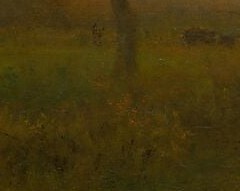
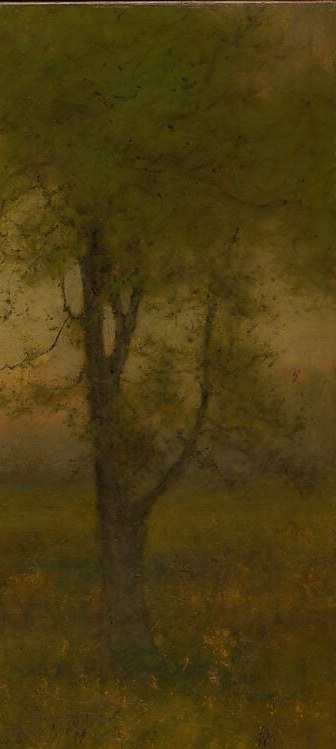
Inness had been a Hudson River School realist early on, but by the 1880s he had fused the Barbizon mood with Swedenborgian mysticism to create what critics called "the American Barbizon." He was a transitional genius, neither realist nor impressionist, who painted atmosphere itself as a spiritual medium. This canvas is deceptively simple: a tree, a glow, a shadow. But that shadow is the real prize. In the lower left corner, the paint surface is a physical event, thick impasto, scraped and reworked, a dense material darkness that anchors the entire luminous composition. You would never see it in a reproduction.
It is a painting about two kinds of substance: the immaterial light that dissolves the world, and the heavy dark matter that holds it together.
Details

Transcript
A sunrise, yes. But the painter is not interested in the sun. George Inness believed a landscape was a spiritual threshold. Look at the horizon. The earth and sky dissolve into a single warm glow. Now find the dark shape in the mist, below the tree. In his late work, every form is a soul, not a prop. One last thing. The paint itself has a secret. In this near-black shadow, the paint is thick, scraped, and built up. Pure texture, invisible at first glance.