Clouds by Thomas Cole
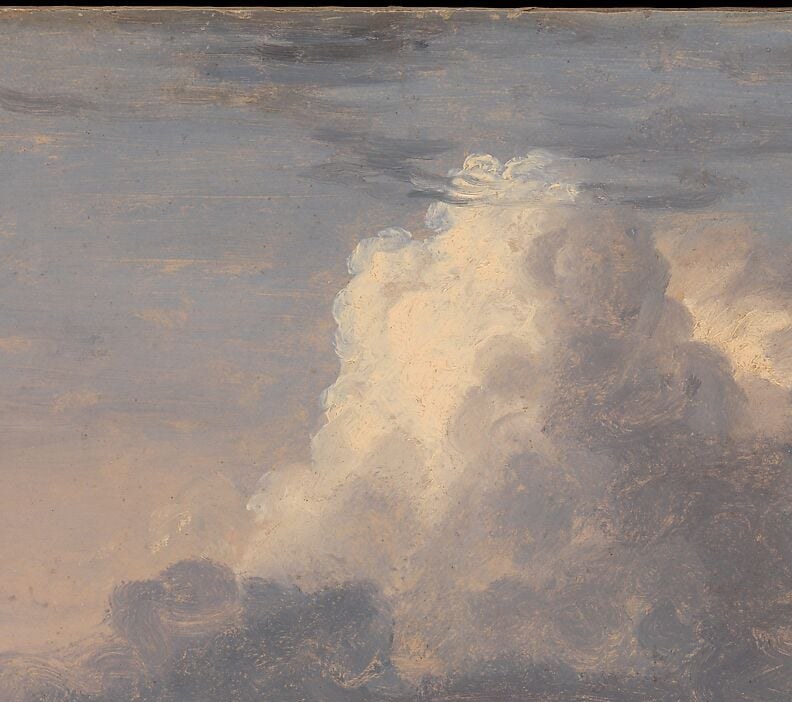
Thomas Cole painted Clouds around 1838, a work with no mountains, no ruins, and almost no earth. The sky is not a backdrop here; it is the entire drama.
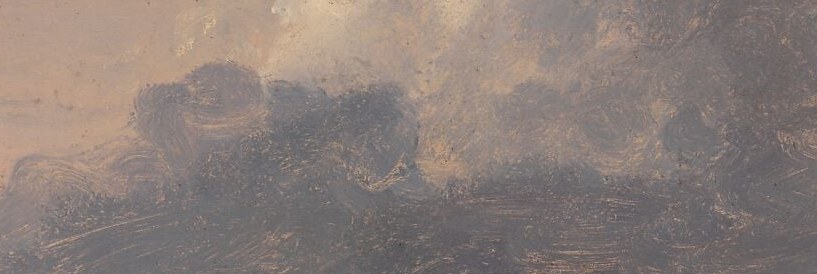
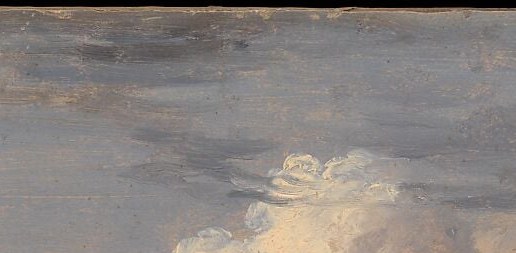
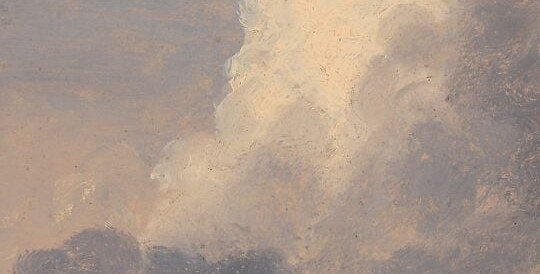
Watch how he builds the central cumulus. A deep purple-gray shadow anchors the base, giving it a threatening weight. The crown glows not from reflected sunlight but from an internal luminosity, as if the cloud generates its own light. The real mastery is the mid-section, where a nuanced gray zone wraps the form into a three-dimensional sphere. At the left edge, a single feathered brushstroke dissolves solid mass into vapor.
Cole founded the Hudson River School and filled his grand landscapes with moral warnings about industry and expansion. But here, around 1838, he dropped the allegory and simply stared at the sky. He studied meteorology to understand what he was painting, then used oil on paper to explain it back to us.
Next time a thunderhead builds on the horizon, you might see it the way Cole did: not as weather, but as architecture.
Details
Transcript
Most painters treat the sky as a backdrop. Thomas Cole made it the subject. Look at the shadow mass beneath the cloud. That deep purple-gray weighs it down like stone. Now look at the top. Light from inside, not on it. The transition zone makes it round: not a flat shape, a sphere. A single brush pulls the edge from mass into vapor. Cole studied meteorology. This is a cumulus cloud built by someone who knew how it worked.