Joseph Badger, the colonial portraitist spent the better part of twenty-five years answering a single question, and he was honest enough never to pretend he had solved it. The question was practical before it was aesthetic. How do you make a New England face hold the eye and carry the weight of a person worth remembering, when you have no academy behind you, no Italian journey, no master's studio, only a stack of black-and-white prints and a sitter who has paid for an hour of your attention? Badger asked that question of a Charlestown ship captain, of a Boston physician, of his own three-year-old grandson. He answered it the same way each time and the answer kept changing under his hand.
This is the thesis worth defending against the usual verdict on him, which is that he was a stiff provincial hack who got swept aside the moment a real talent arrived. Badger was not a genius and he was not trying to be one. He was a problem-solver who returned to the same compositional problem over and over, revising rather than reinventing, and the record of those revisions is the most interesting thing about him. Look at his portraits in sequence and you do not see a man failing to be John Singleton Copley. You see a man working out, canvas by canvas, how much truth a borrowed formula can be made to hold. The several answers are all answers to the one question, and the best of them are genuinely good.
A house-painter who learned to paint faces
Badger was born around 1708 in Charlestown, Massachusetts, across the river from Boston, and he came to portraiture sideways. He started out as a house-painter and glazier, mixing pigments for clapboard and door, setting glass, lettering signs. That is the trade that fed him, and it shaped how he thought about a surface. According to the National Gallery of Art, he had no formal art training and taught himself portraiture by copying the black-and-white mezzotint reproductions of English painters that circulated in the colonies, taking up the work in earnest around 1740. He was among the earliest native-born portrait painters that Massachusetts produced.
That detail about the mezzotints explains almost everything about his manner. A mezzotint hands you a pose, a turn of the head, the fall of drapery, the convention for a gentleman's hand tucked into a waistcoat. What it cannot hand you is color, or the way light actually wraps a cheekbone, or the soft transitions an oil painter learns at an easel beside someone who already knows. Badger absorbed the grammar of English society portraiture and had to invent the rest from observation. So his figures stand in the attitudes of London sitters while their faces report what he could see in front of him in a Boston parlor. The two registers never quite fuse. The seam between them is where his pictures live.
The Getty Union List of Artist Names fixes him plainly: American painter, 1708 to 1765, born in Charlestown, died in Boston, working as painter, portraitist, and miniaturist. The miniature work matters, because it tells you he could operate small and exact when a commission asked for it. The large oils show the same instinct scaled up. He trusts line. He trusts the clean edge of a collar or the silhouette of a wig against a dark ground more than he trusts atmosphere. A sitter, to Badger, is a shape to be gotten right first and softened second.
The grandson, the cherries, and the bird
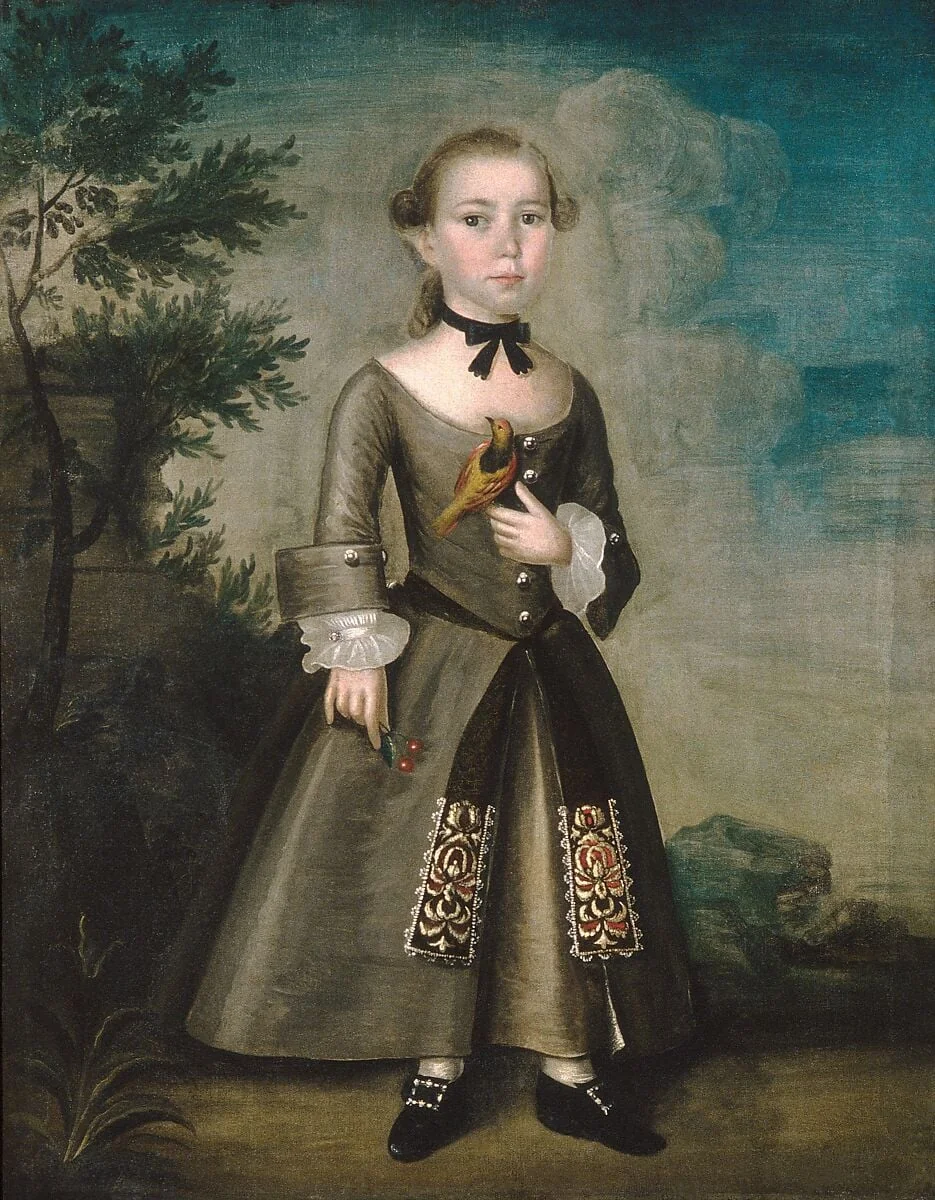
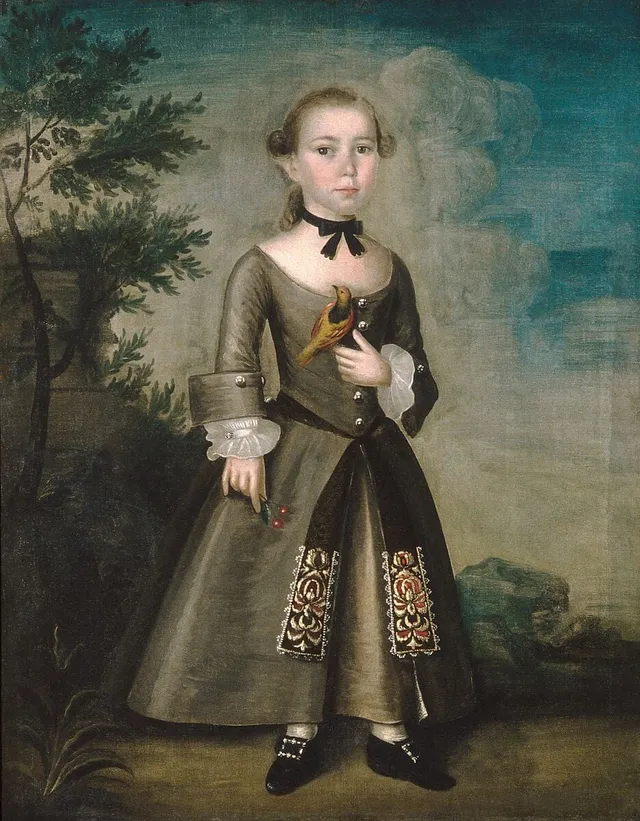
Start where the affection is plainest. The Metropolitan Museum of Art holds Badger's portrait of his grandson, James Badger, painted around 1760 when the child was three. The Met records the essentials: the boy stands in a generalized landscape, holding cherries, with a small bird perched on one finger. Set those props aside for a moment and look at how the picture is built.
The child is presented full-length and nearly frontal, planted on the lower third of the canvas like a figure pinned to a board. The landscape behind him is not a place. It is a backdrop, a painted flat of foliage and sky that recedes by convention rather than by any observed fall of light, and the boy does not stand in it so much as in front of it. His small body is built from the same clean outlines Badger gives a grown man's coat: the edge of the dress, the rounded shoulders, the doll-stiff arms. Where the picture comes alive is the head. Badger has looked hard at this particular face, the wide level gaze, the slightly heavy lids, the soft mouth that has not yet decided what it thinks of being painted. The bird on the finger and the cherries in the hand are borrowed emblems, the kind of innocence-and-mortality props that English child portraits trafficked in, and the boy holds them the way a three-year-old holds anything an adult has placed there, with a grip that is dutiful and absent at once.
The light is the giveaway. It is even, frontal, almost shadowless, the light of a man who learned tone from prints and never fully trusted the deep modeling that would let a form turn into real space. Copley, a few years later, would make a child's satin shimmer and a piece of fruit sit in convincing air. Badger does not reach for that. He gives you the bird, the cherries, the gaze, and the flat green behind, and he lets the tenderness do the work the technique cannot. It is a grandfather's picture. The stiffness is part of the honesty.
The Fosters: one answer, revised
If James Badger shows the question at its most personal, a single family shows it at its most methodical. Our archive carries four members of the Foster family, all by Badger's hand, and read together they form a small laboratory of his practice. There is Captain Isaac Foster, his wife Eleanor Wyer Foster, their relation Dr. William Foster, and the younger Isaac Foster, Jr.. One painter, one household, the same shop of devices applied four ways.
This is where the revising becomes visible. Badger had a finite kit. A three-quarter pose, the body angled while the face comes back toward us. A dark, undescribed ground that throws the head and hands forward. A hand resting on a ledge or slipped into a coat. A palette that runs to browns, deep reds, the cool grey of a man's coat against the warmer note of a face. He deploys that kit on the captain and on the doctor without much variation in the scaffolding. What he varies is the reading of the face, and the variation is not small. A sea captain and a physician are different kinds of New England authority, and Badger knows it. The captain's weight sits in the jaw and the steadiness of the look. The doctor carries his standing in the composure of the mouth and the deliberateness of the hands, the instruments of a man who is paid for judgment.
Eleanor Wyer Foster is the most instructive of the four, because the female portrait forced Badger off his most comfortable ground. Here the borrowed mezzotint conventions are at their thickest: the satin, the lace at the sleeve, the smooth oval of the face that English fashion plates had standardized into a near-mask. A lesser self-taught painter would have surrendered the whole face to that mask. Badger does not quite. The likeness keeps interrupting the formula, a specific set to the eyes, an asymmetry the convention would have ironed out. He cannot render the fabric the way a London hand could, so he gives you its pattern and its edge instead of its sheen, and the result is flatter and, oddly, more frank. You are looking at a real woman wearing the costume of a portrait. The seam shows, and the seam is the truth.
Put the Fosters beside Jeremiah Belknap and the consistency of the method is unmistakable. Same dark ground, same trust in the outline of the head, same even light. Badger is not chasing novelty across these canvases. He is asking the one question of each new sitter and accepting that the answer will be a near-repetition with one honest correction. That is not the working pattern of a man who failed to develop. It is the working pattern of a craftsman who knew exactly what his tools could do and kept testing the edge of it.
Works discussed in this article
What the archive holds
The shape of a working life shows up in the holdings. Artifact World Gallery carries nineteen Joseph Badger works, drawn from nine separate collections, with the dated material clustering across roughly 1701 to 1760. Nineteen pictures across nine venues is a useful figure to hold in mind, because it matches what the scholarship has long said about him. The first serious accounting of his output, Lawrence Park's descriptive list, ran in the Proceedings of the Massachusetts Historical Society back in 1917 and 1918, and it described a steady, regional, family-based practice rather than a national career. Sitters were neighbors, relations, members of the merchant and professional class of greater Boston. The work spread out among the institutions that later inherited New England's family portraits. A scatter across nine collections is exactly the footprint a busy local portraitist leaves, not the concentrated trove of a court painter.
The squirrel and the eclipse
There is one motif that gives Badger a small, real claim on the history of American painting, and it is worth stating precisely because it is so often handed to someone else. The flying squirrel on a gold chain, that emblem of a tamed and pampered pet which Copley would make famous in his portrait of a boy holding such a creature, appears earlier in Badger's work. As the entry on him notes, Badger introduced the pet squirrel into colonial portraiture before Copley did, and on the evidence he holds the apparent claim to primacy for the device. He got there first. He simply lacked the means to make the world remember that he had.
That gap, between getting there first and being remembered for it, defines the second half of his career. Copley rose in Boston through the 1750s, and the contrast was brutal. Where Badger gave you a clean outline and an honest face on a flat ground, Copley gave you skin that seemed to breathe, silk you could almost hear, and a command of light that made a sitter occupy real space. Smarthistory, writing on Copley's celebrated Boy with a Squirrel, records the consequence for the older man: Badger's commissions, including a likeness of John Haskins he painted in 1759, slowed to a trickle once Copley arrived, and his output had dwindled by the time he died in May 1765. The town had found a painter who could do what the mezzotints only promised, and it moved on.
It would be easy to file Badger under failure at this point and close the book. That reading is lazy. A pioneer who is overtaken is still a pioneer. Badger worked in a colony that had almost no painters and no way to train them, and he built a competent, recognizable, sustained body of portraiture out of prints and stubbornness. He answered the one question well enough that dozens of New England families trusted him with their faces. The squirrel he reached for before anyone else is a fair emblem of the whole career: an idea he had the wit to use and not the resources to own.
Why the answers still read
Return one last time to the question Badger kept asking, and to why his answers still hold up. He wanted to make a face carry weight without the European apparatus, and the device that lets him do it is precisely the flatness later critics held against him. Because he will not dissolve a sitter into atmosphere, the face stays present, declarative, almost confrontational. Eleanor Wyer Foster meets you. The captain meets you. The three-year-old meets you over his cherries. These people do not recede into painterly air. They are pinned to the front of the canvas and they look back.
Modern eyes, trained on a century of flat, frontal, design-forward picture-making, often find that directness easier to love than the sumptuous illusionism that buried it in the 1760s. The very limitation that ended Badger's commissions is the quality that makes a viewer stop in front of a Badger portrait today. Compare his grandson's even, shadowless gaze in James Badger with the worked composure of Dr. William Foster, and you are watching the same instinct serve two ages of one man, neither of them apologizing for what it cannot do.
So the verdict to leave you with is not that Badger was a footnote to Copley. It is that he was the question Copley would go on to answer differently. Set the captain, the doctor, the wife, and the child side by side, and what you are really looking at is one stubborn craftsman testing a single problem against four lives, refusing to fake the part he could not paint, and trusting the human stare to carry the rest. The next time a New England face seems to hold still and look straight back at you across two and a half centuries, the odds are decent that a former house-painter from Charlestown got there first.
Sources & further reading
- Joseph Badger — National Gallery of Art
- Joseph Badger — Wikipedia
- James Badger (object record) — The Metropolitan Museum of Art
- Copley, Boy with a Squirrel — Smarthistory
- Joseph Badger (ULAN ID 500022577) — Getty Research Institute (ULAN)
- Lawrence Park, Joseph Badger and a Descriptive List of Some of His Works (Massachusetts Historical Society Proceedings, Vol. 51, 1917-1918) — Internet Archive