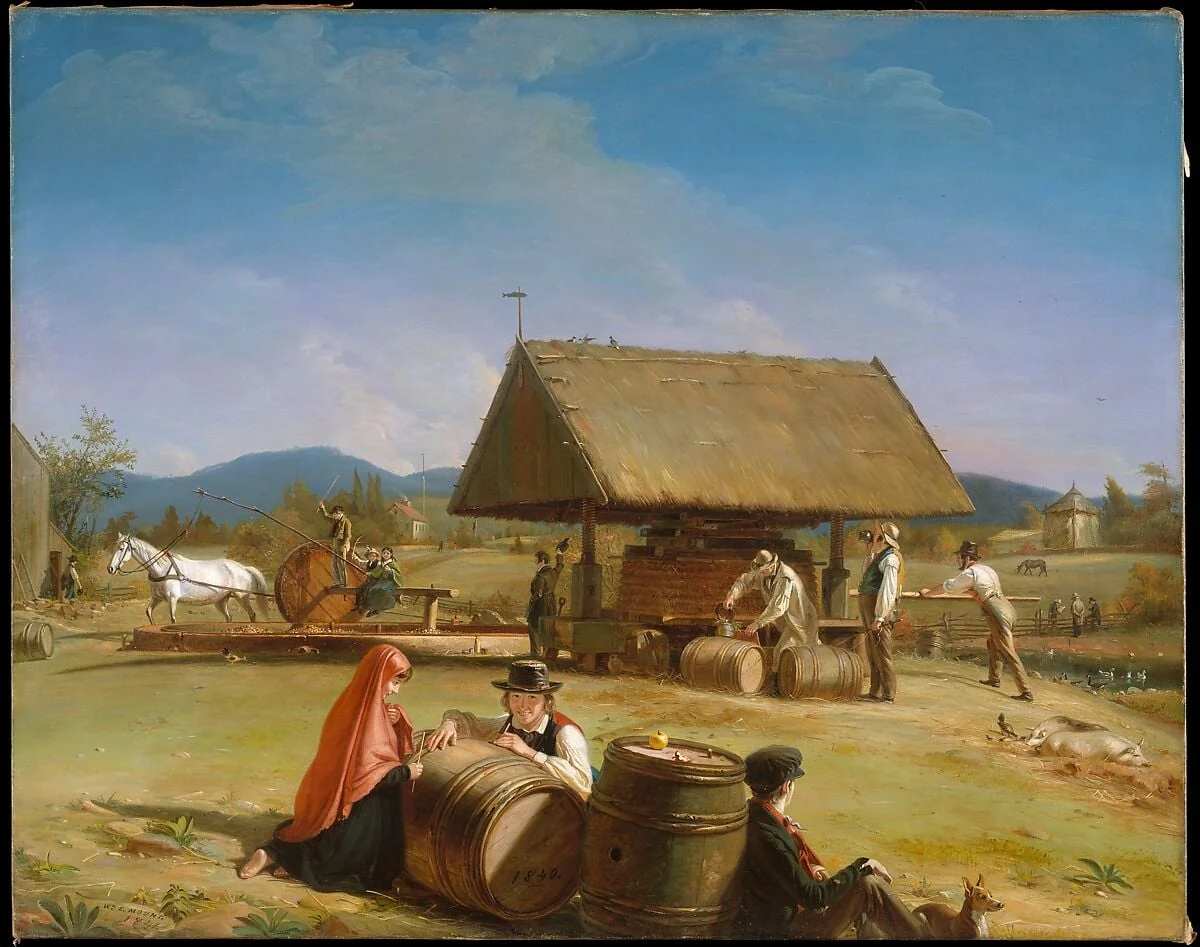
Most accounts of the painter William Sidney Mount open with what he painted: barn dances, horse trades, a cider press in a Setauket yard, the small social theater of rural Long Island. That is the easy story, and it is half wrong. Mount's importance does not sit in his subjects. It sits in his method. The break he made was formal. He built pictures on a shallow stage, lit them with an even working daylight that rarely spikes into drama, and finished them in a plain, legible paint that declines the bravura flourish a European-trained eye expected. He kept the action close to the surface and the colors honest. He took the genre scene, the everyday-life category that Tate defines as paintings of scenes of everyday life, and rebuilt its grammar for an American room.
By the standard reckoning he was the first native-born American to make a career of genre painting, a point the biographical record states plainly. That fact usually gets told as a milestone of subject matter. The more interesting claim is harder to make and worth defending: Mount arrived at a flat, frontal, daylit way of assembling a picture, and that construction, far more than any anecdote about fiddles or bargaining, is what later American realists absorbed. Read the surfaces and the staging across his thirty working years and one argument keeps surfacing. Mount wanted the scene to hold still and be read, not felt as a rush of paint. He treated a barnyard the way a stage manager treats a set: everything placed, everything visible, nothing left to a flattering blur. The rest of this essay follows that argument, work by work.
The break nobody bothered to name
Mount was born in 1807 in Setauket on the north shore of Long Island, and he died there in 1868, in the same village where his eye was formed. He trained briefly at the National Academy of Design, copied the usual plaster casts, tried his hand at the grand historical and religious subjects a young ambitious painter was supposed to attempt, and then turned away from all of it. The turn was not a retreat into provincial small talk. It was a decision about form. The history painters he might have followed, and contemporaries like Emanuel Leutze, built deep diagonal recessions, theatrical chiaroscuro, bodies twisting through dramatic light. Mount went the other way. He pressed his action up against the picture plane and flooded it with daylight. The ambition did not shrink. It changed direction, away from spectacle and toward description.
Call it the shallow stage. In a typical Mount composition the figures occupy a band of space only a few feet deep, parallel to the canvas, like actors lined along the front of a set. The barn wall, the tavern partition, the slope of a yard closes the back of that band and stops the eye. There is air and landscape beyond, but it is a backdrop, not a tunnel inviting you in. This is the structural choice that everything else serves. A shallow stage forces clarity. Every gesture has to register in a single readable plane, and Mount made that legibility the whole point of the picture. It is a harder discipline than it looks, because there is no deep shadow to swallow a clumsy passage and no swirl of distance to carry the eye past a weak figure.
Cider Making: a press, a slope, a light that does not flicker
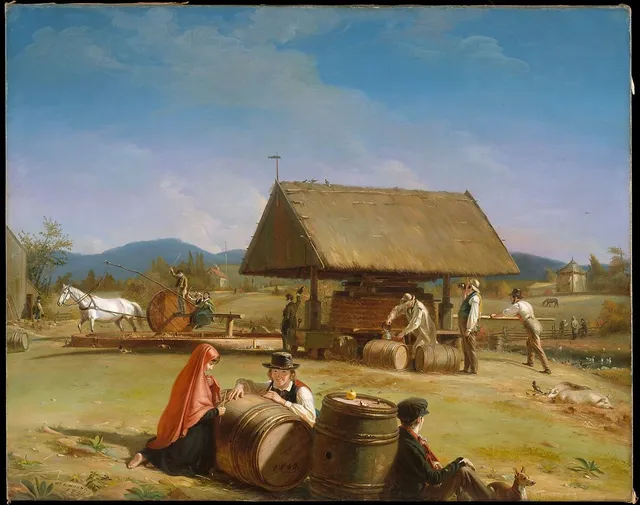
Stand in front of Cider Making, painted in 1840 or 1841 and now at the Metropolitan Museum of Art, and the method announces itself. The great cider press dominates the right half of the canvas, its beam and screw and the heaped pomace built up in careful descriptive paint, the apples in the foreground individually told. The yard slopes gently left to right and Mount uses that slope, not a forced perspective, to organize the figures: the boy at the trough, the men working the press, the horse, the cart, the loungers near the barrels. Nobody is foreshortened into deep space. They spread across the front of the scene in a long readable frieze, each at his task, each fully lit. The composition reads like a sentence, left to right, with no word swallowed by the dark.
Look at the light. It is mid-afternoon autumn daylight, high and even, the kind that models a face without throwing it into half-shadow. There is no single dramatic source, no Caravaggesque shaft. The same clear illumination falls on the barn boards, the apple heap, the horse's flank, and the white shirt of the working man, and Mount lets it sit. Shadows are soft, local, descriptive rather than theatrical. This is paint doing the opposite of what Romantic landscape was doing in the same decade. Where the Hudson River School chased sublime weather, storm light and the glow of a vast continent, Mount chose a working light that flatters nobody and clarifies everything. It is the light of a man who wants you to count the apples.
The subject was not innocent. Cider, and specifically hard cider, was a loaded image in 1840. The Whig Party had just run William Henry Harrison on a log-cabin-and-hard-cider platform, and the campaign's symbolism shadows the picture. Mount, who watched politics closely, knew exactly what a barrel of cider signaled that year. What matters for the formal argument is how he carried the politics: not through allegory or caption, but through the patient, even-handed description of ordinary labor, the same democratic flatness of attention he gave to every figure on the stage. The painting argues for the worth of common work by the simple act of looking at it hard, in plain light, with nothing dramatized. The politics live in the evenness, not in any pointed gesture.
Paint that refuses to perform
Mount's handling is the part critics most often underrate, because it is built to be invisible. His surfaces are tight, smooth, and descriptive. He blends his transitions, keeps his brush quiet, and lets edges stay crisp where a French or English contemporary would have broken them into virtuoso strokes. There is craft everywhere, but it hides. A jug, a fiddle, a worn plank, the nap of a coat: each is rendered with enough specificity that you read the material instantly, and none of it calls attention to the act of painting. This is a deliberate aesthetic position. Mount wanted the viewer looking at the scene, not admiring the paint. The painter steps out of the way.
That restraint reads as conservative until you set it beside what came after. Decades later William Merritt Chase would make the loaded, visible brushstroke the whole subject of a canvas, paint announcing itself as paint. Mount sits at the far end of that spectrum, and his end has its own discipline. A smooth surface gives you nowhere to hide a weak drawing. Every contour has to be right, every value placed, because there is no expressive blur to cover a mistake. The plainness is exacting. What looks like modesty is in fact a higher bar, and Mount cleared it picture after picture.
The tavern and the barn: staging social space
Two pictures outside our archive show the shallow stage at full strength. Bargaining for a Horse of 1835, an early high point of the form that Smarthistory treats as a landmark of American genre, lines two whittling traders along a barnyard fence, the negotiation playing out in body language across a flat frontal band. The Tough Story, a country-tavern scene of 1837 now in the National Gallery of Art, does the same indoors: a seated talker, his listeners, the innkeeper, arranged across the picture like figures on a low relief, the back wall closing the space a short step behind them. The eye never has to travel inward. It moves sideways, taking the cast in turn.
The barn interior became Mount's signature room because it gave him exactly the box he wanted: a defined back wall, a doorway that frames a bright outside, a controllable fall of light through that opening. His 1847 The Power of Music, now at the Cleveland Museum of Art, is the most charged use of that architecture. Inside the barn three white men listen to a fiddler. Outside, against the doorframe, a Black laborer has stopped his work to listen too, leaning in from the threshold, his hat and jug set down beside him. The Cleveland record describes exactly this division: the man kept literally outside the social space of the music yet bound to it by the same tune.
The doorway is doing formal and moral work at once. Mount draws the threshold as a hard vertical seam down the canvas, light on one side, shadow on the other, and places his most sympathetically observed figure precisely on the line. The shallow stage, which everywhere else flattens hierarchy by giving every figure the same plane and the same light, here marks a boundary it cannot dissolve. A historian can debate how far Mount, a man of compromised and contradictory racial politics, intended the indictment. The composition states the fact without flinching. Form carries the meaning, which is the whole thesis of his art. The most generous looking in the painting is aimed at the one figure the scene shuts out.
Portraits as proof of the method
The portraits in our holdings test the argument from a different angle, and they pass. Mount painted faces for income and for kin, and the same priorities govern them: frontal placement, even light, descriptive surface, no theater. Martin Euclid Thompson sits squarely to the viewer, the modeling built in soft graduated daylight, the likeness carried by precise drawing rather than flattering shadow. Mrs. Gideon Tucker gives the same plain treatment to lace and skin, every passage clearly told, nothing dissolved into atmosphere. Mount's near-contemporary in the portrait trade, Rembrandt Peale, reached for a more sculptural, Old-Master gloom; Mount kept the lights up and the surfaces matter-of-fact. The sitter is a neighbor, and the paint treats them as one.
His finest hybrid of portrait and genre is Great-Grand-Father's Tale of the Revolution, a portrait of the Reverend Zachariah Greene that frames an old man's living memory as a small domestic scene. The likeness is exact, but the picture is staged: the listener, the lean of the body, the quiet room. It shows how little distance Mount kept between his portrait practice and his genre practice. Both rest on the same shallow, daylit clarity. And the landscapes confirm it from the third side. Long Island Farmhouses sets its low buildings in a broad even light, the composition spread horizontally and held flat against a high pale sky, the eye moving along the surface rather than plunging into depth. Three genres, one grammar.
Works discussed in this article
What the archive shows
Mount's consistency is not an impression. It is measurable. Artifact World Gallery holds fifty works under his name, drawn from eight venues and clustered across roughly 1827 to 1868, effectively his entire working life from a young academician to the year of his death. That is a near-complete formal arc held in one place, and what it shows when you scroll it is repetition of method, not subject. The cider yard, the barn, the portrait sitter, the farmhouse row: different rooms, the same shallow stage, the same even daylight, the same quiet surface. A career that looks anecdotal in any single picture reveals a fixed structural program across fifty of them. The method does not wobble between the early genre pieces and the late portraits. It hardens.
Set that internal evidence against the external authorities and the case firms up. The reference record names him the first native-born American genre specialist; the museums that hold his anchor works, the Met, the National Gallery, Cleveland, all preserve the same flat daylit construction. The archive lets you verify the claim the institutions make one painting at a time, fifty paintings at once. That is the kind of confirmation a single museum wall cannot offer, because no wall hangs fifty Mounts side by side. The pattern is the proof, and the pattern only shows at scale.
The inheritance
The standard monograph, Alfred Frankenstein's 1968 study tied to the National Gallery's retrospective, made Mount the painter of rural America, and the label stuck so hard it buried the formal achievement under the folklore. Frankenstein's book is indispensable for the documentary life, the diaries, the patrons, the fiddle tunes Mount actually collected. It is less interested in the question this essay has pressed: what kind of picture did he build, and why did it last. The answer is that he built a stage you could read at a glance, lit so plainly that the reading felt like fact, and he handed that machine to the next century. The folklore is real, but it is the wrapping, not the gift.
You can see his settlement working its way forward through the realists who came after, through Samuel Colman and the homegrown scene painters who kept faith with clear American daylight even as European fashion turned toward the broken stroke. Mount's wager was that ordinary life, set on a shallow stage and lit without theater, would carry its own weight if you only described it honestly enough. That wager paid out slowly, in the durability of the pictures rather than in any single dramatic verdict. Walk the cider yard again. The press still turns, the apples still catch the same high autumn light, and the whole crowded yard stays exactly where Mount fixed it, holding still so the next viewer can read it whole.
Sources & further reading
- William Sidney Mount — Wikipedia
- Cider Making (painting) — Wikipedia
- The Power of Music (Cleveland Museum of Art record) — Internet Archive / Cleveland Museum of Art
- The Tough Story, Scene in a Country Tavern (1837) — National Gallery of Art
- William Sidney Mount, Bargaining for a Horse — Smarthistory
- Genre painting (art term) — Tate
- William Sidney Mount, ULAN ID 500017404 — Getty Research Institute (ULAN)
- Cider Making (object page) — The Metropolitan Museum of Art
- Painter of Rural America: William Sidney Mount (Alfred Frankenstein, 1968) — Internet Archive