The Tyrolean painter Johann Georg Platzer built a career on pictures small enough to hold in two hands and dense enough to keep a visitor busy for a whole afternoon. His subject, almost without exception, is pleasure: card tables strewn with coins, banquets collapsing into flirtation, garden parties under fluttering silk, woodland gods too drunk to stand. The lazy reading files this under Rococo froth, decoration for a Viennese cabinet wall. I want to argue the reverse. Platzer's first owners did not buy these little coppers as ornament. They read them as a moralized inventory of the senses, in which every raised glass and every hand laid on a neighbor's wrist carried a second meaning their education had trained them to catch.
That second meaning is the claim this essay defends. The merry companies and the bacchanals are vanitas pictures wearing party clothes. They show the five senses at full appetite and, in the same breath, the brevity of the moment that satisfies them. The copper support does part of the arguing on its own. It is a mirror that has been painted over, a surface that throws candlelight back at whoever leans in close, so the buyer who studied the picture by lamplight caught his own reflected face hovering at the edge of the feast. Platzer never preaches. He lets the gleam do it. To recover what the pictures meant in 1740 we have to stop looking at them as charming and start looking at them as instructed viewers did: as a coded entertainment about wanting things that do not last.
A painter of the cabinet, not the ceiling
Platzer was born in Eppan, in the South Tyrol, on 24 June 1704, and he died in the same town in December 1761, an Austrian Rococo painter and draughtsman who spent his productive years in Vienna (Wikipedia biography). He came from a family of painters. The Getty Union List of Artist Names records him as a painter, engraver, and printmaker, with both a teacher and an artist-parent listed against his name, which tells you the trade was inherited rather than chosen (Getty ULAN). What he learned was not the fresco painter's art of the great Austrian abbey ceilings. It was the opposite scale. Platzer made cabinet pictures, objects sized for a collector's specimen cabinet, and he most often painted them in oil on copper rather than canvas.
The choice of support is the first thing a first viewer would have registered, because it cost more and it behaved differently. Copper takes a finer line than woven cloth. There is no weave to interrupt the brush, so a hair, a pearl, the chased lip of a silver ewer can be set down at the size of a grain of rice and still read. The metal also seals the paint film against a hard, slightly reflective ground, which is why Platzer's whites flash and his shadows stay deep and lacquered. These were luxury goods, and the people who owned them knew it. They handled them, turned them to the light, passed them around. The pictures were made to reward exactly that kind of close, possessive attention.
Place him in his moment. The Metropolitan Museum of Art, which holds his Amusement at the Court of around 1738, calls Platzer the most important artist working in Vienna during the reign of Charles VI (Metropolitan Museum). That is a strong claim for a man who never painted a public altarpiece, and it tells us where the prestige of the cabinet picture sat in the imperial capital. The idiom he worked in was the Rococo, which the National Gallery of Art dates to around 1700 in France, the name borrowed from the French word rocaille for the rock-and-shell work that crusted garden grottoes and ornamental fountains. Tate describes the style as light, sensuous, intensely decorative, a reaction against the heavy grandeur of Versailles. Platzer took that French sweetness and pushed it east and down in scale, into something harder and more enamelled than anything Watteau or Lancret made.
Our own holdings give a useful measure of his range. Artifact World Gallery holds fifteen works by Platzer drawn from six separate collections, all of them clustered in the quarter-century between roughly 1725 and 1750. That is a tight band. It is the span of one settled practice, a painter who found his subjects early and worked them deeper rather than wider. The largest single-roof collection of his work sits today in the Alte Galerie of the Joanneum in Graz, which is the place to go if you want to see how relentlessly he returned to the same handful of themes.
Reading The Artist's Studio
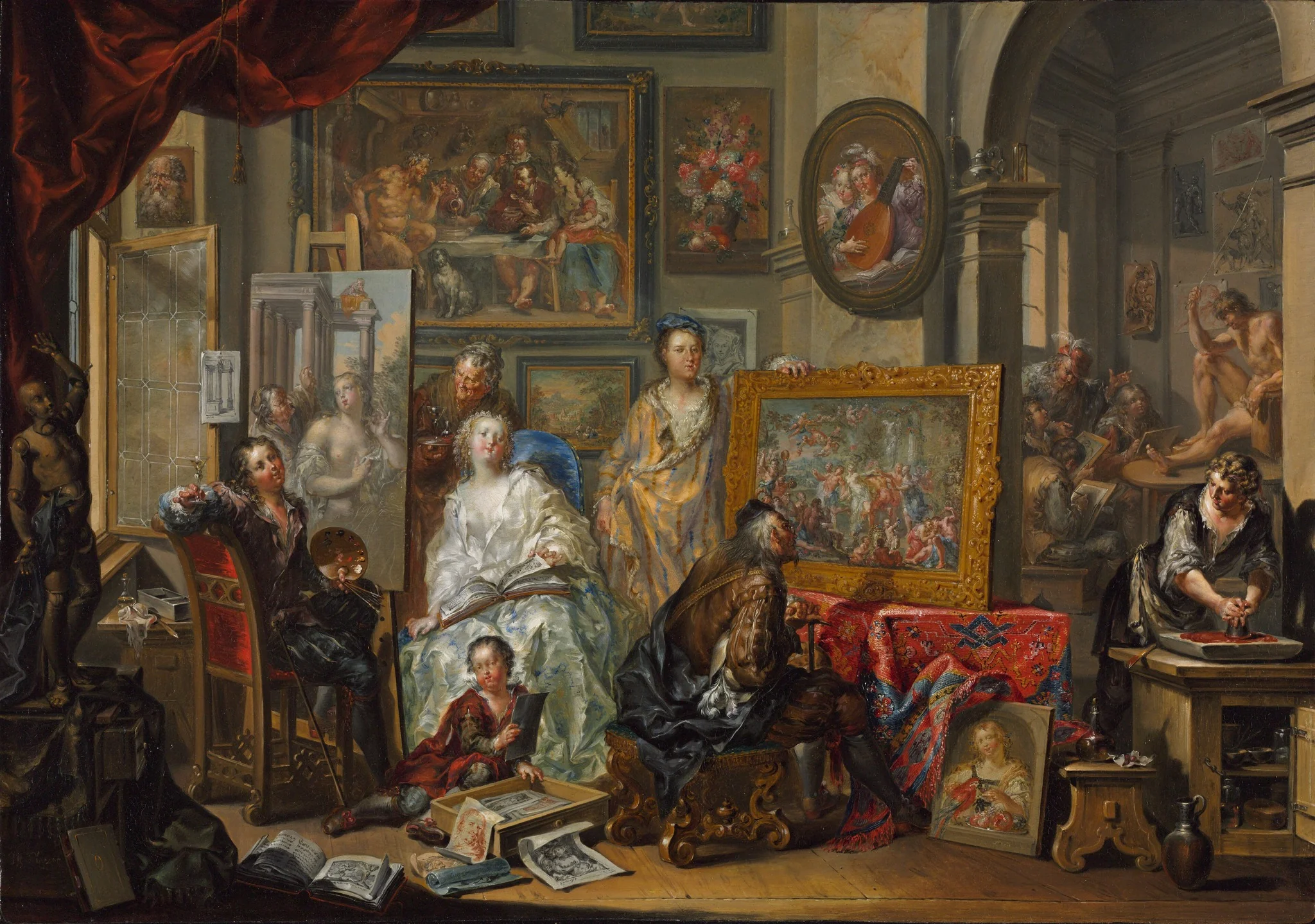
Start with the picture Platzer made about his own trade. The Artist's Studio, oil on copper, now in the Cleveland Museum of Art, is an idealized self-portrait. The Cleveland catalogue reads it as the artist himself, dressed in a fur-lined robe, holding up a painting for the inspection of a visiting connoisseur (Cleveland Museum of Art record). Look at how the scene is staged. The robe is the costume of a gentleman scholar, not a working tradesman in a smock. The visitor leans in. The transaction the picture shows is not a sale across a counter. It is connoisseurship, two educated men weighing the merit of an image, and that is precisely the act Platzer wanted his buyers to perform on the copper they were holding.
Then look at the clutter, because the clutter is the argument. A studio in this period was a stockroom of props and citations: plaster casts, stacked canvases turned face to wall, instruments, drapery, the painter's own finished and half-finished works leaning everywhere. Platzer crams the space until the eye cannot rest. Every object is rendered at the same merciless level of finish, the cast head no softer than the velvet, the velvet no softer than the brass. This is the picture telling you what the rest of his work is about. He is a painter of accumulation, of the cabinet as a place where beautiful things pile up faster than anyone can use them. The studio is a small theatre of possession, and the man in the fur robe is its master, presiding over more than he could ever need.
There is a quiet joke folded into the conceit. The connoisseur examines a painting inside a painting that the real connoisseur, the buyer, is at that moment examining. Platzer hands the owner a flattering mirror. You, the picture says, are the discerning eye in the fur robe. Hold me to the candle and prove it. That invitation, repeated across his output, is the social contract of the cabinet picture, and it is why his scenes of pleasure are never simply indulgent. They were sold to people who prided themselves on seeing through them.
The grammar of the senses
Eighteenth-century viewers came to a banquet scene already fluent in a visual language that ran back through Dutch and Flemish painting of the previous century. The Five Senses were a standard pictorial set: sight, hearing, smell, taste, touch, each assigned its props. A lute or a song stood for hearing. Fruit and wine stood for taste. A flower or a perfume held to the nose stood for smell. An embrace, a hand on skin, stood for touch. When painters gathered these into a single feast, the educated eye did not see a party. It saw an allegory of the senses, and behind the allegory the old warning that the senses lead the soul astray.
Platzer's company pieces are built from exactly this grammar, and once you have it the pictures snap into focus. Consider Making Advances After the Meal. The title names the structure outright. The meal is the sense of taste, already had, already over. What follows the meal is touch, the advance, the hand that crosses from a man's lap to a woman's arm. The picture is a clock. It shows you appetite moving from one sense to the next, the table cleared, the moment after satisfaction when the body looks around for the next thing to want. That is the vanitas engine running under the gilding. Pleasure here is not a state but a sequence that never arrives anywhere.
Cards carry their own freight. Card Player (Ace is Trump) puts chance at the centre of the table. Gaming was a moralist's favourite emblem of Fortune, the wheel that lifts and drops without regard to merit, and the played card frozen at the instant of winning or losing is a small image of a life staked on luck. The trump in the title is the turn that decides everything. To the owner who gambled at court, and most of them did, the picture was both a flattering scene of his own leisure and a faint memento that the same hand which fills a purse empties it. Platzer lets the two readings sit on top of each other without forcing a choice. The pleasure is real. So is the cost.
The outdoor variant works the same way at a larger remove. Merry Company on a Patio moves the gathering into a garden, where architecture and foliage frame the figures and the light comes from the sky rather than a candle. The open-air setting carried its own associations of the pastoral idyll, the dream of leisure outside time. Yet the same props recur, the wine, the instruments, the angled glances, and the same logic governs them. The garden is the stage on which the senses perform, and the performance is the subject.
Works discussed in this article
Gods behaving as guests
When Platzer reached for myth, he reached for the part of myth that licensed the same subjects he painted in modern dress. His bacchanals are the feast pictures with the costumes removed. Nymphs and Satyrs Drinking gives the appetite its frankest form. The satyr is desire with a tail, the body that wants and does not pretend otherwise. Set him beside a nymph and hand them both a cup and you have the human banquet stripped of its manners, the same drive running underneath the silk and the candlelight of the contemporary scenes. To paint a bacchanal was to say the polite thing by way of the impolite one. The myth gave a respectable frame to nudity and excess that a modern interior could not.
Bacchic Revels carries the procession of Bacchus, the god of wine, into full riot. The classical learning mattered to the buyer. A man who could name the figures, point to Silenus slumped on his donkey, identify the thyrsus and the panther skin, was performing his education in front of his guests. The picture flatters that learning while delivering the spectacle. Here, too, the vanitas note sounds underneath. The triumph of wine is also the triumph of forgetting, the god whose gift is pleasure that erases the self. Platzer paints the high point of the revel, the instant before the collapse, which is the bacchanal's version of the cleared table and the turned card.
What unites the mythological and the modern pictures is a single conviction about where meaning lives. It lives in the moment of fullest appetite, because that is the moment most charged with its own ending. Platzer is not a cynic about pleasure. He is a clock-maker of it. He finds the second hand poised at the top of the dial and freezes it there in enamel, so the owner can watch a feast that will never tip over into the morning after.
What the first viewers brought to the picture
An object only means what a viewer is equipped to make it mean, and Platzer's viewers were equipped to a degree that is easy to underestimate now. They were collectors, courtiers, and merchants in a Catholic capital where the sermon and the emblem book had taught everyone to read pleasure as morally double. They owned cabinets of curiosities where a polished shell sat next to a coin and a carved cherry stone, and where the pleasure of looking was itself understood as a kind of test. Could you admire the workmanship without being captured by the thing? The cabinet picture was the painted equivalent of that test, and Platzer's coppers were among the hardest and most rewarding examples of it.
This is where the material and the meaning fuse. The extreme finish of the copper, the way it forces the eye into every jewelled corner, is not decoration laid over a subject. It is the subject. A picture that makes you want to keep looking is a picture about the difficulty of looking away, and that difficulty is the whole vanitas problem in miniature. The very seduction of the surface is the moral the surface carries. Platzer's buyers paid a great deal of money to be tempted, expertly, by a craftsman who agreed with the preachers about temptation and disagreed with them only about whether it should be enjoyed on the way.
There is a class dimension worth naming. These were not images for the church wall, where the message had to reach everyone. They were private images for a small, literate elite, and their pleasures were partly the pleasures of exclusion. Knowing the Five Senses code, recognizing Silenus, catching the joke of the painting-within-the-painting, all of this drew a line around the people who got it. Platzer's iconography flattered that line. To own and to understand one of his coppers was to belong to the company who could afford both the object and the education needed to read it. The pictures meant, among other things, membership.
Set Platzer against his French models and the difference sharpens. Watteau's fêtes galantes leave the figures wrapped in a tender, slightly melancholy haze, the feeling deliberately blurred. Platzer refuses the haze. His finish is too sharp, his light too hard, his every gesture too legible. He wants the iconography to stay readable, the card and the cup and the reaching hand to keep their old emblematic clarity. That sharpness is conservative in the best sense. It keeps the moral machinery of the seventeenth century running inside the pleasure machinery of the eighteenth. The result is a body of work that looks forward in its delight and backward in its conscience, which is exactly the doubleness his first owners were trained to enjoy.
Why the reading still holds
It would be possible to leave Platzer where the survey usually leaves him, as a dazzling technician of the late Austrian Rococo, a hand without much to say. The objection to that verdict is the consistency of the work itself. Across the fifteen pictures in our holdings, and across the far larger output behind them, the same emblems recur with the discipline of a man who knows what they mean: the feast that has just ended, the game whose outcome hangs, the god who drinks himself out of his own dignity. A painter without an idea does not return to the same idea for twenty-five years. Platzer did, and the return is the evidence of intent.
So the next time one of these coppers comes up to the light, do what its first owner did. Find your own face in the reflection at the picture's edge, hovering over the banquet you are not invited to. That reflection is the point Platzer engineered into the metal. The feast is fixed and you are not. The card will never turn, the meal will never be cleared, the revel will never reach its morning, and you, holding the small bright object, are the only thing in the room that is actually running out of time.
Sources & further reading
- Johann Georg Platzer — Wikipedia
- The Artist's Studio (oil on copper, accession 2012.41) — Cleveland Museum of Art / Internet Archive
- Johann Georg Platzer (ULAN ID 500016832) — Getty Research Institute
- Amusement at the Court, ca. 1738 — The Metropolitan Museum of Art
- Rococo (art term) — Tate
- Rococo — National Gallery of Art