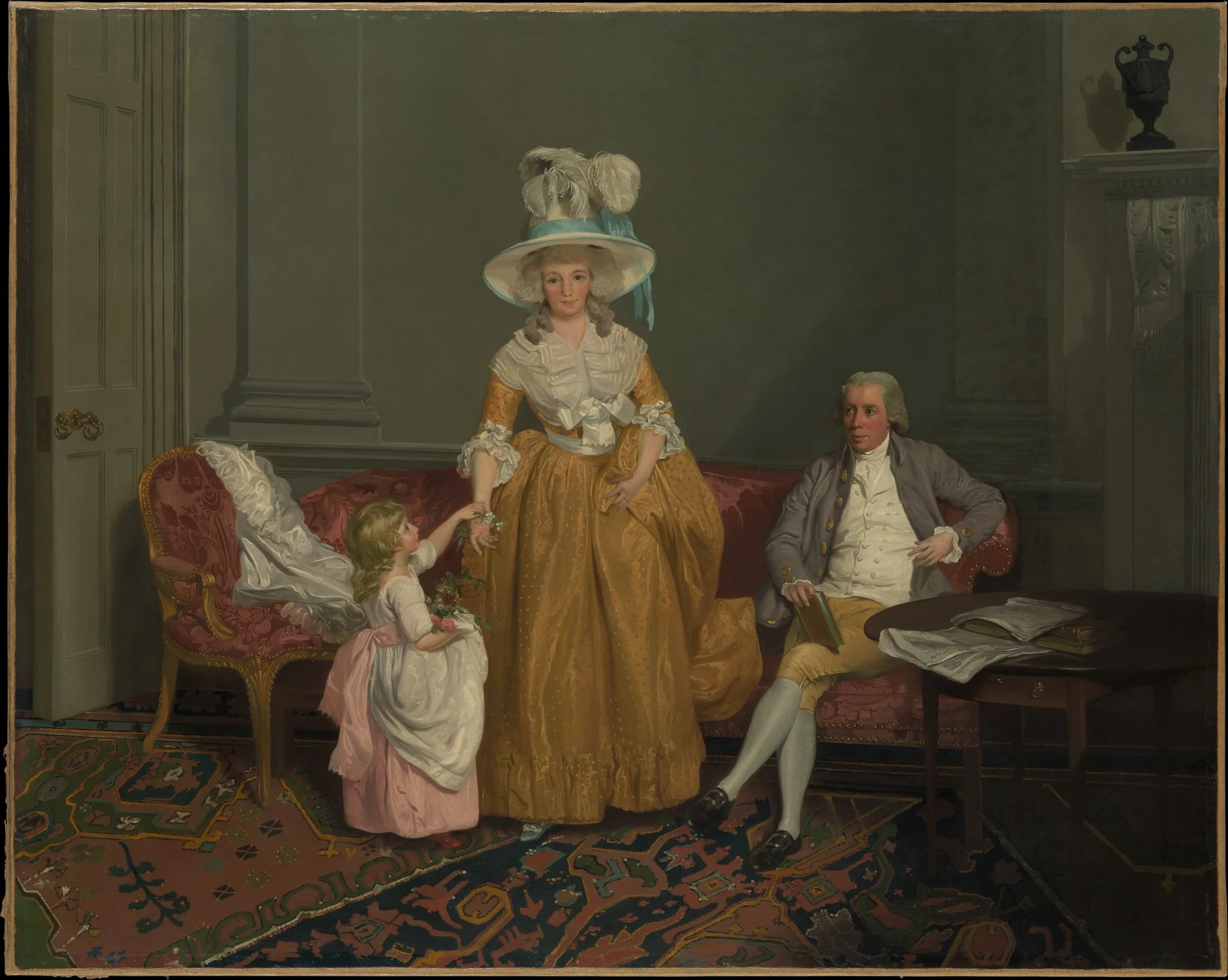
Francis Wheatley's portraits made their reputation by moving the family group out of the paneled drawing room and standing it in open weather. That sounds like a small adjustment of setting. It was a formal decision with consequences for everything else in the picture: how the figures are spaced, where the light enters, how thickly the brush is loaded across silk and leaf. The claim of this essay is that Wheatley's real break was compositional and atmospheric before it had anything to do with subject matter. He loosened the boxed geometry of the early conversation piece, let landscape light wrap the sitters, and in doing so nudged English portraiture toward the airy, sentimental manner that the print trade would soon carry into parlors across Britain.
Hold that against the usual account. Surveys file Wheatley under the sentimental: the cottage door, the milkmaid, the man who fed Francesco Bartolozzi the designs to engrave. The label is not wrong. It arrives too late. Before the cottage scenes there was a problem of design to solve, which was how to keep a dozen small full-length figures legible in one continuous field of light without the starch of the older posed group. Watch him work that problem and the later pictures stop reading as a loss of nerve and start reading as the end of a method. He learned to compose in light. The stipple plates only cashed in what the oil paintings had already settled.
The room comes apart
The conversation piece was already an English habit when Wheatley took it up. Tate defines it as an informal group portrait, small in scale, that grew popular early in the eighteenth century and ran down a line through Mercier, Hogarth, and Zoffany. The format had a built-in look. Figures gather for tea or cards inside a room; the walls supply the geometry; the light is even and lateral, the kind a window throws. Everyone is scaled down so the whole party fits at half life-size, and the picture trades grandeur for anecdote. It is a sociable, slightly stagey thing, a theater box seen from the stalls.
Wheatley inherited that box and could not leave it alone. Born in London in 1747, he trained in the city's drawing schools and worked for a time alongside the decorative painter John Hamilton Mortimer before establishing himself as a portraitist, and he was elected an Associate of the Royal Academy in 1790 and a full Academician the year after, the institutional seal on a career that the standard record dates from 1747 to 1801. Long before those honors, in the 1770s, he had begun to do something the interior conversation piece resisted. He took the group outside. Once the back wall is gone, the even window light goes with it. The painter has to decide where the sun sits, how the sky reads against a head, how a stand of trees can do the framing a chimneypiece used to do. That single move, from room to landscape, is the hinge of his whole formal development.
It changed the spacing first. Indoors, figures cluster around furniture; the table organizes them. Outdoors, Wheatley spreads them along a shallow arc near the front of the canvas, a frieze of small full-lengths read against open ground and sky. The grouping has to carry the design on its own silhouette, because there is no architecture to lean on. This is where his compositional intelligence shows. He stages the party as a single legible shape, then breaks the shape internally with turned heads, a leaning child, a dog, a glance passed from one sitter to the next, so the eye travels the row without snagging.
Close looking: The Saithwaite Family
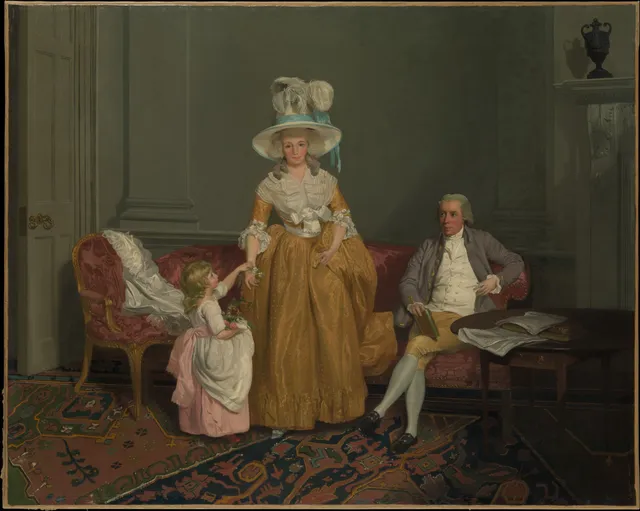
Stand in front of The Saithwaite Family, an oil on canvas of about 1785 now in the Metropolitan Museum of Art, and the method declares itself. The family is set out of doors, the members ranged across the lower third of the canvas in a long, low band that runs almost the full width. Behind them the ground falls away to a pale, cool sky, and a mass of foliage closes one side like a curtain pulled halfway across a stage. The figures are small in the field, full-length, scaled the way the conversation piece demands. What is not conversation-piece at all is the air around them. They sit inside weather.
Look at how the light is distributed. It rakes in from the side and slightly above, catching the pale silks and the lit edges of the faces, then thins as it crosses the group so the far figures sink a half-tone into shadow. That gradient is doing structural work. It pulls the row of sitters into depth without any of the receding floorboards an interior would use to fake it. The brightest accents fall on the women's dress and on a child's cheek, the darkest reserves go into the tree mass and the gentleman's coat, and the whole arrangement reads as one breath of light moving left to right. Wheatley is not lighting each sitter in turn the way a studio portraitist would. He is lighting the scene.
Then look at the handling, because it is not uniform, and the variation is deliberate. The foliage is laid in with a loaded, fluid touch, dabs and drags that stay frankly paint, never resolving into botany. The sky is thin and brushed almost flat. But the faces and the fall of the fabric tighten up. There the paint is controlled, the contours crisp, the modeling smooth enough that you could trace it onto a copper plate without losing a line. That split, loose in the setting and precise in the figures, is the signature of Wheatley's mature picture-making. The landscape breathes; the portraits hold still. He wants the family sharp and nameable while the world behind them softens into atmosphere. The ground near the front edge tips up a little toward us, the way an artist accommodates a row of figures he needs us to count, and that gentle tilt is the one concession the old format still extracts from him.
Light out of doors, paint under control
The same logic governs the other outdoor groups in our holdings. In Portrait of a Married Couple in a Park, two figures are given the whole sweep of a landscape and the picture's drama comes from the contrast between their finished, lit forms and the loosely brushed parkland that dissolves behind them. The grand Portrait of The Marquess and Marchioness of Antrim raises the stakes to aristocratic scale, yet the same compositional reflex holds: pose the sitters as a coherent silhouette, then let air and foliage carry the rest. Wheatley keeps the figures legible and lets the surround go atmospheric, every time.
Set a single child against that practice and you see how supple the method is. Portrait of a Boy, called John Cumming has none of the spacing puzzle a family group sets. One figure, one light source. Here Wheatley can let the precise side of his hand do almost everything, modeling the face and costume with the smooth, plate-ready clarity he reserves for what must be recognized, while a few quick passes establish the setting. The contrast with The Wilkinson Family, where five or six presences must be balanced across the field, tells you the painter thought in two registers at once: the close, engravable finish of the principal heads and the open, weather-making looseness of everything around them.
Compare the demands two of these pictures make and the discipline shows. Portrait of a Married Couple in a Park needs only to balance a pair, so Wheatley lets the parkland open wide and the eye rests on two clear forms. The Marquess and Marchioness of Antrim asks for rank and ceremony, and he answers by tightening the figures into one commanding shape while the foliage behind stays frankly brushed. Neither picture changes the underlying rule. The number of sitters changes, the social register changes, the size of the canvas changes; the practice of lighting the field once and finishing only what must be recognized stays fixed. He had found a grammar of outdoor portraiture flexible enough to absorb whatever a commission threw at it, and that flexibility is exactly what the survey accounts miss when they reduce him to charm.
This is the formal break stated plainly. Wheatley did not invent the outdoor portrait; Gainsborough and Reynolds were already setting sitters in landscape on a far more heroic scale. What Wheatley did was specific and his own. He brought the intimate, half-life-size conversation piece outdoors and rebuilt its lighting from scratch, so that a modest family picture could carry real open-air light instead of borrowed window glare. The genre stayed small and sociable. The illumination went atmospheric. That combination, domestic scale with landscape light, is the thing later painters of the sentimental portrait would mine for decades. You can already see the recipe fixed in a canvas like The Wilkinson Family, where the outdoor light does the structural work an interior never could.
Works discussed in this article
From the brush to the plate
There is a reason the tight, controlled side of Wheatley's handling matters so much, and it has to do with where his images went after they left the easel. By the late 1780s he was supplying compositions to the engravers, and the stipple method then in fashion rewarded exactly the qualities his figures already had: clean contour, smooth tonal transition, a face that could be rebuilt out of dots and flicks without losing its likeness. The Rijksmuseum keeps a stipple engraving of Winter, cut by Bartolozzi after Wheatley in 1789, a single sheet that shows how cleanly his design translated to copper.
The famous case is the Cries of London, the series of London street vendors he painted from about 1792 and which the engravers turned into one of the best-selling print sets of the age. The Met holds twentieth-century replicas of those prints, color-printed in the stipple manner, still circulating two centuries on. It is tempting to read the Cries as Wheatley going soft, trading the rigor of the family groups for charm. The brushwork argues otherwise. The same divided hand is at work, the milkmaid and the strawberry seller finished and lit like the principal heads of a conversation piece, the street behind them brushed loose. He had built a manner that survived reproduction, and the reproduction made him a household name long after the original canvases dispersed.
Ireland and the public picture
One episode tests the thesis from the outside, and it survives the test. In the late 1770s Wheatley left London for Dublin, partly to escape debts and a tangled private life, and there he attempted something far larger than an intimate group: a crowded public history piece, The Dublin Volunteers on College Green, painted in 1779 to 1780 and now in the National Gallery of Ireland. It records the Volunteers' parade of 4 November 1779, hundreds of figures massed before the Bank of Ireland's portico under an open Irish sky.
The picture is an outdoor crowd, and Wheatley handles it with the instincts he had built on the small groups. The architecture is firm and finished where it must read; the mass of troops and onlookers dissolves into a loose, light-struck haze as it recedes. He is again lighting the whole scene rather than parading each head, again pairing a controlled foreground with a brushed, atmospheric distance. Scale it up from a family of six to a regiment and the method does not break. That is the mark of a real formal principle, not a mannerism. It worked at any size he asked of it.
What the archive shows
The shape of Wheatley's surviving output, read across collections, supports the reading. Artifact World Gallery holds nineteen of his works gathered from eight separate institutions, dated from roughly 1770 to 1797, which sets our cluster squarely on the productive middle of his life. The early cataloguer W. Roberts, whose 1910 monograph remains the standard list, records Wheatley as a constant exhibitor at the Society of Artists and the Royal Academy from 1765 to 1801, a span of thirty-six years. Our nineteen works fall almost entirely inside the stretch when the outdoor-group method matured and then fed the print trade, which is to say they document the break itself rather than the apprenticeship before it or the long tail of reproduction after.
Wheatley's range across those years was wider than the cottage-door reputation allows, and one outlier in our holdings proves it. Lady Easy's Steinkirk lifts a scene straight from Colley Cibber's comedy The Fearless Husband and stages it as a painted theatrical moment, evidence that the same hand that lit family groups could also light a literary tableau. He moved between portrait, anecdote, stage subject, and public history without changing his fundamental approach to design. Compose for a legible silhouette. Light the whole field once. Finish what must be known and let the rest stay paint.
Wheatley died in London on 28 June 1801, his last years dogged by gout and money trouble, his reputation already passing into the engravings rather than the canvases. That is the irony worth ending on. The very precision that let his figures survive translation to copper is also what got him filed as a maker of pretty prints, a step below the painters he trained beside. Put the oils back in front of the reproductions and the order reverses. The Saithwaite Family is not a charming relic of a vanished sociability. It is a working demonstration of how to carry a room full of people out into the light and keep every one of them in focus. Set Wheatley's portraits beside the prints that made him famous and the canvases win, and the next generation of British portraitists spent thirty years catching up to them.
- Composition: the family staged as one band against open sky, depth carried by spacing and overlap rather than receding architecture.
- Light: a single raking pass across the whole group, brightest on silk and faces, sinking the far figures a half-tone into shadow.
- Handling: loose, fluid paint in foliage and sky against crisp, plate-ready finish in the heads and dress.
Sources & further reading
- Francis Wheatley (painter) — Wikipedia
- The Dublin Volunteers on College Green — Wikipedia
- The Saithwaite Family — The Metropolitan Museum of Art
- Cries of London (modern replicas) — The Metropolitan Museum of Art
- Conversation piece (art term) — Tate
- Winter, stipple engraving by Bartolozzi after Wheatley, 1789 — Rijksmuseum
- F. Wheatley, R.A., his life and works (W. Roberts, 1910) — Internet Archive
- Francis Wheatley, collection person record — The J. Paul Getty Museum