The Chinese Orthodox School of Qing landscape painting is usually filed as the conservative wing of the early Qing, the camp that looked backward while the so-called Individualists pushed forward. That framing misses what the movement actually did. Its central practice was painting after the old masters: not tracing line for line, but rebuilding a Song or Yuan composition out of memory, theory, and a trained wrist. A picture made that way has already traveled before it is finished. It has moved from one century into another, from one hand into a later hand, picking up small changes at every transfer. The Orthodox School was, at bottom, a method for moving images through time, and this essay follows what happened to those images while they were in motion.
Here is the claim the rest of this piece defends. The Orthodox style was never stable, and its founders never intended it to be. It changed when it carried south to north into the Kangxi court and became an instrument of a new dynasty's legitimacy. It changed when it was folded into albums a collector could roll up and send across a province. It changed again when twentieth-century museums swept three centuries of loosely related work under a single label and shelved it by nationality and dynasty. Each of those moves kept the name and altered the meaning. Track the school geographically and institutionally, and you watch a supposedly backward-looking manner turn into something none of the Four Wangs would have recognized as their own.
A style that moved by being copied
The movement had a theory before it had a name. Writing in the late Ming, the painter and critic Dong Qichang (1555-1636) sorted the long history of landscape into competing lineages and argued that the serious artist advances by absorbing the old masters rather than by transcribing the visible world. His student Wang Shimin (1592-1680) carried that program into the early Qing and turned it into something close to a workshop discipline. Around Wang Shimin formed the painters later grouped as the Four Wangs, the quartet of Wang Shimin, Wang Jian, Wang Hui, and Wang Yuanqi who became the public face of orthodox taste, all of them working from Dong Qichang's premises (Wikipedia, The Four Wangs). The Metropolitan Museum's survey of the period traces the same line: Dong's disciple Wang Shimin led an early Qing circle that converted the literati habit of studying the masters into a systematic reconstruction of landscape painting (Met, The Qing Dynasty: The Traditionalists).
The shared method has a deceptively plain description. You painted after a master. The word hid a great deal of work. To paint after Huang Gongwang or after Dong Yuan, a Qing artist had to hold a remembered or half-remembered model in mind, isolate its structural logic (how the foreground hill answers the far ridge, how a stand of trees is built), and then put that logic down in his own brush. The result was rarely a forgery. It was a translation. And like any translation, it carried the original somewhere new while claiming fidelity to it. The most ambitious of the group, Wang Hui (1632-1717), made the translation program explicit. Summoned to Beijing to direct the scrolls commemorating the Kangxi emperor's southern inspection tour, he chased what he called a great synthesis, fusing the descriptive landscape of the Song with the calligraphic brushwork of the Yuan (Met, Wang Hui). Smarthistory puts the working habit bluntly: Wang Hui preferred to copy the Song masters and rework their framework into new compositions rather than paint directly from nature (Smarthistory, Art of the Qing Dynasty).
You can read the after-method straight off our own holdings. The archive keeps a cluster of works recorded as After Li Gonglin, the great Song figure-and-horse painter whose name survives here not as the author of a single sheet but as a destination that later brushes kept arriving at. The same logic produces a work like the one cataloged as Untitled, after Hao Cheng, attributed to a follower working in an earlier master's manner (the artist record sits under After Hao Cheng). A label that names two painters at once, the model and the maker, is the Orthodox School's signature in miniature. It tells you the picture is a place a tradition passed through.
South to north: the manner enters the palace
The first long-distance journey was political, and it ran from the cultured river towns of the south to the Manchu capital in the north. The Orthodox manner began as a private, scholar-amateur pursuit in the Jiangnan region, the kind of painting gentlemen made for one another and inscribed with poems. Then the new dynasty came looking for it. Beginning in the 1670s the Kangxi emperor recruited scholars out of southern China, and those men brought north a settled preference for the literati painting the Orthodox masters practiced. What had been a connoisseur's idiom became, on arrival at court, a language of state.
The brush vocabulary did not change much. The work it was asked to do changed completely. A manner that prized withdrawal, the dry restrained touch of a man painting for friends, was now enlisted to picture an emperor's command of his territory in monumental scrolls. The southern tour commissions Wang Hui oversaw needed exactly the descriptive reach he had assembled from the Song, mapped onto territory the dynasty wanted seen as orderly and possessed. This is transit in the strict sense: the same images, moved across a distance, made to mean a different thing at the far end. The Orthodox painters did not abandon their principles in Beijing. Their principles were simply put to a use no Ming literatus would have chosen.
Looking closely: Ni Yuanlu's crane
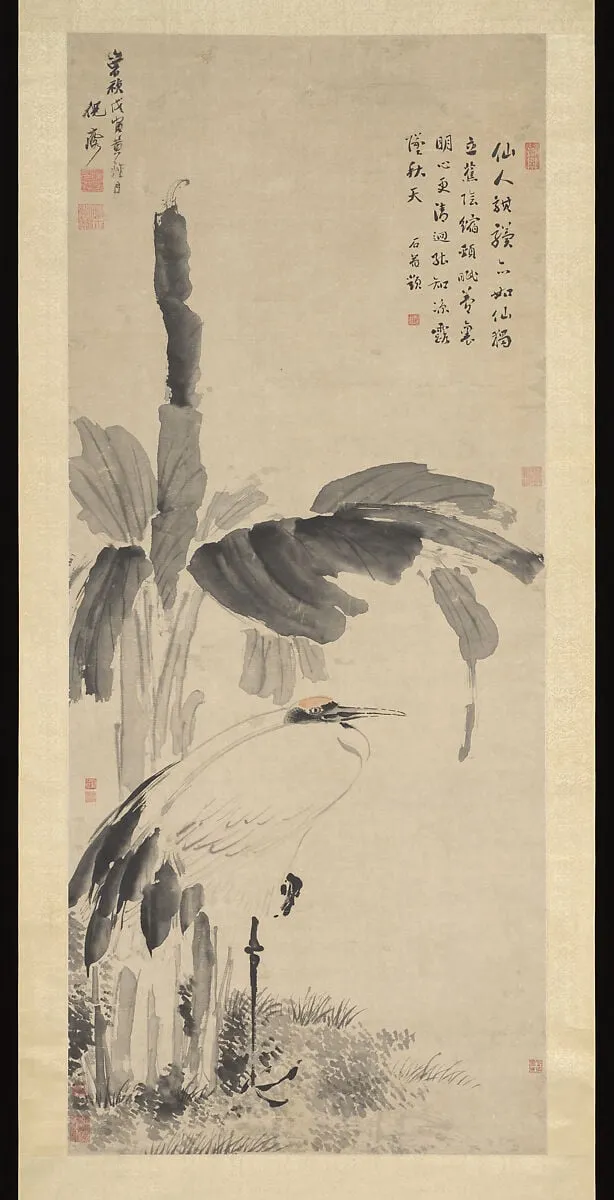
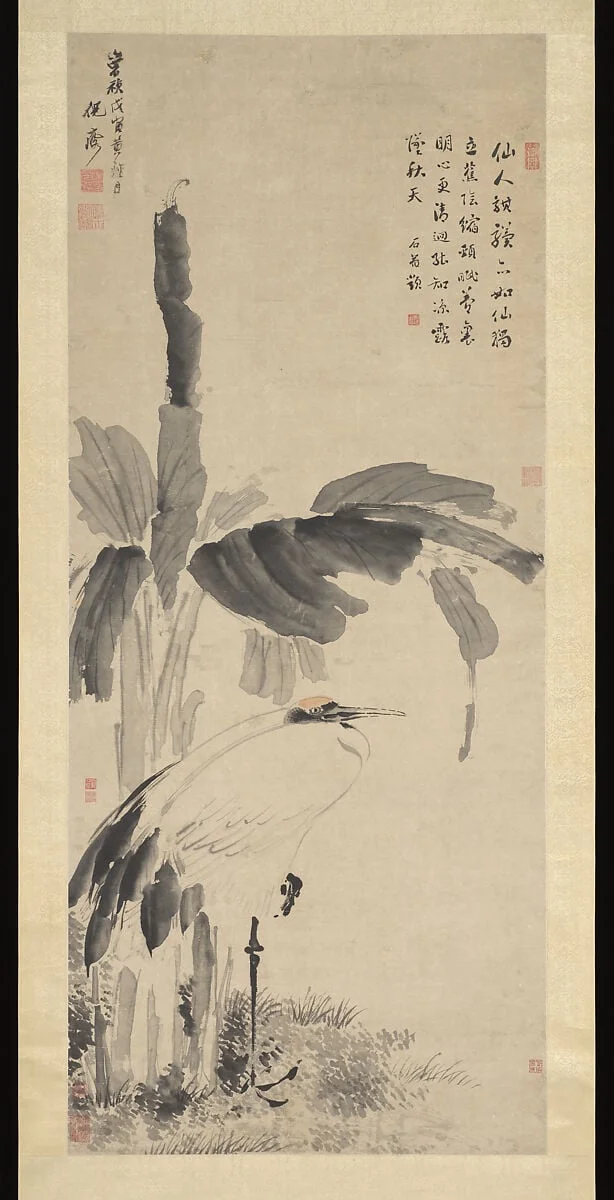
Stand in front of Crane Beneath a Banana Tree by Ni Yuanlu and the after-method shows its other side, the eccentric edge the Orthodox program kept trying to discipline. The banana leaves are laid in with broad, soaked strokes, the ink pooling dark at the spine of each blade and bleeding pale toward the torn tips, so the foliage reads as half-ruined, weather-beaten. Against that wet mass the crane is built almost entirely from dry, deliberate line. Its body is a few economical contours, the long neck a single confident curve, the legs thin as reed. The bird does not pose. It stands a little off-center, weight settled, attention turned away from the viewer, and the empty paper around it does the rest of the work, pushing the crane forward and letting the banana hang above it like a collapsing roof. Notice too how little the painter spends. The whole sheet is two gestures, the drenched leaf and the drawn bird, and the rest is held back, so the eye keeps returning to the small hard knot of the crane's body.
The contrast is the point. Ni Yuanlu, a late-Ming scholar-official who would not survive the dynasty's fall, paints wet against dry, soft mass against hard line, ruin against composure, and refuses to resolve the tension. This is the inheritance the Orthodox theorists were sorting and taming: a literati brush that could go strange, that valued the trace of a particular temperament over any smooth ideal. Set this scroll beside Wang Hui's measured synthesis and you see the two poles the corpus keeps under one roof. The crane is what the after-method looked like before it was systematized, and it is a reminder that the lineage absorbed difficult, individual hands long before museums smoothed them into a single school name.
The album as a portable argument
If the southern tour scrolls show the style traveling by imperial summons, the painting album shows it traveling by ordinary means. An album is a physically mobile object. It folds flat, fits in a sleeve or a case, passes between collectors, gets carried home from a visit. The format made the after-method portable in the most literal way, and it turned each book into a small traveling argument about the history of painting. A handscroll unrolls in one direction and dictates the order of looking. An album does the opposite. The hand chooses the next leaf, lingers, doubles back, and the sequence the painter intended becomes a sequence the owner remakes every time the book is opened.
Look at two leaves by Zha Shibiao from his Landscape Album in Various Styles. In Boating in Spring Water the touch is loose and damp, a few figures adrift on a wash of river, the far bank dissolving into pale ink. Turn to The Stream of Wuling and the hand tightens, the brush turns drier and more architectural, the rocks built in firmer planes. The phrase in various styles is the whole conceit. One painter performs a sequence of earlier manners across a single bound set, leaf by leaf, so that the book itself becomes a guided tour through the masters Dong Qichang had ranked. The collector who owned it owned a compact map of the tradition, and could carry the entire argument of the Orthodox School in one hand.
That portability is exactly how the style propagated and mutated. Each artist who worked in various styles added his own accent to the inherited manner, and each owner who studied the album absorbed a slightly shifted version of the lineage. The album is the school's transit system in miniature, and the small divergence from leaf to leaf is the change that the transit produced.
What the archive remembers, and how it sorts
Here is a number worth sitting with. Artifact World Gallery holds 317 works tagged to the Chinese Orthodox School, spread across 9 venues and credited to 137 artists, with dates running from roughly 1018 to 1944. Read that span again. No single workshop, no actual school of teachers and students, lasted more than nine centuries. The 1018-to-1944 range is not a fact about a movement. It is a fact about a category, and the category is doing something the founders never asked it to do. Count the artists again. One hundred and thirty-seven hands, scattered across those nine centuries, were gathered under a name that four men in seventeenth-century Jiangnan would have reserved for a far smaller circle.
The label has become a net, and the net is wide. Under it sit works that belong to very different projects. There is an untitled sheet by Jin Nong, whose author, Jin Nong, is usually counted among the eccentrics of Yangzhou, the opposite of orthodox restraint. There is an untitled work by Liu Yen (Liu Yen's record), and the run of copies after Song masters discussed above. The number tells the truth that the tidy textbook account hides: what we call the Orthodox School is partly a retrospective sorting, a decision made by cataloguers about which works to gather near the Four Wangs. The movement traveled even in this sense. It traveled into the filing system, and changed shape to fit the drawer.
Works discussed in this article
Across the ocean, into the catalogue
The longest journey came last, and it was westward. Beginning in the late nineteenth century and accelerating through the twentieth, Orthodox-School paintings left China for European and American collections, and there they met a different system of knowledge. Western institutions sorted them by nation and dynasty before sorting them by master or manner. The National Gallery of Art, for instance, catalogs its relevant holdings under the broad maker record Chinese, Qing dynasty, the period anchor for the very years the Orthodox School flourished (NGA, Chinese, Qing dynasty). The Getty's authority file, meanwhile, pins individual reputations to fixed dates, recording the school's leading figure Wang Hui under a single identifier as a Chinese painter, 1632 to 1717 (Getty ULAN, Wang Hui).
Something is gained and something is lost in that crossing. The Western catalogue gives the work durable dates, stable identifiers, a place in a global index. It also tends to flatten the lineage distinctions that were the entire point for Dong Qichang. To him the difference between painting after the northern manner and after the southern manner carried moral and historical weight. To a maker record organized by dynasty, that difference can disappear into a single century-long bracket. A date is a convenience and a loss at once. It lets a researcher in Washington or Berlin find the work in seconds, and it buries the question Dong Qichang cared about most, which earlier hand the painting is reaching back toward. The scholarly counterweight arrived early. Osvald Sirén devoted the fifth volume of his survey of Chinese painting to the later Ming and the leading Qing masters, and that volume is now freely readable in full, which means the fine-grained lineage account and the coarse-grained catalogue label travel side by side today (Sirén, Chinese Painting, vol. 5, on the Internet Archive).
The change is the legacy
Put the four journeys end to end. A late-Ming theory of studying the masters becomes an early-Qing workshop practice. That practice moves north and becomes a court language of empire. It folds into albums and moves hand to hand across the south. It crosses an ocean and is re-sorted by dynasty in a foreign catalogue. At no point did the brush stop being recognizably Orthodox, and at no point did the meaning hold still. A style whose stated ambition was fidelity to the past turns out to be one of the most mobile and mutable bodies of work in Chinese art, precisely because copying is a form of motion. Copying, in this tradition, was never the rival of invention. It was the vehicle that carried invention forward, leaf by leaf and hand by hand.
That is the argument worth carrying out of the gallery. The next time a wall label or a database calls a painting orthodox, treat the word as a record of travel rather than a verdict of stasis. Look for the earlier master named inside the title, the album format that let the sheet move, the dynasty bracket a Western archive dropped it into. Each of those is a stamp in the passport. The crane standing under its torn banana leaf has been on the road for four hundred years, and it has not arrived anywhere yet.
Sources & further reading
- The Qing Dynasty (1644-1911): The Traditionalists — The Metropolitan Museum of Art, Heilbrunn Timeline of Art History
- Wang Hui (1632-1717) — The Metropolitan Museum of Art, Heilbrunn Timeline of Art History
- Art of the Qing Dynasty — Smarthistory
- The Four Wangs — Wikipedia
- Chinese, Qing dynasty: artworks — National Gallery of Art
- Wang Hui (ULAN ID 500327902) — Getty Research Institute, Union List of Artist Names
- Landscapes after old masters (accession 41481) — The Metropolitan Museum of Art
- Chinese Painting: Leading Masters and Principles, Vol. 5 (Later Ming and Leading Ch'ing Masters) — Osvald Sirén, Lund Humphries, 1956 (Internet Archive)