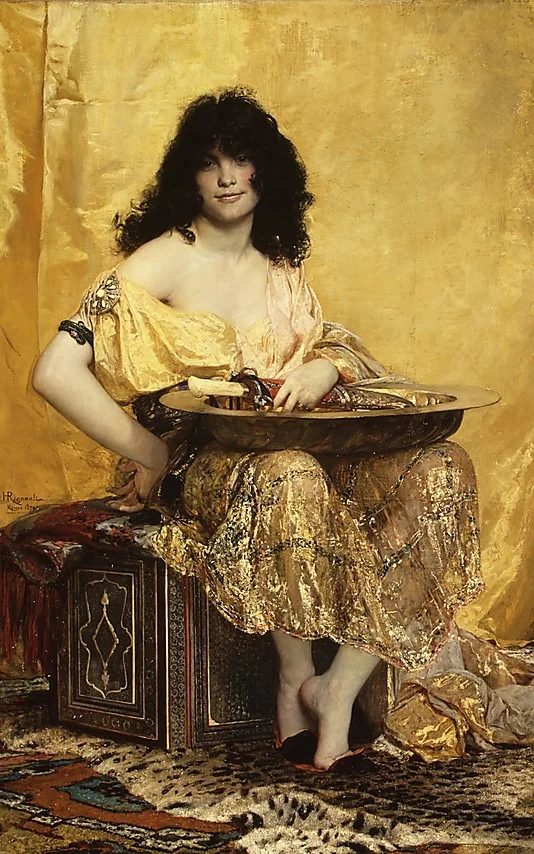
The painter Henri Regnault left a problem behind him rather than a finished body of work. He was shot in January 1871 during a failed sortie outside Paris, in his twenty-eighth year, with the Salome of the previous spring still fresh on Parisian walls and a decade's worth of restless experiment behind it. The canvases he had managed to complete do not agree with one another about who he was. A young French academic on the proper Prix de Rome track points one way. A swaggering Spanish general on a rearing horse points another. A seated woman in gold satin, smiling over a platter and a knife, points somewhere stranger still. Each one is convincing. None of them is the same painter.
So this essay is built around a single question, the one his contemporaries asked the moment they heard he was dead: what was Regnault going to become? The work answers in several voices, and the answers contradict. That is my argument. Regnault matters less as a fixed achievement than as an unresolved one, a career frozen in the middle of changing its mind. The fifteen pictures that survive in our collection are not a settled style caught at different moments. They are rival proposals, each making a serious bid for the artist he might have been, all of them cut off before any could win. To read him honestly you have to hold the contradictions open instead of smoothing them into a tidy line of development.
A career stopped at twenty-seven
The biographical facts are quickly told and they are unusually grim. Regnault was born in Paris in 1843 and killed on 19 January 1871 at the Battle of Buzenval, during the Prussian siege of the city, having enlisted rather than sit out the war abroad. He was twenty-seven. Four years earlier he had taken the Prix de Rome, the most coveted prize in the French academic system, with a mythological set-piece on Thetis bringing Achilles his new armor. The prize sent him to Italy on the state's money, then loosed him toward Spain and Morocco, where his painting changed faster than any examiner had bargained for.
That sequence sets up the central tension. The Prix de Rome was a machine for producing a specific kind of painter: the history painter, the inheritor of Poussin and David, the man who would furnish the Republic with its grand mythologies and martyrdoms. Regnault won the machine's top prize and then spent his last years pulling against it. He kept the technical confidence the training gave him and aimed it at subjects the Academy considered minor or merely decorative. The death at Buzenval froze that argument mid-sentence. We will never know whether the academic or the renegade would have won, and the not-knowing is exactly what makes the surviving pictures worth slowing down over.
One small correction the record keeps demanding: this is the painter, not the chemist. The National Gallery of Art keeps a dedicated record for Henri Regnault the painter, distinct from the near-contemporary physicist Henri-Victor Regnault, with whom he is still occasionally confused in older catalogues. The conflation is harmless until you try to assemble a coherent picture of the artist, at which point it adds noise to a story already full of it.
First answer: the history painter the system wanted
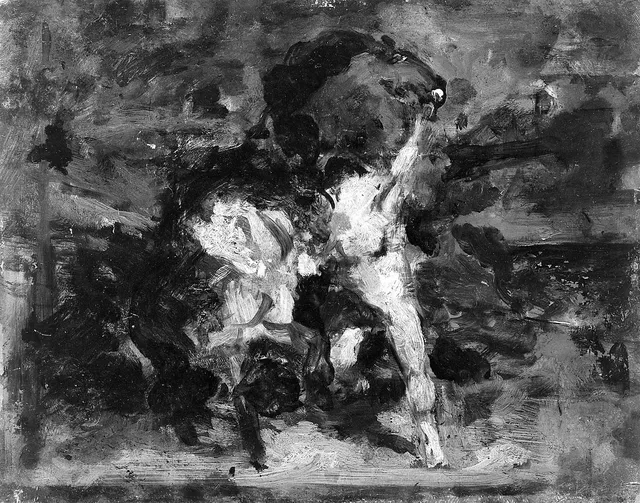
Start with the answer the institution expected. Regnault won the Prix de Rome in 1866 with a Homeric subject, and the appetite for that register survives in our holdings as the Sketch for Automedon with the Horses of Achilles. Automedon was Achilles' charioteer, and the subject is a pretext for the thing Regnault actually wanted to paint: two huge immortal horses fighting their handler, muscle and mane against a man's braced weight. A sketch is the right place to catch a painter's instincts before finish smooths them over. Here the instinct is for violent torque and for animal mass treated as the real protagonist, with the human figure almost an afterthought clinging to the reins.
This is the orthodox Regnault, the one the École could be proud of. The lineage runs straight back through Géricault's struggling horses to the antique. Had he lived and stayed on this road, he would have become a competent supplier of large mythologies, a slightly more energetic version of the men who already filled the Salon's history-painting rooms. His teacher's generation produced exactly that. Look at the polished mythologies of Alexandre Cabanel, whose Venus and academic nudes defined Second Empire taste, and you can see the safe, salonnier future that the Prix de Rome was quietly preparing for its laureate. Regnault had the hand for it. What he visibly lacked was the patience.
Second answer: the portraitist with a journalist's nerve
The second proposal is the strongest, and the one most critics underrate because it is the least exotic. Regnault was a portraitist of real force, and the proof is the General Juan Prim. Prim was the Spanish general and politician at the center of the 1868 revolution, and Regnault, in Madrid at the time, painted him as a man caught in the act of seizing power. The general is mounted, the horse pivots toward us, and behind him a smear of troops and smoke does the work of a whole battle without naming one. It is closer to political reportage than to court flattery. The sitter does not pose so much as ride into the frame and stop.
Set beside that public bravado the two quieter heads we hold, and the range of the portraitist comes clear. The Portrait of a Young Woman is built from a few decisions taken fast and kept: a turn of the neck, the warmth banked into the shadow side of the face, paint left frankly visible where a duller painter would have blended it away. The Self-Portrait with a Maulstick shows him with the tool of the trade in hand, the slender rod a painter rests against to steady the working wrist. It is a quiet professional's declaration. He wanted to be seen as a maker, not a prodigy. The two faces together argue that portraiture, the genre the Academy ranked below history, was where Regnault's eye was sharpest and his ego most under control.
This is the career that, on the evidence, would actually have paid. A portraitist with that much attack and a famous name could have owned a corner of the Salon for thirty years. The general on his horse is the bridge between the two ambitions: it is a portrait with the scale and noise of a history painting, and it suggests Regnault had already started fusing the genres the Academy kept separate.
Works discussed in this article
Third answer: the Orientalist, and the picture that ate the others
The third proposal is the one that made him famous and the one that has shadowed his reputation since. After Spain came Morocco, and after Morocco came the taste for North African and biblical subjects rendered with deliberate sensuous excess. Our Chief of Abyssinia belongs to this turn: a single costumed figure studied for the textures of cloth, skin and metal, the kind of head that lets a painter show off without committing to a narrative. These works sit squarely inside the nineteenth-century French fashion for the East as spectacle, and historians treat Regnault's late manner as a textbook case. Smarthistory uses his 1870 Salome as a key example in the development of Orientalism, precisely because it shows how easily a religious subject could be repurposed into an exercise in surface pleasure.
And the Salome is where all three answers collide, so it deserves a long look. Regnault gives us a single seated woman and almost nothing else. She sits low, weight on one hip, a cascade of golden-yellow satin pooling over her knees and spilling toward the foreground in long, loaded strokes that he has not bothered to discipline into smoothness. Against that blaze of yellow the dark ground reads as pure absence, no architecture, no court, no severed head, only a brass charger and a knife resting in her lap. Her upper body is bare to the loose blouse, one arm propping her, the other hand laid near the metal. The face is the trap. It is the most finished passage in the picture, lips just parted into something between a smile and a dare, eyes turned out toward us as if we had walked in on her and she had decided not to mind.
Notice the engineering of it. The platter and the knife are the only clues that this is Salome at all, and Regnault keeps them low, dull, half-shadowed, so that the eye runs straight past the biblical horror to the warmth of the fabric and the living face above it. The violence of the story is demoted to a prop. What he actually paints is appetite: the gold, the flesh, the slow turn of the head. He has taken a tale of beheading and made it an essay in yellow. That is the Orientalist instinct at full pressure, beauty severed from meaning and offered as its own reward, and it is the reason the picture both dazzles and discomforts a modern viewer.
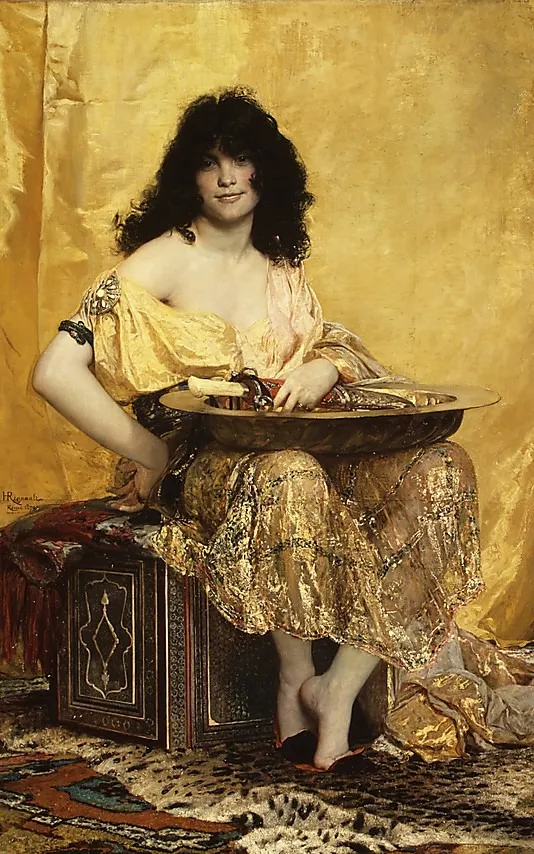
The picture's career was as dramatic as its maker's. Salome was the sensation of the Salon of 1870, shown only months before Regnault was killed, and when it eventually left France for America in 1912 the departure provoked public protest at home before it settled into the Metropolitan Museum of Art, where it hangs now. A painting that became a national possession by accident of its author's death, then a national loss when it was sold abroad. Few canvases carry that much extra-pictorial weight, and it has not always served Regnault well: the Salome is so seductive that it tends to swallow the portraitist and the history painter whole, leaving him filed under a single label that the rest of his work does not support.
What the archive actually holds
This is where our own holdings let us check the legend against a count. Artifact World Gallery holds fifteen works attributed to Regnault, spread across six separate collections, and almost every one of them was made inside a single decade, roughly between 1860 and 1870. Two numbers in that sentence matter. First, the compression: fifteen pictures, one short decade, and inside it the academic, the portraitist and the Orientalist all jostling at once. This was not a slow evolution from one manner to the next. The contradictions are simultaneous. Second, the spread across six venues tells you how thoroughly the legend has been distributed. A painter dead at twenty-seven, with a small surviving output, scattered through that many institutions, has been kept alive by curators who each wanted a piece of the myth more than they wanted a coherent account of the work.
The dispersal continues today. The J. Paul Getty Museum holds an object titled Salomé attributed to Regnault, a reminder that the most famous subject generated its own afterlife of related sheets and versions. Pull the holdings together and the pattern is plain: the celebrated Salome is the outlier the public remembers, while the portraits and studies, less reproduced, carry the better evidence of what his hand could do day to day.
Why the contradictions were never resolved
It is tempting to claim that the three answers would eventually have fused, that the portraitist's eye and the Orientalist's appetite and the history painter's scale were all heading toward one mature synthesis. The General Prim hints at it. But the honest position is that we do not know, and that the fusion was nowhere near settled when he died. The Salome and the Automedon sketch want opposite things from paint. One wants to dissolve narrative into sensuous surface; the other wants muscular structure and story. A working life resolves such tensions slowly, picture by picture, compromise by compromise. Regnault was denied the time to make those compromises, which is why his work still reads as a set of open questions rather than a position.
The way Paris mourned him is part of the evidence too. The cult formed almost instantly. Théophile Gautier rushed out a commemorative notice that doubled as an early catalogue of the work, fixing the heroic narrative before the paint was dry. Camille Saint-Saëns dedicated his Marche héroïque to the painter's memory, and Henri Chapu raised a monument to him in the courtyard of the École des Beaux-Arts in 1872. A composer and a sculptor and a critic all moved at once to canonize a man whose actual direction was still undecided. The monument settled the legend. It could not settle the painting.
So the question the essay opened with does not get a single answer, and I think that is the correct verdict rather than a failure to reach one. Regnault is one of the rare artists whose interest lies in the fork, not the road taken. Stand the Self-Portrait with a Maulstick next to the Salome and you are looking at a man holding the tool of a sober professional and, on the next wall, a man drunk on yellow satin. Both are twenty-seven. Both are honest. Neither got the chance to argue the other down. The pleasure of his work, and its melancholy, is that it keeps every option open at once, the way a career does only at the very beginning, before the world has forced it to choose.
Sources & further reading
- Henri Regnault — Wikipedia
- Salome (1870) — The Metropolitan Museum of Art
- Orientalism — Smarthistory
- Henri Regnault : notice (commemorative essay and catalogue) — Internet Archive (Théophile Gautier)
- Salomé (attributed to Henri Regnault) — The J. Paul Getty Museum
- Henri Regnault (1843-1871) — National Gallery of Art