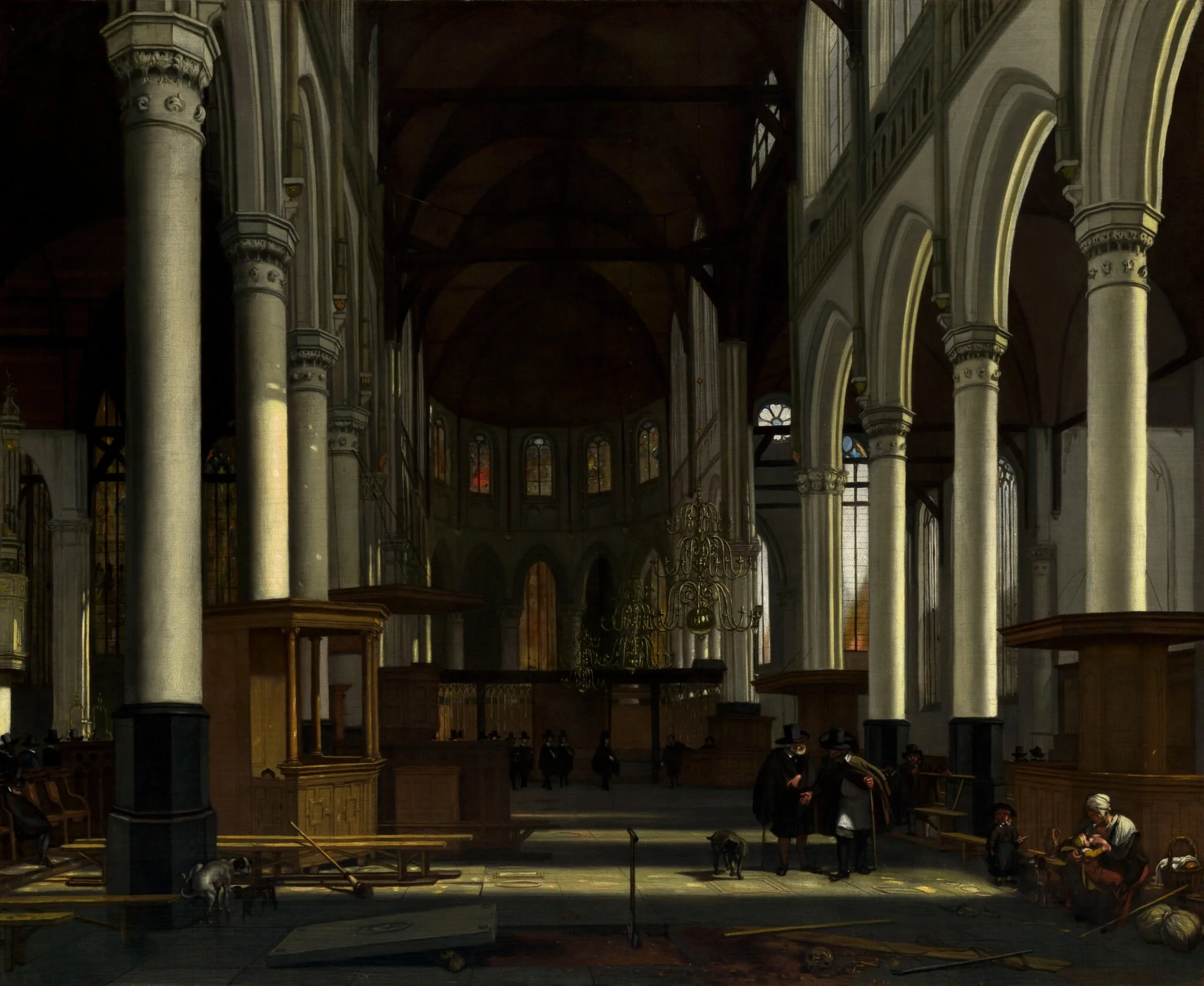
The church interiors of the Dutch painter Emanuel de Witte look, on a first pass, like sober reports: tall stone, whitewashed walls, a few worshippers scattered under a Gothic vault. They are not reports. They are an argument. By the time de Witte settled into the genre in the 1650s, the painted Dutch church already had a presiding master and a settled grammar, and de Witte spent four decades quarreling with both. The quarrel is the subject of this essay. His predecessors had decided that a church was a structure to be surveyed and set down with the patience of a draughtsman. De Witte decided it was a volume of moving air and slanting light, a place where a dog wandered and a sermon droned, and that the truest picture of it was the one that bent the measurements to catch the mood.
Here is the thesis, plainly. De Witte did not invent the Dutch church interior; he revised what it was for. The generation before him, anchored by Pieter Saenredam, treated the building as a sitter and painted its portrait, calibrated and chaste. De Witte treated the same buildings as theatres of light and human occasion, and in doing so he reopened a question the genre had thought closed: whether a painter owes the church its true dimensions or its true feeling. He kept choosing feeling. That choice, repeated across more than twenty versions of a single Amsterdam nave, is the through-line of his career and the reason his work still reads as alive while many of his contemporaries' read as inventory.
A pupil of still life, a painter of stone
De Witte came to architecture sideways. Born in Alkmaar around 1617, he trained in Delft under Evert van Aelst, a still-life specialist, and his earliest documented ambitions ran to figures and history rather than buildings. The Getty Union List of Artist Names still files him as a painter of interiors, architecture, portraits, marines, and landscapes, which is a useful corrective to the idea that he was a one-genre man. The church interior was a discipline he chose, not a cage he was born into. That matters, because a painter who arrives at architecture from still life brings different instincts than one trained as a perspectivist. Van Aelst's studio taught him how light falls across a surface and pools in a shadow, how a single shaft can organize a whole composition. He carried that lesson into the nave.
Around 1651 he moved to Amsterdam, and the city's two great medieval churches, the Oude Kerk and the Nieuwe Kerk, became his standing subjects for the rest of his life. The biography ends grimly. In 1692, in debt and out of favour, he tried to hang himself from an Amsterdam canal bridge; the rope broke and he drowned, and his body was not found for weeks. The bare facts of that death have a way of coloring the paintings backward, tempting us to read melancholy into every cold floor and empty pew. Resist it. The pictures are not depressive. They are precise about loneliness in the way a man who understands light is precise about shadow, which is a different thing from being sad.
What the predecessor wanted
To see what de Witte was arguing against, you have to know what Saenredam had built. Saenredam, a generation older, approached a church the way a surveyor approaches a coastline. He drew the building on site in careful measured studies, sometimes dated to the day, then worked the construction up into paint in the studio over months. His naves are flooded with even, sourceless light; his walls are pale to the point of austerity; his perspective is exact. The pictures feel true the way a good architectural elevation feels true. They are portraits of buildings, and like a portraitist he flattered his sitters by leaving them dignified, undisturbed, and almost unpeopled.
This was not a neutral style. It carried a theology. The Reformation had stripped the Dutch churches of their altars, their images, their gilt, and the whitewashed interior became a Protestant statement in itself: the house of God as clean geometry rather than encrusted spectacle. Saenredam's measured clarity was the perfect visual equivalent of that purge. The Metropolitan Museum, which holds one of de Witte's own Delft naves, names Saenredam and de Witte as the two leading seventeenth-century specialists of the genre, and the pairing is exactly right as a statement of rank. The catalogue note puts them side by side, which is also how their contemporaries would have understood the field. They are the two poles. Saenredam is the law. De Witte is the appeal.
Standing in the Oude Kerk
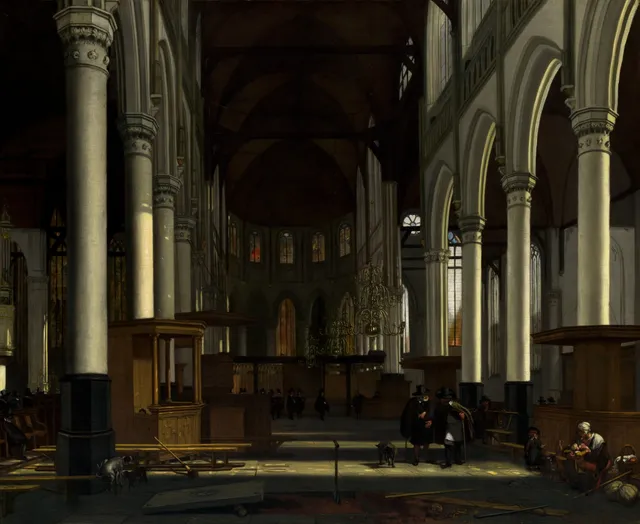
Look hard at The Interior of the Oude Kerk, Amsterdam, painted around 1660. The first thing you notice is that de Witte refuses Saenredam's even daylight. The light here has a source and a direction. It comes in from the high windows on one side and lands in bright patches on the clustered Gothic piers, leaving the far reaches of the nave in a soft brown gloom. One pier catches the sun full on its rounded face and seems to step forward out of the picture; the next, half a metre deeper, sinks into shade. De Witte is using light the way his still-life training taught him: to model, to weigh, to pull some things near and push others away.
Then the floor. It is paved with worn ledger stones, the flat grave-slabs that carpeted Dutch churches, and de Witte tilts and rakes them so the eye slides down the nave toward the small figures gathered for a service. The people are tiny against the architecture and almost incidental, yet they do the crucial work: a seated woman, a standing man, a child, and, low in the foreground, a dog, that recurring de Witte signature, sniffing along a tombstone with complete indifference to the sermon. The dog is the whole argument in miniature. Saenredam would never have let it in. It breaks the building's solemnity and replaces it with something humbler and more observed, the church as a room people actually use, where the sacred and the ordinary share a floor. Above, a brass chandelier hangs into the cool grey air, and the vault dissolves upward into shadow that de Witte declines to map precisely. He wants the height felt, not counted.
The effect is atmospheric where Saenredam is architectural. You do not leave the picture knowing the building's exact proportions. You leave it knowing what it felt like to stand inside on a particular bright morning, with the cold coming up through the stone floor and a dog padding past. That is a deliberate trade. De Witte gives up the surveyor's accuracy and buys, with the difference, the sensation of presence.
The fiction inside the measurements
The sharpest evidence that de Witte was not in the accuracy business comes from how he treated the Oude Kerk over time. The National Gallery of Art, which owns the c. 1660 version reproduced above, records in its scholarly catalogue that de Witte painted more than twenty views of that one church's interior, and that they range from faithful to frankly fanciful. Its entry makes the point that you cannot reconstruct the building from his pictures, because he moved walls, recombined chapels, and reassembled the space to suit the composition in front of him. A Saenredam is a document you could almost build from. A de Witte is a performance on a theme.
This is where one of our own numbers earns its place in the argument. Across this gallery's holdings, Artifact World Gallery carries forty paintings by de Witte, spread across twenty venues and spanning roughly 1650 to 1692, the full working life. Set that against the National Gallery's count of twenty-plus Oude Kerk variations and a pattern sharpens: a substantial share of an artist's entire surviving output orbiting a handful of buildings, returned to again and again, each time rearranged. That is not the behaviour of a man recording the world. It is the behaviour of a man using a fixed motif the way a musician uses a tune, to test what variation can do. The corpus spread, many works across many collections, is itself the footprint of a serial improviser rather than a documentarian.
The variations are easy to follow once you start comparing. In Interior of a Protestant, Gothic Church during a Service, the congregation clusters around a preacher and the architecture organizes itself to frame the act of listening. In Interior of a Protestant, Gothic Church, with a Gravedigger in the Choir, the same kind of space turns toward mortality, a grave opened in the choir while ordinary life carries on a few steps away. Strip the human incident back almost to nothing, as in Interior of a Church, and the architecture and the falling light have to carry the whole picture by themselves. The buildings are cousins; the meanings are not. De Witte changes the staffage, shifts the light, and the room says something new. Saenredam's churches, by contrast, say the same calm thing every time, because saying it accurately was the point.
Works discussed in this article
The Delft inheritance, and a wider room
It would flatten the story to make de Witte purely a rebel against Saenredam. He learned his trade in Delft, and Delft in the 1650s was a hothouse of light and perspective. Gerard Houckgeest and Hendrick van Vliet were already loosening the church interior there, taking it off the central axis, slicing it on a diagonal, letting columns crowd the foreground and partly block the view. De Witte absorbed all of it. His Interior of the Oude Kerk, Delft belongs to that local experiment, the oblique vantage and the dramatized recession that the Delft painters pioneered. What de Witte added, when he carried the manner to Amsterdam, was warmth and weather, a softer and more populated light than the cooler Delft pictures. He took the Delft innovation in viewpoint and married it to a still-life painter's feeling for how light sits on a surface.
And he refused to stay inside the Protestant nave. Two late canvases show how far his curiosity ran. In 1683 de Witte painted the tomb of the admiral Michiel de Ruyter in the Nieuwe Kerk, with sightseers gathered before the naval hero's marble monument. The monument stands exactly where the high altar had stood when the building was still Catholic, and de Witte made that coincidence the quiet point of the picture: the new civic religion of national heroes occupying the literal footprint of the old faith, the history of the Reformation compressed into a single spot on the floor. He did not have to spell it out. He put the monument where the altar had been and let the room carry the meaning.
Three years earlier, in 1680, he had gone further afield and painted the interior of the Portuguese Synagogue in Amsterdam during a service, a subject almost no other Dutch painter touched. It is the same artistic project carried into a wholly different faith: the building as a vessel of light and gathered people. The synagogue picture proves that the church interiors were never really about churches. They were about how a large quiet interior holds light and holds a congregation, a problem de Witte found everywhere he looked.
The argument, revisited
Step back and the shape of the quarrel is clear. The genre de Witte entered had been defined by a question of fidelity: how truly can a painter set down a building? Saenredam answered it brilliantly and, in a sense, finally. There was little room left to be more accurate than he had been. De Witte's contribution was to change the question. He asked instead how fully a painter could make you feel inside a space, and he was willing to falsify the architecture to get there. The more than twenty Oude Kerk variations, the moved walls, the recombined chapels, the dog on the grave-slab, are all answers to the new question, not failures at the old one.
Call it, if you like, the perennial argument of any maturing art form, the one between accuracy and atmosphere, between the document and the impression. It is worth revisiting because the same fault line runs through everything that came after, from the topographers against the Romantics to the realists against the Impressionists. De Witte is an early, lucid instance of a painter deciding that truth to feeling outranks truth to fact, and building a whole career on the wager. The wager paid the work, if not the man.
What survives is a body of work that still puts you in the room. Stand again in front of any of his Protestant naves and you are not consulting a record of a building that no longer looks that way. You are feeling cold light fall through high glass onto stone that other feet wore smooth, and a dog you half expect to hear. De Witte's churches keep their grip precisely because he was willing to lie about the floor plan to tell the truth about the air. The next painter who chooses mood over measurement is, knowingly or not, picking up the side of the argument de Witte took first and held longest.
Sources & further reading
- Emanuel de Witte, Interior of the Oude Kerk, Amsterdam (catalogue entry) — National Gallery of Art
- Emanuel de Witte (biography) — Wikipedia
- Emanuel de Witte, Interior of the Oude Kerk, Delft — The Metropolitan Museum of Art
- Emanuel de Witte in the Union List of Artist Names — Getty Research Institute
- Dutch Paintings of the Seventeenth Century (scholarly catalogue) — Internet Archive / National Gallery of Art