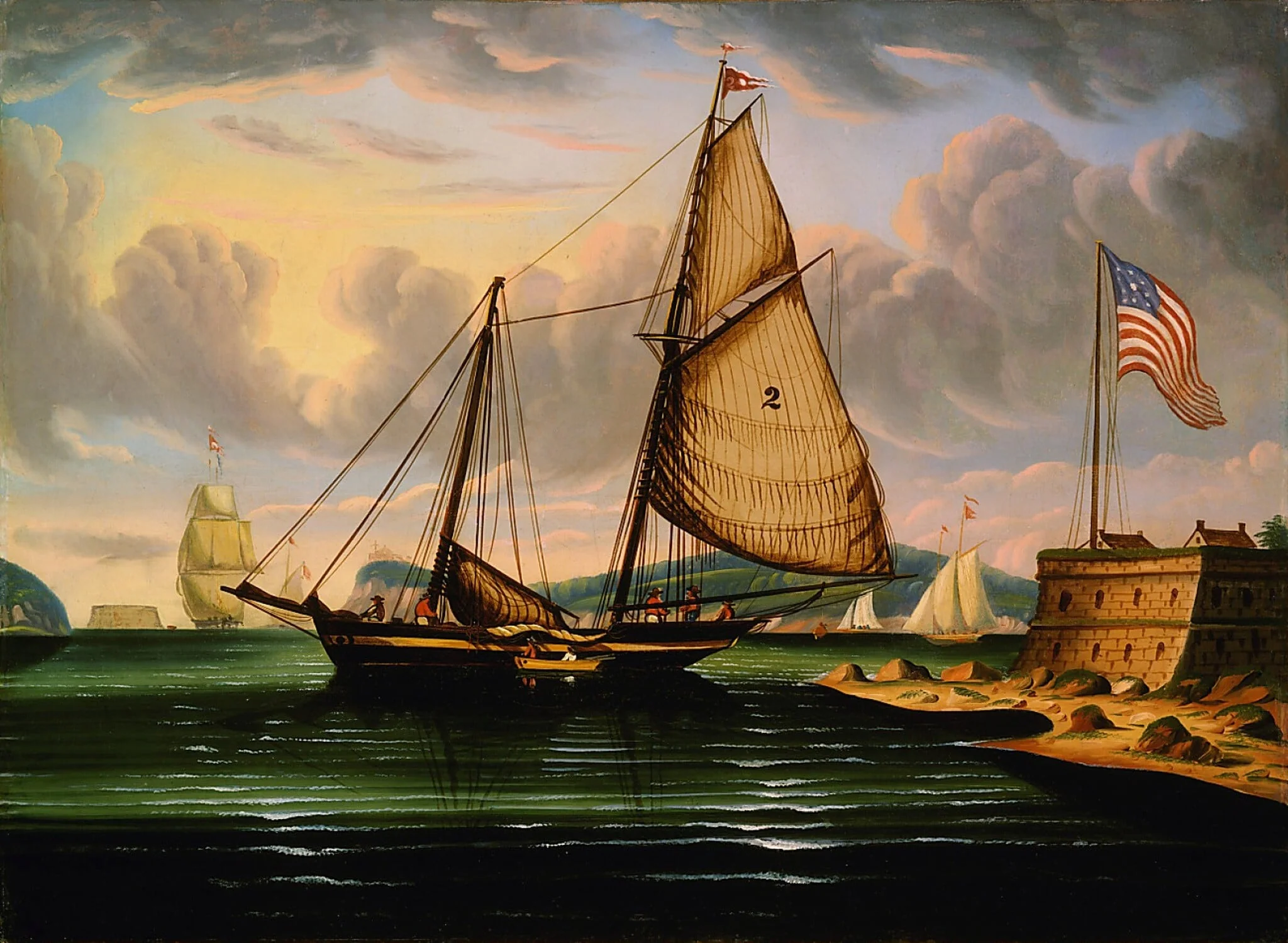
Every genre has a founding subject, but marine painting as a genre has a founding argument. From the moment specialized painters first set out to render the sea, they were not only depicting water and rigging. They were disputing the previous generation's account of what the sea was, and how a flat panel could be made to hold it. The history of the genre reads less like a steady accumulation of skill than a sequence of rebuttals. Each new school corrects the last for looking at the ocean the wrong way, and the correction is rarely polite. A calm answers a storm; a slab of troweled paint answers a counted-out hull; a smear of river light answers a portrait of a named ship. The water stays the same. The quarrel about how to see it never settles.
That is the claim this essay defends: marine painting advances by quarrel, and the quarrel is legible on the surface of the pictures themselves. You can stand in front of two seascapes painted a century apart and watch one answer the other, plane against atmosphere, decorum against catastrophe, inventory against light. Our own holdings make the long arc visible. Artifact World Gallery keeps 2,104 marine works by 796 artists, scattered across 107 venues and spanning roughly 1291 to 2015. That is a seven-century stretch in which the same coastline gets repainted by people who could not agree on what they were seeing, and the disagreement, more than any single masterpiece, is the genre. Most of those 107 venues hold only a handful of marine pictures apiece, which tells you something about how the genre actually survived. Its center of gravity was distributed, not monumental, a craft kept warm in port towns and provincial cabinets as much as in royal galleries. Read the chain forward and a pattern holds: every phase defines itself by what it refuses to do that its predecessor did.
The ship portrait, and the thing it could not paint
Marine art arrived late and arrived narrow. Painters had used the sea as a backdrop for saints and battles for centuries, but the distinct genre, with artists who did almost nothing else, formed only toward the end of the Middle Ages, and it formed as the ship portrait: a careful likeness of a named vessel, its rigging counted out line by line, its flags identified, its hull sitting on the water like a prized animal posed for the breeder. The full flowering came with the Dutch in the seventeenth century, when marine painting separated cleanly from landscape and became a trade with its own masters and its own clients, the merchants and admiralties who wanted their ships on record (Wikipedia, Marine art). The genre began, in other words, as documentation, and its first internal argument was about whether documentation was enough.
Willem van de Velde the Elder embodies the documentary impulse at its most disciplined. He drew and painted the Dutch fleet at close range, sometimes sailing out as an official recording artist to witness engagements at sea and bring back the visual minutes (J. Paul Getty Museum). His pen-paintings could fix the precise geometry of a three-decker's spars, the angle of every yard, the number of gunports along a flank. What that precision could not do was hold weather. A counted hull tells you the vessel's name and rate. It does not tell you the temperature of the morning, the weight of the air, the way a low sun turns a flat sea to pewter. The ledger had limits, and a younger painter pressed on exactly those limits.
Jan Porcellis is where the first revision happens. Praised in his own day as the Raphael of marine painting, he pulled the genre away from the bright descriptive realism of the ship portrait and toward a near-monochrome tonal manner, a decisive transition from early realism to the tonal phase (Wikipedia, Jan Porcellis). In a Porcellis the ship shrinks. The sky swells to two-thirds of the panel, the palette drops to silvers and umbers and a single cold daylight, and the subject quietly changes from the vessel to the air around it. A small boat may still ride the swell in the foreground, but it is there to take the measure of the wind, not to be portrayed. This is the argument stated for the first time in paint: the sea is not an object to be catalogued but a condition to be felt. The whole later history of the genre is built on that swap, and on the people who kept trying to swap it back.
Decorum exported, then broken
The Dutch settlement traveled. Willem van de Velde the Younger and his father emigrated together to England in 1672, and from 1674 they worked in the service of King Charles II, carrying the Dutch formula into the heart of a rival naval power (Rijksmuseum). With them the genre acquired its first international grammar: a legible middle distance, an orderly fleet, a calm or a manageable breeze, weather present but governed. Call it decorum. The sea in a van de Velde the Younger is powerful and also fundamentally on its best behavior, a stage on which national glory can be read off the trim of the sails. For nearly a century that grammar was simply what a marine painting was, and to paint the sea at all was to paint it in the Dutch accent. Even painters who had never crossed the Channel learned to compose a harbor the way the van de Veldes had taught England to compose one.
J. M. W. Turner broke the decorum on purpose. His marine work, including the Shipwreck sketchbook of around 1803 to 1810, records a long preoccupation with the marine sublime and with shipwreck imagery, the sea not as a governed stage but as a force that breaks governance (Tate). Where the Dutch counted the rigging, Turner dissolved it into spray and vapor until the named vessel became a victim rather than a subject. His quarrel with his predecessor is almost programmatic. The Dutch made the ocean answerable to human order; the British sublime made human order a small thing tossed inside a weather system that does not notice it. The horizon line is the same in both. The verdict on who commands it is reversed.
The American answer: a third way out
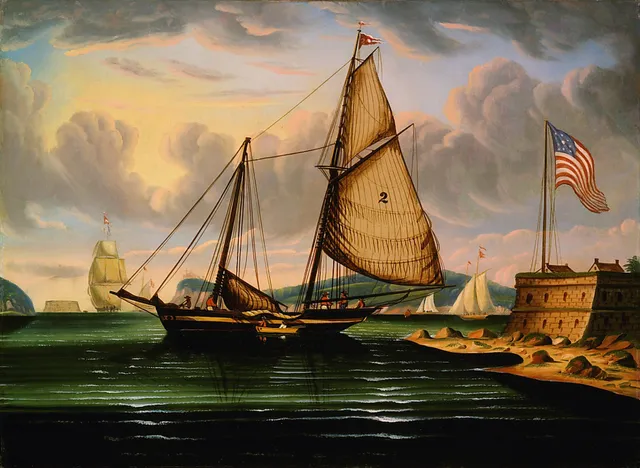
Nineteenth-century American marine painters inherited both quarrels, the Dutch ledger and the British storm, and several of them declined both. The most distinctive of them did not try to out-describe van de Velde or out-thunder Turner. They flattened, stilled, and stylized, and in doing so they reopened the oldest question in the genre: is a seascape a window or a designed surface? Thomas Chambers gives the bluntest answer of all.
Look at New York Harbor with Pilot Boat "George Washington". Chambers gives you a foreground sloop heeled hard over, its sails a stack of clean cream planes with almost no atmospheric softening at the edges, so the canvas reads as cut shapes rather than billowing cloth. The water is neither Porcellis weather nor Turner chaos. It is a pattern: rows of stylized whitecaps marching across a deep blue-green ground, each crest a small comma of white laid on with a loaded brush and spaced like stitching. The far shore sits as a low flat band, the clouds above it banded too, and the whole harbor tilts up toward you so that distance becomes height on the panel rather than recession into it. Light does not pool or fall here; it is simply the brightness of the paint. Chambers is not recording a port. He is composing it into a flat emblem of one, decorative, frontal, almost a sign. The argument he is having is with realism itself, and he settles it in favor of design.
He repeats the move with variations. In Threatening Sky, Bay of New York the drama lives in pattern, the dark cloud mass cut against light water in bold contour rather than dissolved into vapor, so a storm that Turner would have smeared becomes a crisp silhouette you could trace with a finger. In Packet Ship Passing Castle Williams, New York Harbor the famous fortress and the rigging become graphic notation, every line decisive. A van de Velde wanted you to believe you were there. Chambers wants you to admire the panel as a made thing. That is a genuine position, not a failure of skill, and it answers the Dutch grammar by refusing the illusion the Dutch worked so hard to build.
Then the luminists swing the argument the other way, toward silence. Martin Johnson Heade in Rio de Janeiro Bay lays a glassy harbor under a low horizon and lets the air carry the entire picture, the light pooling on water so still it stops being a body and becomes a mirror. The far hills are a soft warm bruise; the boats near the shore double themselves exactly in the surface, so that the reflection is as solid as the thing reflected. There is no storm to survive and no fleet to count. The subject is the held breath of a windless hour. Alfred Thompson Bricher builds the same hush along New England shores in his Marine Landscape, where the swell barely lifts and the light comes in low and level across wet rock, and William Stanley Haseltine hardens it into geology, painting sunlit rock and clear shallow water with a precision that is descriptive again but in service of stillness rather than inventory. Their quarrel is with everyone. Against the Dutch bustle and the British catastrophe, they argue for an ocean in which nothing happens and light is the only event.
Courbet: the wave as matter
If the luminists emptied the sea of incident, Gustave Courbet emptied it of narrative and gave it back its weight. His marine pictures often dispense with the ship entirely. A wave rises, breaks, and slams down across the lower register of the canvas, built not from drawn contours but from paint dragged and slabbed on with a palette knife until the pigment itself has the density of wet sand and churned foam. The horizon sits high and the sky is a narrow bruised strip; the real event is the green-black wall of water and the dirty cream of its collapse. You can see the trowel marks. That is the point. Courbet's argument is the most materialist in the whole genre: the sea is not a story about heroism or about light, it is a physical fact, and the honest way to paint a fact is to make the paint behave like the thing. Where the ship portrait pointed past the surface to a named vessel, Courbet stops at the surface and insists the surface is where the truth lives. He rebuts Turner's drama and the Dutch ledger in a single gesture, by painting matter instead of meaning.
Pissarro and the dissolve
The last turn in this particular chain belongs to Impressionism, and Camille Pissarro makes it on a river rather than an ocean. In Charing Cross Bridge, London the Thames is all atmosphere: the bridge a soft horizontal, the boats reduced to grey smudges trailing smoke, the water a field of broken touches that register light and damp far more than any specific hull. The vessel, which the genre began by portraying with anxious accuracy, has finally vanished into the weather around it. This is Porcellis's old swap carried to its conclusion. Two and a half centuries after a Dutch painter decided the air mattered more than the ship, an Impressionist lets the ship become an incident of the air. The subject is no longer the sea, and no longer the boat, but the light moving across both at a particular hour over a particular bridge. The connection to Impressionism's wider program is direct: these river paintings belong to the same broad assault on the fixed contour that the movement waged on dry land, only here the dissolving subject happens to float.
The argument, revisited
Set the chain end to end and it stops looking like a series of styles and starts looking like a single long debate conducted in oil. The ship portrait says the sea is an object; Porcellis says it is a condition. The van de Veldes say it is a governed stage; Turner says it is an ungovernable force. Chambers says it is a flat design; the luminists say it is a held silence; Courbet says it is sheer matter; Pissarro says it is only light passing over water. No phase agrees with the one before it, and each disagreement is something you can point to on the panel, in the handling of a wave or the size of the sky. The genre never resolved its first question. It only kept asking it in new accents.
That is also why marine painting refuses to feel finished. The latest works in our holdings run up to 2015, more than seven centuries after the first ship portraits, and the same quarrel is still audible in them, because every painter who faces the sea has to decide all over again whether to count it, dramatize it, flatten it, weigh it, or let it dissolve. The next person to set an easel on a wet pier inherits the whole argument and answers it with a single choice about where to put the horizon. The sea will keep doing what it has always done. The genre is the record of our refusal to agree on what that is.
- Inventory vs. air: the ship portrait counts the rigging; Porcellis paints the weather and lets the ship shrink.
- Decorum vs. catastrophe: the van de Veldes govern the sea; Turner lets it break the ship.
- Design vs. silence vs. matter: Chambers flattens, the luminists still, Courbet trowels, and Pissarro finally lets the boat dissolve into light.
Works discussed in this article
Sources & further reading
- Marine art — Wikipedia
- Jan Porcellis — Wikipedia
- Willem van de Velde the Younger: ten things — Rijksmuseum
- Sea Pictures: Turner's Marine Sublime and a Sketchbook of c.1803-10 — Tate
- Willem van de Velde the Elder (Dutch, 1611-1693) — The J. Paul Getty Museum
- Landscape Painting in the Netherlands — The Metropolitan Museum of Art
- Old Sea Paintings: The Story of Maritime Art as Depicted by the Great Masters — Internet Archive