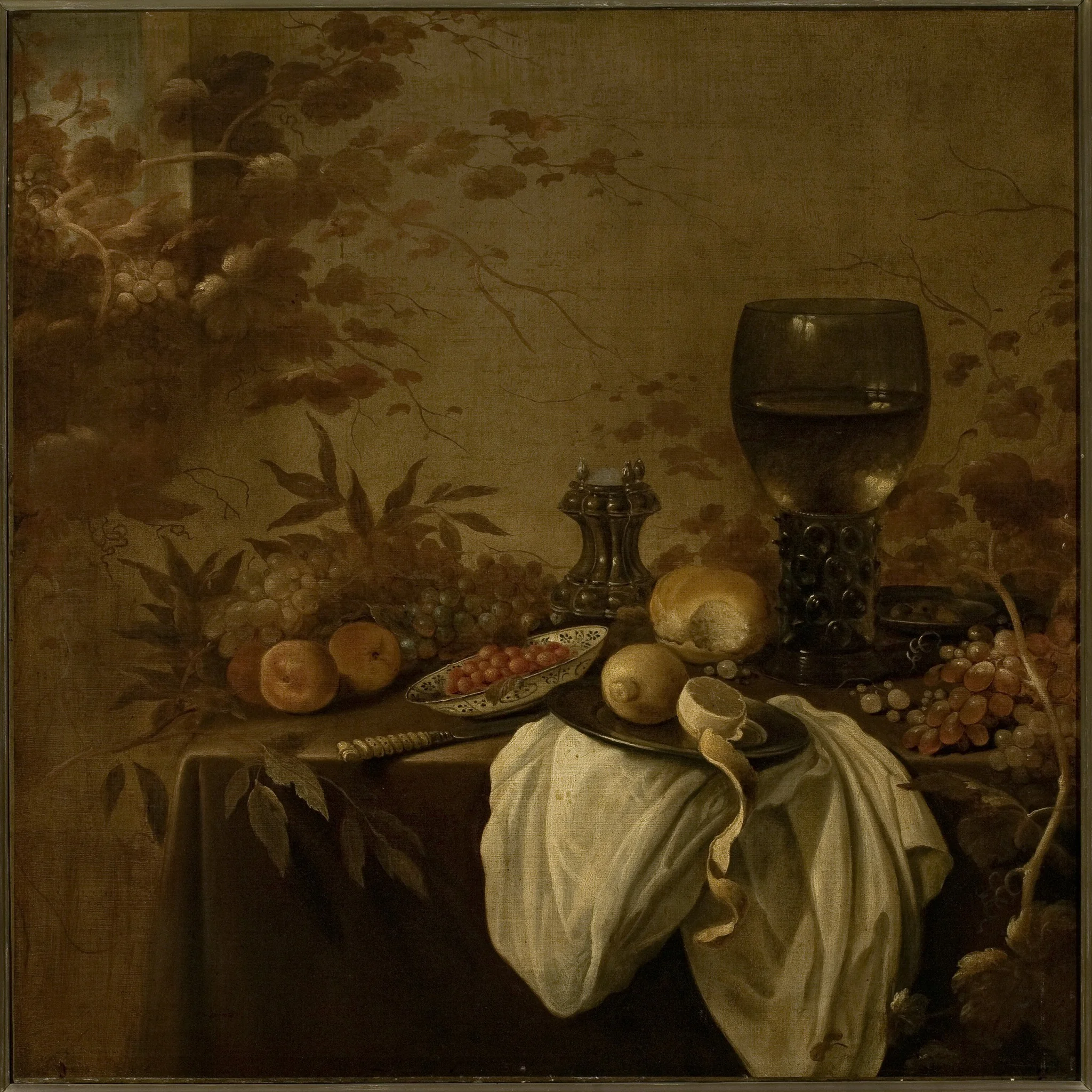
The collection of the National Museum in Warsaw is usually filed under national treasury: a record of what Poland kept and later clawed back. Read its paintings in sequence and a different subject swims up. These works are bound together less by nation than by one technical problem, worried at across seven centuries. How does a painter get light and weight onto a flat surface without merely naming the objects set in front of him? That problem has a textbook turning point, the late nineteenth century, when European painting supposedly broke with description for good. The Warsaw rooms will not let the break sit quietly in that decade. They keep showing it happen early, in places no syllabus thinks to look.
My claim is narrow, and I will hold it work by work. The formal break was not a single event of the 1870s. It was a recurring renegotiation of three things at once: composition, the behavior of light, and the handling of paint. The collection rehearses that renegotiation more than once. It happens early in the medieval gold-ground panel. It happens again in the Dutch breakfast piece. It happens a third time, and most completely, in the open fields of Józef Chełmoński. Each time a painter decides that the old way of describing a thing has stopped being enough, and reorganizes the surface around light instead of around outline. Put the centuries side by side and the break looks less like a frontier than a habit. Warsaw is an unusually good place to catch the habit in the act, because it holds the extremes of the story and very little of the comfortable middle.
A museum built late, on purpose
The institution holding these pictures is younger than most of them. It was founded on 20 May 1862 as the Museum of Fine Arts in Warsaw and took its current name only in 1916, per the museum's recorded history. Its present home on Jerusalem Avenue, a restrained modernist block by the architect Tadeusz Tołwiński, opened on 18 June 1938, barely a year before the war that would test everything inside it. So the frame is modern, deliberately so. The argument it contains is far older than the frame, and the building's clean 1930s lines throw that age into relief.
That gap between container and contents is not a quirk of fundraising. A picture gallery assembled this late gets to choose its own emphases rather than inherit them from a royal hoard. The Warsaw curators chose breadth across time and a willingness to hang the unfashionable next to the canonical. A medieval polyptych, a low Dutch still life, and a wet Polish field would sit in different wings of an older museum, sorted by prestige. Here they read as one continuous experiment, because the institution young enough to know better never separated them by rank.
Gold ground and the refusal of shadow
Start at the early end. The Polyptych of Sant'Agostino, Nicosia by Alvaro Pirez d'Evora belongs to a system that predates the problem I described, and that is exactly why it earns its place here. Pirez works on gold. Light in the panel is not a physical event arriving from a window; it is the ground itself, a sheet of burnished metal that the figures are set against rather than lit by. Scale is hierarchical, not optical: the holiest figure is the largest, regardless of where he stands. Drapery is described by contour and by incised gilt hatching, and the body underneath is an article of faith more than an observation. There is no consistent cast shadow anywhere. Nothing in the panel weighs anything.
Look at how the saints are arrayed. They stand shoulder to shoulder across the register, each in his own pocket of gold, haloes touching like coins laid in a row. The eye is given no recession to travel into; it slides along the surface from one frontal figure to the next. Where a later painter would model a face by letting light die gradually into the far cheek, Pirez draws the features and fills them with even, unmodulated color. The gold does the rest, throwing the whole company forward as a single luminous plane. This is description by sign, not by sight. A viewer is meant to read the panel the way one reads a creed, in fixed and legible terms.
That refusal is not incompetence. It is a different theory of what a picture is for. The gold-ground panel asserts a sacred order, and an order does not need weather or weight. Hold the thought, because the formal break, when it comes, is precisely the decision to let weather and weight back into the picture.
The museum makes that older theory unforgettable in its Faras Gallery, opened to the public in 1972 alongside the first congress of a brand-new discipline its scholars named nubiology, according to the gallery's published account. The murals came from the cathedral of Faras in present-day Sudan, lifted from the path of the rising Aswan reservoir during excavations run from 1961 to 1964 under Professor Kazimierz Michałowski. Sixty-seven wall paintings, made between the seventh and fourteenth centuries, traveled to Warsaw.
Among them is the image catalogued as Bishop Petros Protected by Saint Peter, a late tenth-century painting in plaster and tempera that the Metropolitan Museum of Art records as now held in Warsaw, per its object entry. Look at how it is built. The bishop stands frontal and flat, his eyes enlarged, the saint's hand laid on his shoulder in a gesture that reads as rank rather than touch. The pigment sits in the plaster the way mural pigment does, bound into the wall so that color and surface become one thing; Tate's definition of fresco describes that integration precisely. There is no modeling of the kind a later painter would use to round a cheek. The figure is authority rendered as pattern.
Notice the economy of it. Two men, a few fields of flat color, a border, and a strip of inscription naming the bishop, and the picture has said everything it set out to say. The folds of the bishop's vestment are linear conventions, repeated at intervals, not the record of cloth falling under its own weight. Saint Peter behind him is taller and paler, marked as the greater of the two by size and placement rather than by any trick of distance. The whole image holds still by design. It is meant to outlast the man it portrays, and stillness is the point of it.
The Dutch table tilts
Now jump forward and west, to a small Dutch panel where the break is already half-finished. The Still life by Pieter Claesz is a banketje, a monochrome breakfast piece, and its real subject is not food. It is tone. Claesz drains color almost entirely out of the picture and rebuilds the table in a narrow band of greys and silvered browns. The light rakes in low from the left and skids across the surfaces, catching a rim of glass here, a dull edge of pewter there, then dying into shadow.
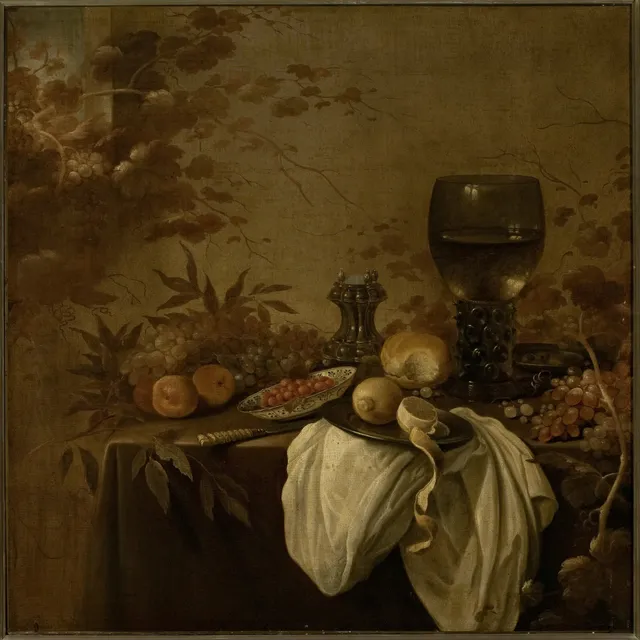
Watch what the composition does with depth. The tabletop tilts up toward us, pushed toward the picture plane so that the objects seem to slide forward into our space rather than recede into the painter's. Claesz models almost nothing with line. A vessel's volume is carried by a single graded passage from highlight to core shadow, and the contour where one form meets the next is often just a difference in value, not a drawn edge. Stand close and the paint is frank about itself: a loaded touch of lead white for the brightest skid of light, thin scumbles where the cloth falls into half-tone. He is finding out how little outline a thing needs before tone alone can carry its weight.
This is the same surface that the Faras saint refused, turned inside out. The Nubian painter made paint into inscription and kept the light constant. Claesz lets the light do the describing and keeps the inscription out entirely. Nothing on his table tells a story or names a doctrine. The picture is about the encounter between a raking beam and a few dull surfaces, and about a painter watching that encounter closely enough to set it down in value alone. Strip away the centuries and the genre labels, and you are left with a man solving the problem this essay is tracking.
The same instinct, cooler and more aristocratic, runs through the Still life with a herring by Gerret Willemsz Heda. Heda lays his objects along a quiet diagonal and lets a single fish on pewter anchor the whole restrained event. Where Claesz is gruff, Heda is fastidious, yet both painters have made the same structural bet. The picture is organized by the path of light, not by the inventory of objects. The herring is barely a meal. It is a pretext for the painter to study how a wet surface throws back a window, how the matte body of the fish sits against the cold sheen of the plate. This is the formal break arriving two centuries early, in a genre too modest for the textbooks to credit with it.
There is an irony worth naming. Academic theory of the period ranked still life at the bottom of the genres, beneath history painting and portraiture, on the grounds that it only copied dumb matter. Yet it was in this low genre, free of the duty to narrate, that Dutch painters could treat a picture as a pure problem of light and surface. No saint had to be recognizable, no battle correctly staged. The Warsaw panels are evidence that the radical formal work often happens exactly where the critics are not looking, in the corners of art that nobody is policing for meaning.
Baroque light as theater
There is a second route to the same destination, and the Warsaw collection holds it too. Where the Dutch tonalists broke description by subtraction, the Italian and Flemish Baroque broke it by excess. The Adoration of the Magi by Francesco Fontebasso sends a diagonal surge of figures up and across the canvas, the composition spiraling toward a burst of light above the manger. The brushwork loosens as it climbs. Drapery is laid in with quick, confident strokes that make no pretense of counting threads. Light here is not Claesz's quiet fact. It is an event, a flare that reorganizes the whole surface around itself.
Trace the eye's path. It enters low among the kneeling kings, climbs the diagonal of bowed backs and lifted arms, and arrives at the radiance over the child, where Fontebasso thins his paint and brightens his key until the canvas seems to open. The figures at the bottom are nearly finished, those at the top dissolved into gesture. Description has not been abandoned so much as overrun by drama. The painter is betting that a viewer swept up the diagonal will not stop to ask whether each fold is accounted for, and the bet pays. Order has given way to motion.
The Adoration of the Magi (Matthew 2:10-11) by David Teniers the Younger works the Flemish side of the same impulse, and the museum holds a dozen of his pictures, enough to feel his range. Teniers builds the scene around a shaft of light striking into a shallow, dim interior. His handling stays tighter than Fontebasso's, yet the principle is shared: the drama of illumination can do the structural work that contour once did. Where the Venetian flares, the Fleming concentrates, pooling brightness on a few faces and letting the rest of the room sink into warm gloom. Two temperaments, one discovery. A painting can be held together by where the light falls.
Chełmoński and the field that will not hold still
The collection's center of gravity, for my argument, is Józef Chełmoński. Among the painters gathered here he is the most deeply represented, and his work is where the long renegotiation finally arrives at something we recognize as modern. The Rushing cart driven by a Jew is paint as weather and motion. The cart pitches forward across a flat plain under a huge, low sky, and Chełmoński paints the speed rather than the vehicle. Wheels and harness dissolve into the road, a churn of loaded strokes. The horizon is a bare, charged line. The air itself seems to have texture.
Here the three terms have fully changed places. Composition is dictated by movement and by the weight of the sky, not by a posed arrangement. Light is atmospheric, the diffuse grey luminosity of an overcast day on open ground, the kind of light a camera would struggle to expose. And the handling has stopped finishing. Chełmoński leaves the strokes legible, lets the ground show through, and trusts the eye to assemble the scene from marks that, up close, are frankly abstract. The gold-ground panel asserted an order. This painting records a moment, and refuses to pretend the moment held still long enough to be drawn.
Stand back from the canvas and the cart resolves, hurtling and whole. Step in close and it falls apart into smears and drags of grey-brown pigment, the horses' legs a blur, the rutted road a single rapid passage of the loaded brush. That double reading, coherent at distance and abstract at arm's length, is the signature of the very modernism the textbooks date to Paris in the same years. Chełmoński reaches it from a Polish road and a Polish sky, working a subject the metropolitan avant-garde would have thought provincial. The provincialism is a red herring. The eye solving this field is the same eye that would soon be praised for solving a Paris boulevard.
That is the break, fully consummated, on Polish ground and in a Polish subject. The point worth holding is that nothing in Chełmoński's method would have shocked Claesz. The tonalist already knew that light, not line, could carry a picture. Chełmoński simply took the lesson outdoors, enlarged it, and let it get muddy. The Warsaw collection lets you watch the inheritance pass from a quiet Haarlem table to a roaring Mazovian road without ever leaving the building.
Works discussed in this article
What the holdings show
The shape of the collection backs this reading. Artifact World Gallery catalogues 2,755 works tied to this single venue, made by 856 different hands, the earliest dated near 1280 and the latest near 1937. That is a span of roughly six and a half centuries concentrated in one institution, and the concentration is the point. A visitor can stand within a few rooms of a gold-ground polyptych, a monochrome Dutch breakfast piece, a Baroque adoration, and a Chełmoński field, and read the formal break not as a date on a wall label but as a problem handed forward from one generation to the next.
Think about what 856 hands across 2,755 works means in practice. This is not a collection built around a handful of stars, the way a princely gallery clusters on its Rembrandts and its Raphaels. It is broad and thin, a great many painters represented by a few works each, which is exactly the profile that lets a single argument run across it. No one artist dominates the sightlines and bends the story toward biography. You are left looking at the problem itself, restated by hand after hand, from a panel painted around 1280 to a canvas finished near 1937. Six and a half centuries, and the same question keeps coming up off the wall.
Set that internal evidence against the external record and the museum's character sharpens. Its scholars did not only collect the break. In the Faras Gallery they enlarged the very idea of what counted as the history of painting, dragging medieval Nubian murals into the canon and inventing a discipline to study them. A museum founded in 1862 to hold fine art had, by 1972, redefined its own subject. That is an unusual thing for an institution to do, and it tells you something about the temperament of the place: less a vault than a working argument about what painting is and where its history begins.
Walk it backward sometime. Begin at the Chełmoński, with its wet road and its refusal to settle, then move to the Dutch tables where the same trust in light was first risked in miniature, and finish in front of the Faras saint, whose hand on the bishop's shoulder weighs nothing and was never meant to. The distance between that hand and that road is the whole argument. The National Museum in Warsaw keeps both within walking distance, and leaves it to you to decide how far apart they really are.
Sources & further reading
- National Museum in Warsaw — Wikipedia
- Faras Gallery at the National Museum in Warsaw — Wikipedia
- Wall painting: Bishop Petros Protected by Saint Peter — The Metropolitan Museum of Art
- Fresco (art term) — Tate
- Bishop Petros, Cathedral of Faras — Smarthistory
- Nubia: Jewels of Ancient Sudan — The J. Paul Getty Museum
- The Cathedral of Faras as a Monument of Medieval Nubian Memory (Dumbarton Oaks Papers, vol. 76) — Internet Archive (Dumbarton Oaks Papers)