Artist
Andrea della Robbia
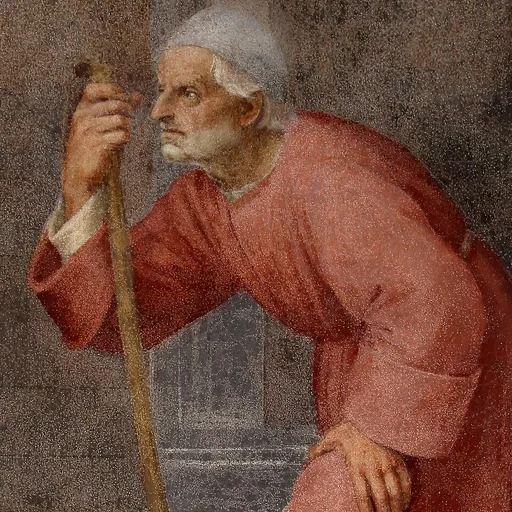
Republic of Florence, 1435–1525
Andrea della Robbia was a Republic of Florence Renaissance artist. 2 works are cataloged here, principally at Victoria and Albert Museum. Andrea della Robbia was born in Florence.
Andrea della Robbia (1435–1525) was an artist, born in Florence.
Biography & dates
Andrea della Robbia was born in Florence on 20 October 1435, the son of Marco della Robbia. His father died in 1448, after which his uncle Luca della Robbia, the renowned sculptor who had popularised glazed terracotta, took Andrea into his household and workshop. Andrea lived with Luca for the remainder of his uncle's life, eventually assuming full leadership of the workshop around 1470. In 1471, Luca formally excluded Andrea from his inheritance, claiming that his training had already brought him considerable wealth. Andrea had been admitted to the arte dei maestri di pietra e legname as an intagliatore, or stonecutter, in 1458, and was registered in the guild's matriculation from 1465, serving multiple terms as consul. His first independent commission came in 1455, a Madonna possibly intended for a Medici villa. He married in 1465 and had seven sons, of whom five, including Giovanni della Robbia, continued the family business. Andrea died in Florence on 4 August 1525, leaving a workshop that would persist through his descendants.
Style & movement
Andrea della Robbia operated within the Renaissance tradition but developed a highly distinctive approach that distinguished his work from that of his uncle Luca. His style was characterised by a precise, idealised manner that drew more inspiration from contemporary painting than from sculpture, in contrast to his predecessors. The hallmark of his production was a strict chromatic system: brilliant white figures symbolising purity set against a matte blue background representing heaven and paradise, with the blue derived from costly lapis lazuli pigment. Many works featured naturalistic garlands of fruit and foliage in varied enamel colours, greens, yellows, oranges, and browns, framing the central white relief. Andrea introduced technical innovations in glazing methods and notably expanded the scale and architectural application of the medium, creating large retables, friezes, fountains, lavabos, and ceiling decorations. He sometimes omitted glaze on faces and hands to achieve greater realism, as seen in certain portrait-like heads. His compositions frequently incorporated the Madonna and Child, with the infant placed at her right, a reversal of Luca's convention, and he favoured the motif of worshippers taking refuge in the folds of the Virgin's mantle for corporate devotional commissions.
Influences & students
Andrea della Robbia's primary influence and teacher was his uncle Luca della Robbia, from whom he learned the techniques of glazed terracotta and inherited the family workshop. The early death of his father Marco in 1448 made this apprenticeship central to his formation. Andrea's own artistic circle included his five sons who carried on the workshop, most notably Giovanni della Robbia, who assumed leadership after Andrea's death. The workshop also trained Benedetto Buglioni, who became a significant sculptor in his own right. Andrea's collaboration with his uncle on certain projects, such as the sculptural wall frieze of the Works of Christian Mercy at the Ospedale del Ceppo in Pistoia, indicates a transitional period where Luca may have provided designs while Andrea executed the work. The family enterprise that Andrea established became a model for Renaissance artistic workshops, with specialisation passed through generations.
Legacy
Andrea della Robbia's legacy rests on his transformation of glazed terracotta from a specialised technique into a major medium for Renaissance art and architecture. By expanding its application to large-scale public and religious commissions throughout Tuscany and beyond, he ensured the della Robbia name became synonymous with the distinctive white-and-blue enamelled style. His workshop, continued by his son Giovanni and other family members, preserved and propagated this tradition well beyond his death in 1525. The widespread distribution of his works in churches, hospitals, and palaces across Italy, from Florence to Arezzo, Prato, Pistoia, Viterbo, and as far as Trapani in Sicily, attests to the commercial success and cultural reach of his enterprise. Works attributed to him or his workshop are now held in major international collections including the Metropolitan Museum of Art, the National Gallery in London, the National Gallery of Art in Washington, the Detroit Institute of Arts, and the Louvre. The continued scholarly attention to distinguishing his hand from those of his sons and the workshop output reflects both the scale of his production and the enduring importance of his contribution to Renaissance ceramic sculpture.
Works by Andrea della Robbia
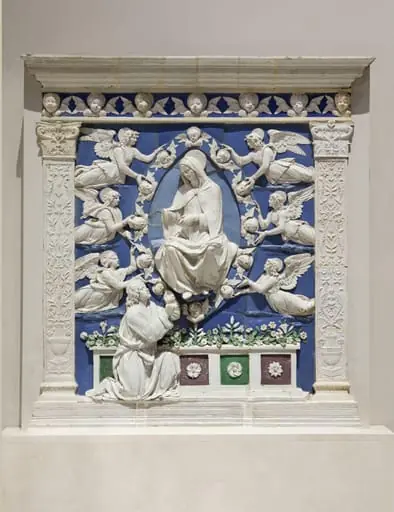
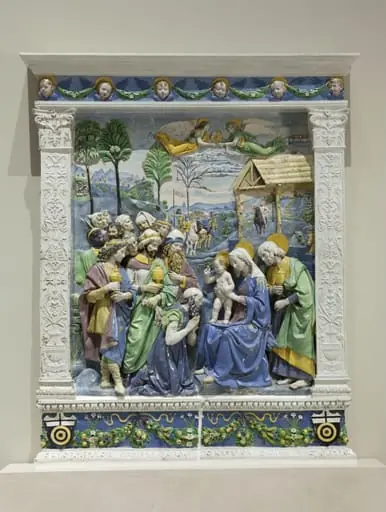
Collections represented

Artists in a similar vein
Artist
Artist