Artwork
Manda Lamétrie, fermière
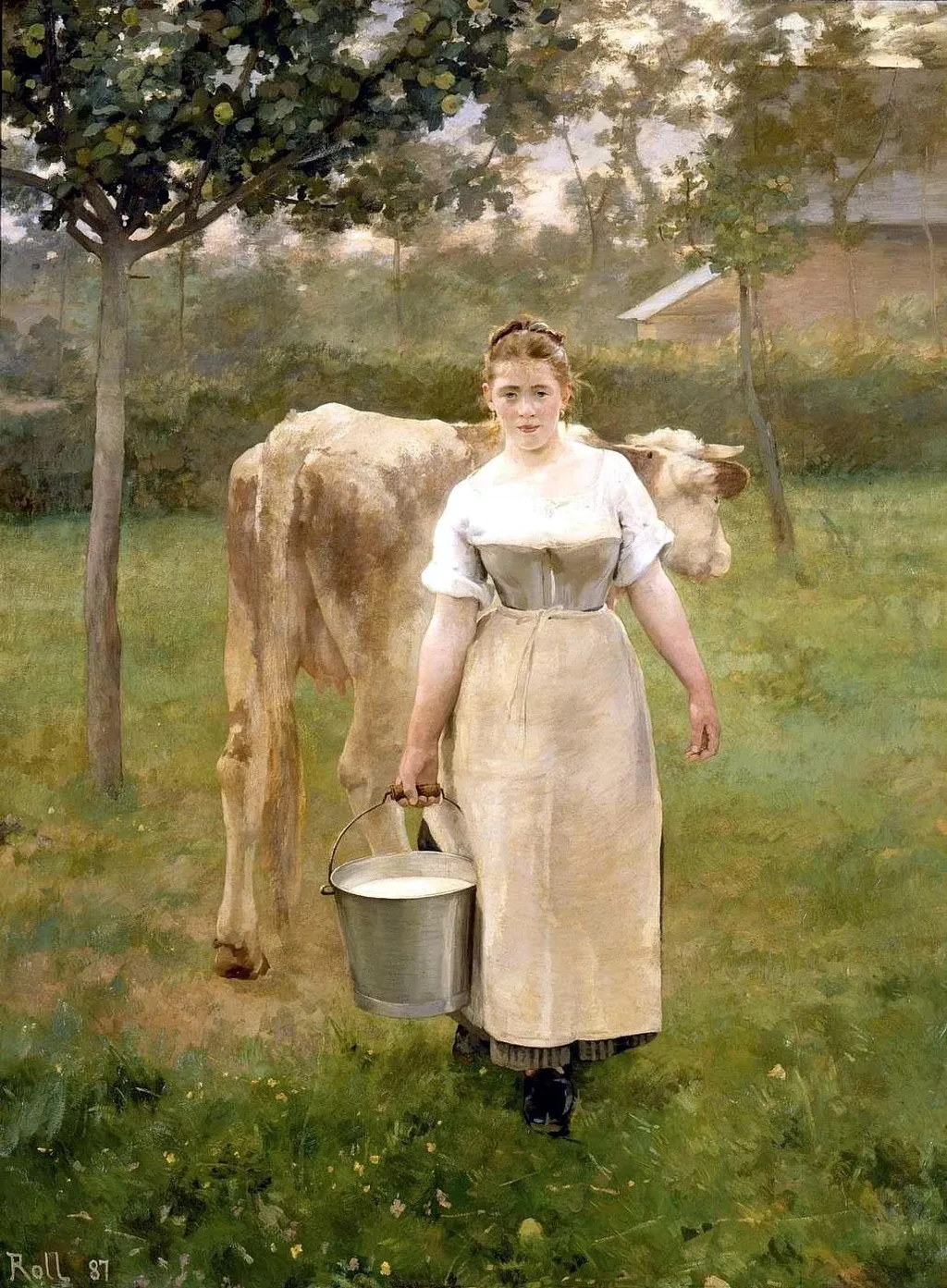
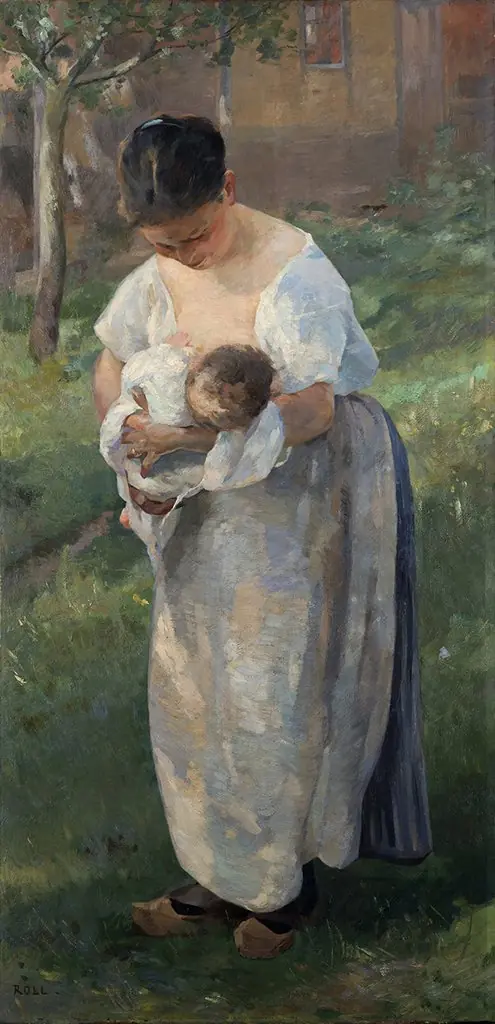
Manda Lamétrie, fermière is an oil painting by the Impressionist artist Alfred Philippe Roll. It dates from 1894 and is held in the collection of the Musée d'Orsay.
About this work
Subject & Meaning
The painting depicts Manda Lamétrie, a twenty-year-old peasant woman and farmer from Sainte-Marguerite-sur-Mer in Upper Normandy.
The painting depicts Manda Lamétrie, a twenty-year-old peasant woman and farmer from Sainte-Marguerite-sur-Mer in Upper Normandy. She is portrayed in a monumental, frontal composition walking directly toward the viewer with a determined gaze, carrying a bucket filled with cow's milk after milking one of her three cattle in an orchard setting. The work includes detailed elements of rural life such as her dress, apron, and blond hair styled in a chignon, alongside background features like meadows, hedges, and broad-leaved trees.
Executed in a naturalistic style that utilizes a light palette without adopting loose Impressionist techniques, the image transforms Lamétrie into an icon of the French rural population. Reflecting the naturalist belief that environment and occupation define destiny, the artwork elevates a specific daily labor scene into a symbol of the peasantry, presenting the subject not merely as an individual but as a representative figure of agricultural life.
Technique & Style
Alfred Philippe Roll rendered Amanda Lamétrie, fermière in oil on canvas, employing a naturalistic style that emphasizes precise, frontal modeling of the figure. The work depicts a young peasant woman in a modest dress and apron, standing in a garden with a bucket of milk, rendered with a restrained palette reminiscent of Impressionist light yet maintained through controlled brushwork. Roll’s composition elevates the everyday act of milking into a dignified, iconic portrayal of rural French life, reflecting the naturalist interest in ordinary labor and the social context of the sitter.
The painting measures 214.3 cm × 160 cm and has been part of the Musée d’Orsay collection since 1980, having previously entered the Musée du Luxembourg in 1888 and the Louvre in 1920.
History & Provenance
The work was commissioned by Alfred Philippe Roll and painted in 1887. It was first shown at the Salon of 1888 and later at the Exposition Universelle of 1889.
It was purchased from the artist in 1888 for the Musée du Luxembourg. In 1920 it was transferred to the Louvre’s Department of Paintings. In 1980 it moved to the Musée d’Orsay, where it remains in the national collection.
Manda Lamétrie, fermière is held in the Musée d'Orsay collection in Paris, where it has been since 1980. The work was acquired directly from the artist in 1888 for the Musée du Luxembourg and later transferred to the Louvre in 1920 before moving to its current institution. It was exhibited at the Salon of 1888 and the Exposition Universelle of 1889.
Context
When Roll exhibited Manda Lamétrie, fermière at the Salon of 1888, the work was hailed as a triumph. A critic writing in the Gazette des Beaux-Arts singled it out as the painting of the year, and the canvas subsequently featured in the Exposition Universelle of 1889. The painting is now regarded as one of the high points of a series of naturalistic female portraits Roll produced during the 1880s, in which he adopted the light palette of Impressionism while rejecting that movement's loose handling of paint. Sharing the naturalist conviction, articulated with Zola, that a sitter's milieu and labor largely determine her fate, Roll rendered the twenty-year-old Amanda Lamétrie frontally and monumentally, transforming the Norman milkmaid into an icon of the French rural population. The painting's acclaim did not alter Lamétrie's circumstances: she remained unmarried, continued to farm, and supplemented her income by guarding summer houses and catching shrimp until her death.
Legacy
Upon its exhibition at the Salon of 1888, Alfred Roll's *Manda Lamétrie, fermière* achieved immediate critical acclaim. A reviewer for the *Gazette des Beaux-Arts* hailed it as the painting of the year, recognizing the work's power to elevate a rural subject into an icon of the French peasantry. The portrait is noted for its monumental, frontal composition, which transformed the twenty-year-old model into a definitive symbol of rural life within the Naturalist movement.
The painting's enduring reputation is reflected in its institutional history. Acquired by the state in 1888 for the Musée du Luxembourg, it was transferred to the Louvre in 1920 before moving to its current home at the Musée d'Orsay in Paris in 1980. Despite the fame the artwork brought to the artist, the sitter's own life remained largely unchanged; she continued to manage her farm and work as a guardian and shrimp fisher until her death.
Artist & collection
Artist
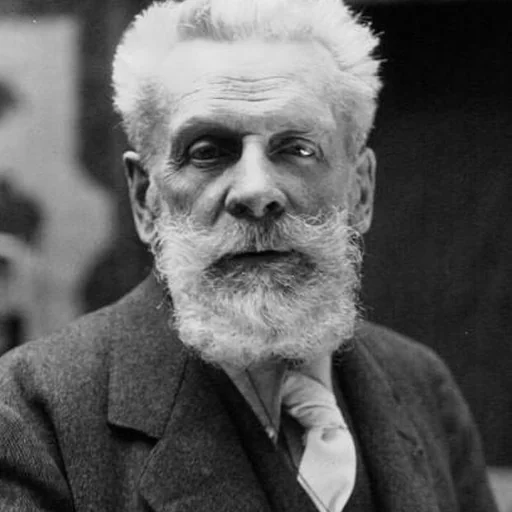
Alfred Philippe Roll (1845–1919) was an artist, born in former 8th arrondissement of Paris.