Artwork
Eagle and Young
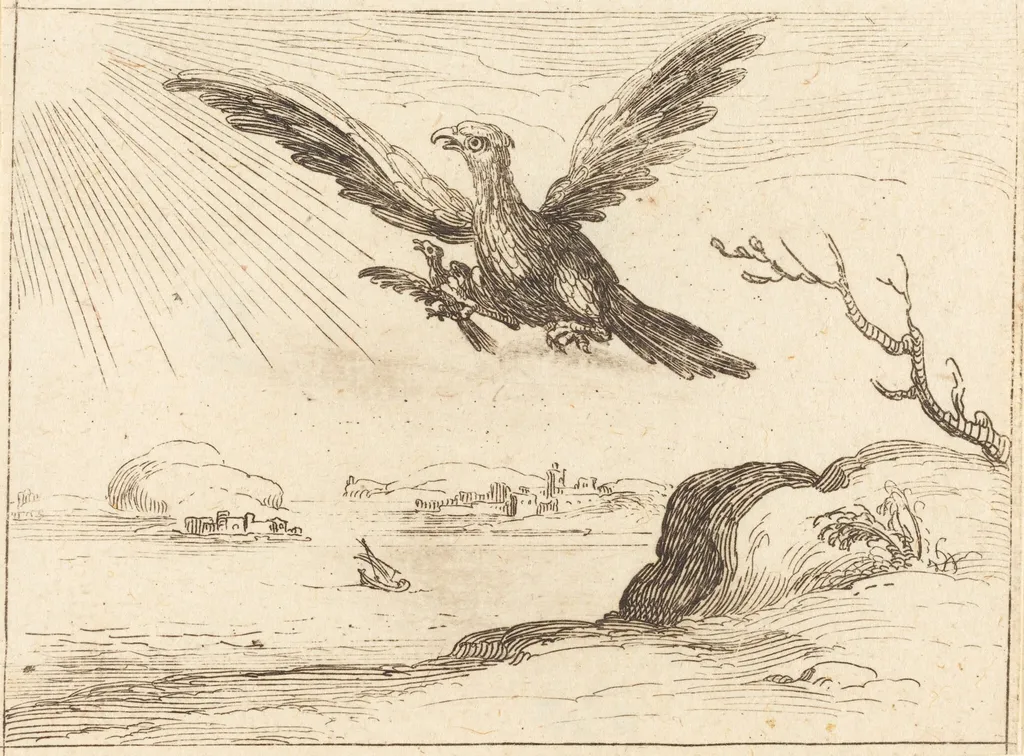
Eagle and Young is an ink print by the Renaissance artist Jacques Callot. It dates from 1628 and is held in the collection of the National Gallery of Art.
About this work
Overview
Jacques Callot, a printmaker from the Duchy of Lorraine, produced Eagle and Young in 1628 as an etching on laid paper. Part of a vast output of over 1,400 prints, this work exemplifies his focus on natural and human drama rendered with precision. Unlike many of his narrative scenes depicting social life, this piece turns to the wild, capturing a moment of tension between predator and environment.
Subject & Meaning
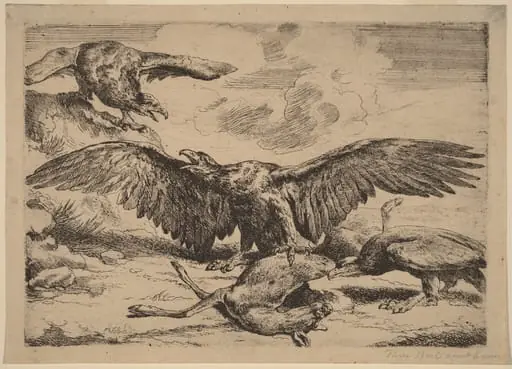
The image depicts a large eagle in flight, its talons clutching a small, indistinct form, possibly its chick, above a turbulent sea.
The image depicts a large eagle in flight, its talons clutching a small, indistinct form, possibly its chick, above a turbulent sea. Below, a capsized boat and a distant hilltop settlement suggest human vulnerability against nature’s force. The scene evokes themes of survival, dominion, and isolation, without overt moralizing. The eagle’s dominance contrasts with the fragile human presence, reinforcing a natural hierarchy.
Technique & Style
Callot employed fine-line etching to render intricate textures: individual feathers, churning waves, and distant architecture are defined with meticulous precision. His use of cross-hatching and controlled line weight creates depth and movement, especially in the storm-lit sky and crashing surf. The composition balances vertical flight with horizontal chaos, guiding the eye from the eagle’s apex to the submerged boat below.
History & Provenance
Created during Callot’s mature period in Nancy, the print was likely made for private collectors rather than public dissemination. It survives in several institutional collections, though its early ownership remains undocumented. As part of a broader print culture in early 17th-century Europe, it reflects the period’s interest in natural phenomena and the artist’s technical mastery over the etching medium.
Context
In the 1620s, European printmakers increasingly turned to nature as a subject worthy of detailed observation, moving beyond religious or allegorical themes. Callot’s work aligns with this shift, influenced by Flemish landscape traditions and scientific curiosity about the natural world. His etchings often merged observation with poetic tension, distinguishing them from purely decorative prints of the time.
Legacy
Though less famous than his war scenes or beggar series, Eagle and Young demonstrates Callot’s range and technical control. It influenced later printmakers interested in naturalistic detail and atmospheric effects. The work remains a quiet example of how etching could convey both biological realism and emotional resonance without narrative exposition.
Own this work as a print
Artist & collection
Artist
Jacques Callot (French: ; c. 1592 – 1635) was a baroque printmaker and draftsman from the Duchy of Lorraine. He is an important person in the development of the old master print. He made more than 1,400 etchings that…

 Holy Family at supper
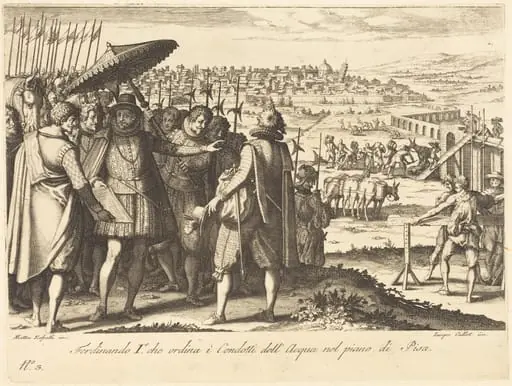 Restoration of the Aqueduct at Pisa
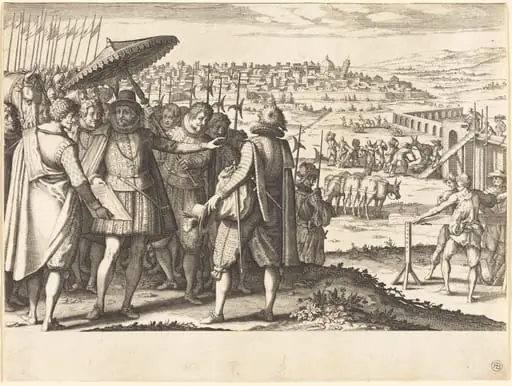 Restoration of the Aqueduct at Pisa
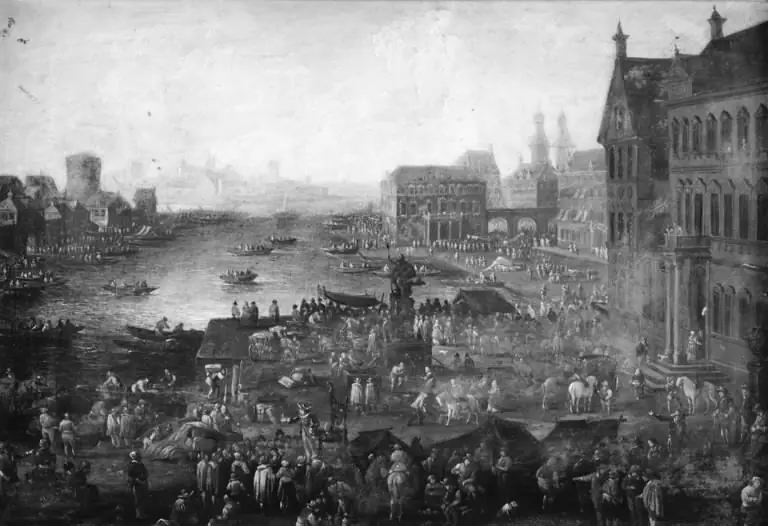 Square in Paris with Many Figures
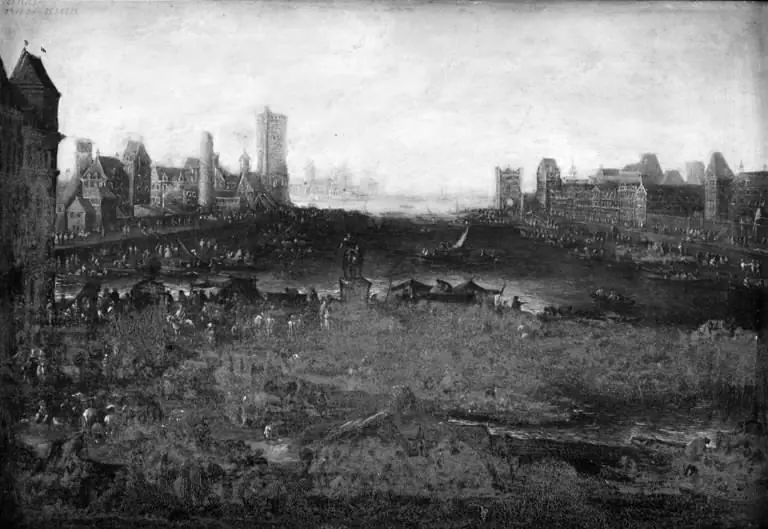 Square in Paris with Many Figures
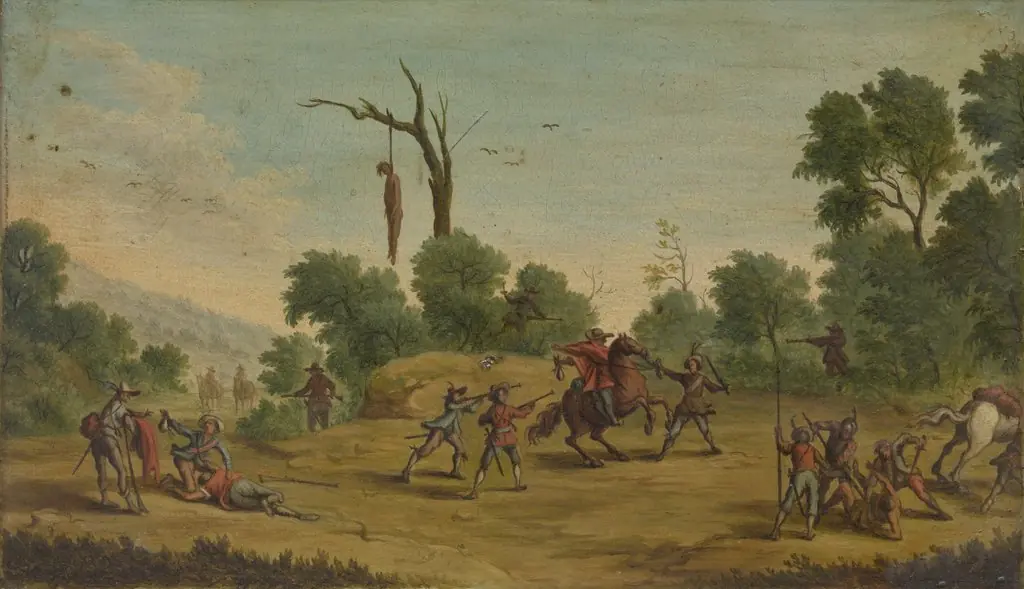 Horsemen Attacked by Robbers
 HOW WILL A COVERED PART BE CORRECTED?HOW WIKA A COVERED HEART DEED CORRECTED?
![Christ Walking on the Water [second plate], by Jacques Callot](https://artifactworldgallery.com/img/jacques-callot--christ-walking-on-the-water-second-plate--2069f3bfe4cb2126-w320.webp) Christ Walking on the Water [second plate]
Christ Walking on the Water [second plate]