Artwork
The Dance
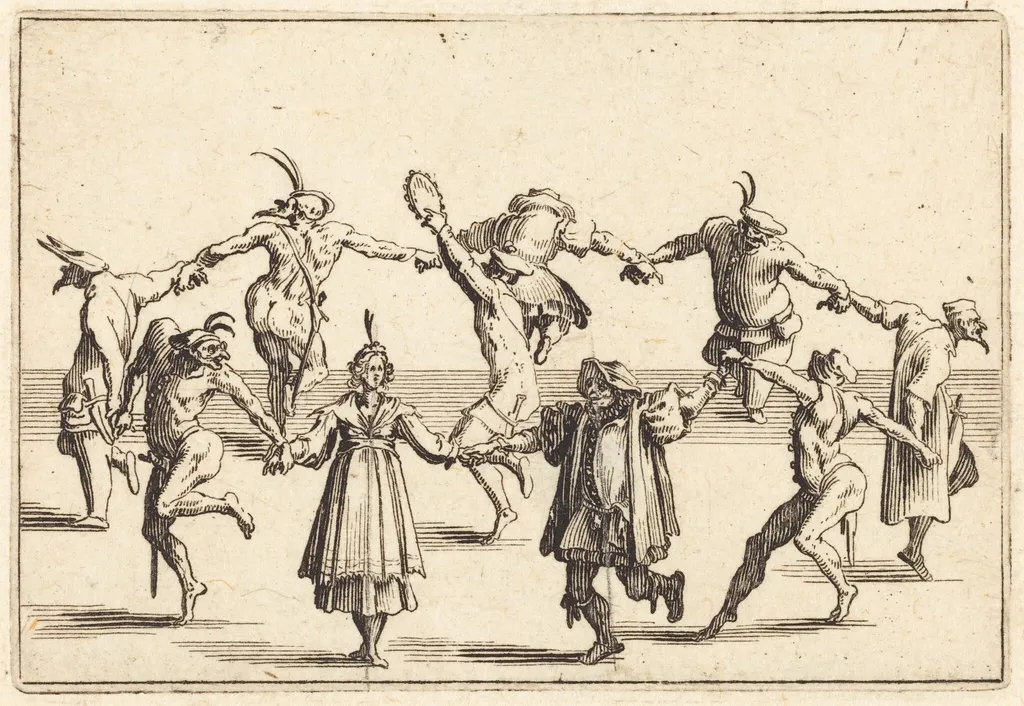
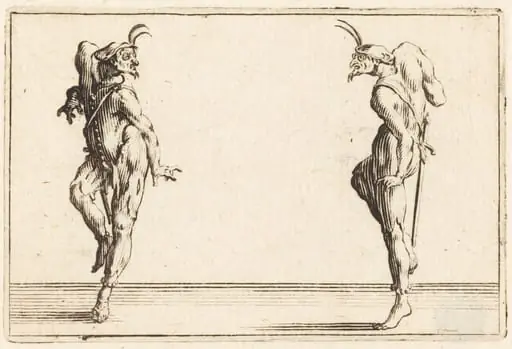
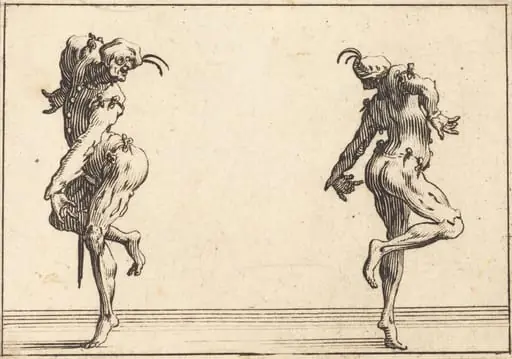
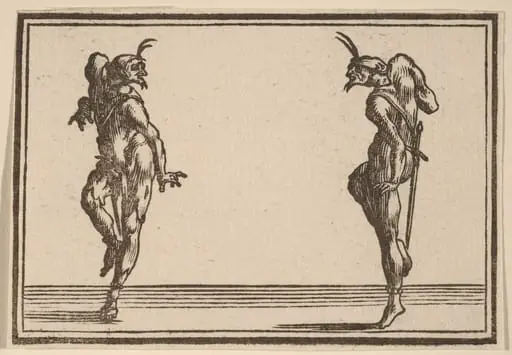
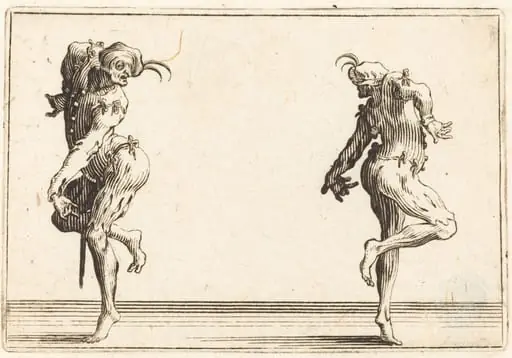
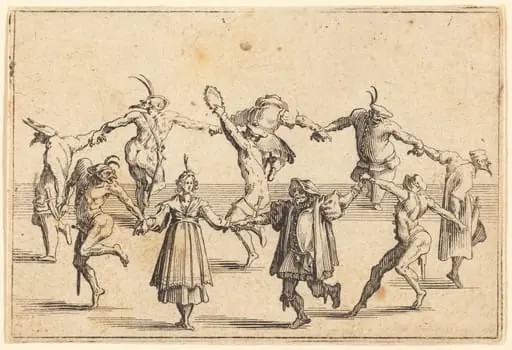
The Dance is an ink print by the Baroque artist Jacques Callot. It dates from 1622 and is held in the collection of the National Gallery of Art.
About this work
Overview
As part of a vast body of over 1,400 prints, this work exemplifies Callot’s focus on everyday life in early 17th-century Lorraine.
Jacques Callot’s The Dance, created around 1622, is an etching on laid paper that captures a lively outdoor gathering. As part of a vast body of over 1,400 prints, this work exemplifies Callot’s focus on everyday life in early 17th-century Lorraine. Unlike grand historical or religious scenes common in the period, it presents an unidealized moment of communal celebration, rendered with meticulous detail and a keen eye for social observation.
Subject & Meaning
The scene depicts a circle of figures in elaborate attire dancing beneath trees and near modest structures. Their gestures suggest merriment, and the absence of overt narrative or moralizing implies a focus on transient human joy. Callot’s choice to portray such a moment, free from religious or aristocratic symbolism, reflects a quiet interest in the vitality of ordinary life, offering a rare glimpse of unscripted social interaction in Baroque printmaking.
Technique & Style
Callot employed fine-line etching to achieve remarkable clarity and texture, using a sharp burin to incise details into a metal plate. The intricate rendering of fabric, foliage, and architecture demonstrates his mastery of the medium. His use of dense cross-hatching and delicate line variation creates depth and movement, allowing the viewer to perceive both the rhythm of the dancers and the spatial setting with precision.
History & Provenance
Created during Callot’s mature period in Nancy, the etching likely circulated among collectors and artists in northern Europe. While its early ownership is undocumented, its survival in multiple institutional collections suggests it was valued for its technical excellence and social insight. Callot’s prints were widely disseminated, influencing later generations of printmakers through their observational rigor and compositional clarity.
Context
In an era dominated by religious iconography and courtly portraiture, Callot’s focus on peasants, soldiers, and festive crowds was unconventional. His work emerged amid the turmoil of the Thirty Years’ War, making depictions of communal joy all the more notable. These prints served not as propaganda but as quiet records of human resilience and ritual, offering an alternative to the era’s prevailing visual narratives.
Legacy
Callot’s The Dance contributed to the elevation of etching as a serious medium for documenting social life. His precise technique and subject matter influenced Dutch and French printmakers who followed, particularly in their attention to everyday scenes. Though not widely exhibited in his lifetime as a standalone work, its cumulative impact helped redefine the potential of printmaking as a vehicle for secular, observational art.
Own this work as a print
Artist & collection
Artist
Jacques Callot (French: ; c. 1592 – 1635) was a baroque printmaker and draftsman from the Duchy of Lorraine. He is an important person in the development of the old master print. He made more than 1,400 etchings that…

 Holy Family at supper
 Restoration of the Aqueduct at Pisa
 Restoration of the Aqueduct at Pisa
 Square in Paris with Many Figures
 Square in Paris with Many Figures
 Horsemen Attacked by Robbers
 HOW WILL A COVERED PART BE CORRECTED?HOW WIKA A COVERED HEART DEED CORRECTED?
![Christ Walking on the Water [second plate], by Jacques Callot](https://artifactworldgallery.com/img/jacques-callot--christ-walking-on-the-water-second-plate--2069f3bfe4cb2126-w320.webp) Christ Walking on the Water [second plate]
Christ Walking on the Water [second plate]