Artwork
The Flamingo (Phoenicopterus ruber)
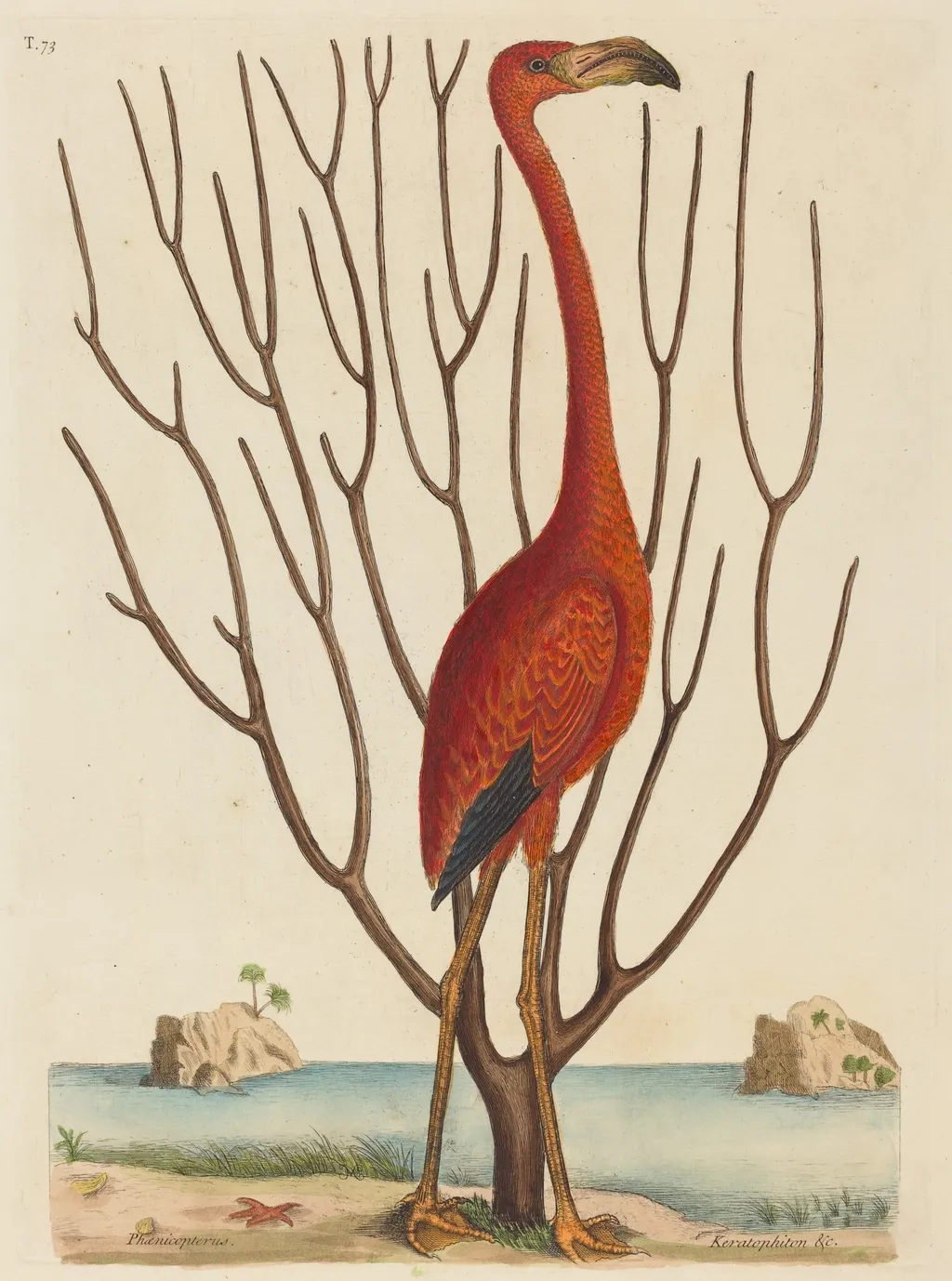
The Flamingo (Phoenicopterus ruber) is an ink print by the Baroque artist Mark Catesby. It dates from 1737 and is held in the collection of the National Gallery of Art. Created in 1737, this print portrays a vivid pink flamingo (Phoenicopterus ruber) standing in shallow water amid green vegetation.
- Inscription
- Inscribed:lower left in plate (along shoreline): MC; lower left in plate: Phaenicopterus.; lower right in plate: Keratophiton &c.; upper left in plate: T.73
About this work
Overview
Created in 1737, this print portrays a vivid pink flamingo (Phoenicopterus ruber) standing in shallow water amid green vegetation. Executed as an etched and engraved image that was subsequently hand‑colored on laid paper, the work combines precise line work with delicate washes of color, giving the bird a lifelike yet slightly idealized presence.
Subject & Meaning
The image captures the flamingo’s characteristic long legs and curved beak, emphasizing its graceful stance in a wetland setting. By presenting the bird in a naturalistic pose, the print reflects the 18th‑century scientific aim of documenting New World species with visual accuracy while also appealing to European curiosity about exotic fauna.
Technique & Style
Catesby employed copperplate etching and engraving to render fine details of plumage and foliage, then applied hand‑applied pigments to achieve the bird’s distinctive pink hue. The use of laid paper provides a textured surface that enhances the contrast between the bird’s bright coloration and the muted greens of the surrounding plants.
History & Provenance
The print forms part of Mark Catesby’s monumental series Natural History of Carolina, Florida and the Bahama Islands, a multi‑volume work issued between 1729 and 1747 that included 220 illustrated plates. This particular plate is notable for being the first colored depiction of a flamingo to reach a European audience, marking a milestone in transatlantic natural history illustration.
Context
Catesby, an English naturalist, spent several years traveling throughout the American South and the Caribbean in the early 1700s, gathering specimens and sketches. His publications aimed to provide scholars and collectors in Europe with reliable visual records of the region’s flora and fauna, bridging scientific observation and artistic representation.
Own this work as a print
Artist & collection

Artist
Mark Catesby (24 March 1683 – 23 December 1749) was an English naturalist who studied the flora and fauna of the New World.