Artwork
Ring Gymnast No. 2
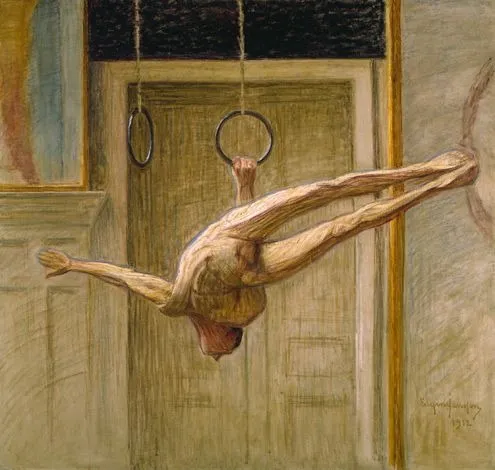
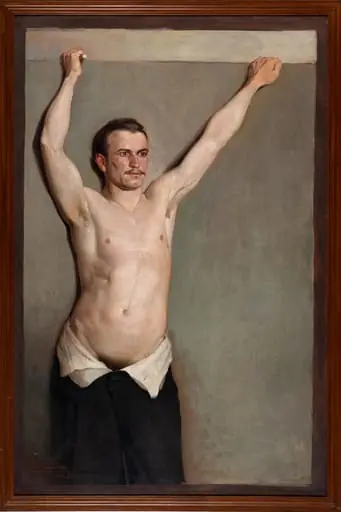
Ring Gymnast No. 2 is an oil painting by Eugène Jansson. It dates from 1912 and is held in the collection of the Detroit Institute of Arts.
About this work
Overview
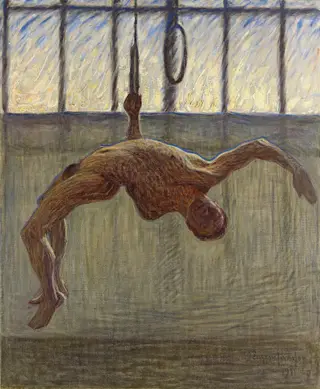
Eugène Jansson painted Ring Gymnast No. 2 in 1912 using oil on canvas. Created during a period when he turned from urban night scenes to studies of the male form, this work reflects his interest in physical movement and anatomical structure. The painting is part of a small series focused on gymnasts and is now in the collection of the Detroit Institute of Arts.
Subject & Meaning
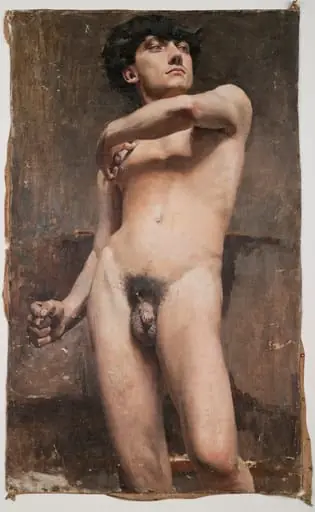
The painting portrays a nude male athlete suspended from parallel rings, his body contorted in a pose that emphasizes strength and balance. There is no narrative context, only the figure and his environment. Jansson’s focus on the body in motion suggests an exploration of physical discipline and human form, detached from theatrical or mythological associations.
Technique & Style
Jansson employs a restrained palette and simplified forms to direct attention to the figure’s musculature and posture. The background is minimal, a flat wall with a doorway and windows, offering no distraction. Brushwork is controlled, with subtle modeling of light across the skin to suggest volume without overt realism, aligning with a modernist tendency toward reduction.
History & Provenance
After 1904, Jansson abandoned his earlier blue-toned cityscapes to concentrate on male nudes, a shift influenced by personal and artistic reorientation. Ring Gymnast No. 2 emerged from this phase, likely painted in his Stockholm studio. It entered the Detroit Institute of Arts’ collection in the 20th century, though specific acquisition details remain undocumented in public records.
Context
In early 20th-century Europe, interest in physical culture and the idealized male body was widespread, reflected in sports imagery and artistic studies.
In early 20th-century Europe, interest in physical culture and the idealized male body was widespread, reflected in sports imagery and artistic studies. Jansson’s gymnast series aligns with broader European trends but avoids overt nationalism or idealization. His approach is introspective, emphasizing form over symbolism, distinguishing his work from contemporary academic or propagandistic depictions.
Legacy
Jansson’s gymnast paintings are now recognized as a distinctive chapter in Swedish modernism. Though not widely exhibited outside Scandinavia, they contribute to understanding how Nordic artists engaged with the human body during a period of artistic transition. Ring Gymnast No. 2 remains a quiet, focused example of his late style, valued for its restraint and formal clarity.
Artist & collection
Artist
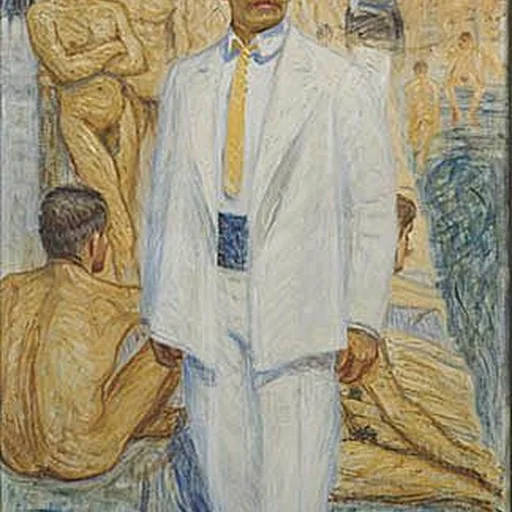
Eugène Fredrik Jansson (18 March 1862, Stockholm – 15 June 1915, Nacka) was a Swedish painter known for his night-time land- and cityscapes dominated by shades of blue.