Artwork
Views of a Pawn - Threat
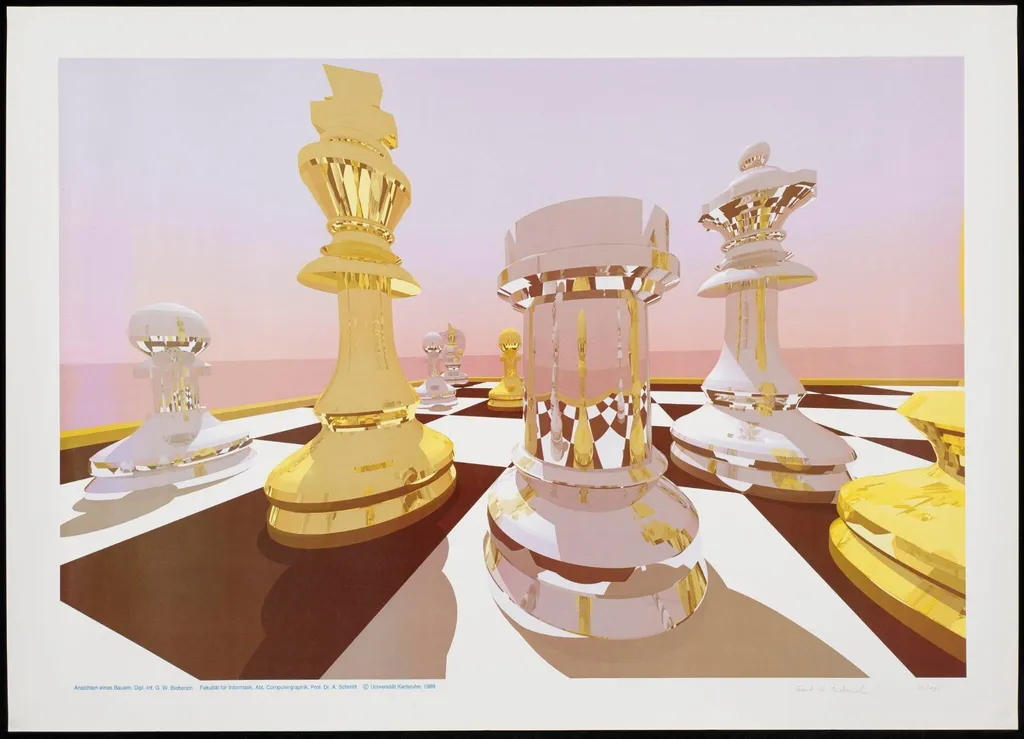
Views of a Pawn - Threat is a print by Gerd W. Bieberich. It dates from 1986 and is held in the collection of the Victoria and Albert Museum. Views of a Pawn – Threat is a 1986 digital print by German artist Gerd W.
About this work
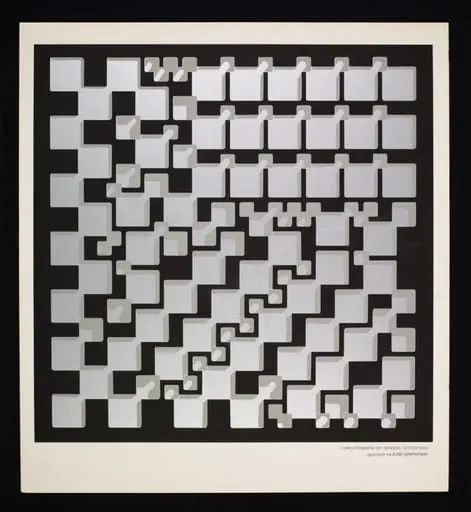
This is a 1986 print by Gerd W. Bieberich. It shows a chessboard with silver and golden pieces. The title hints at danger: the viewer may be the golden pawn about to be taken.
It’s an early 3D computer image made with ray tracing. Bieberich used a special math trick called VERA to make light and reflections look real.
Look up Gerd W. Bieberich.
Overview
The work stands as an early demonstration of photorealistic rendering through ray tracing, combining artistic intent with computational experimentation.
Views of a Pawn – Threat is a 1986 digital print by German artist Gerd W. Bieberich, produced during his studies at the University of Karlsruhe. It depicts a chessboard with silver and golden pieces, rendered using early 3D computer graphics. The composition invites the viewer to identify with the golden pawn, suggesting a precarious position on the board.
The work stands as an early demonstration of photorealistic rendering through ray tracing, combining artistic intent with computational experimentation.
Subject & Meaning
The image presents a chess scene where the silver castle reflects the viewer’s perspective, implying that the observer occupies the position of the golden pawn. This subtle shift in viewpoint transforms the static board into a narrative of vulnerability, the pawn, though small and expendable, becomes the locus of tension. The title underscores the existential risk inherent in the game’s logic, framing the digital image as both a visual puzzle and a metaphor for agency under threat.
Technique & Style
Bieberich employed the VERA ray tracing algorithm, developed at his university, to simulate light behavior with unusual precision for the time. The rendering captures reflections, gradients, and surface textures that mimic physical materials, departing from the flat, stylized graphics common in early computer art. Each pixel was computed over weeks due to the algorithm’s intensity, resulting in a highly detailed, almost tactile surface that blurs the line between digital construction and optical realism.
History & Provenance
Created in 1986 as part of an academic assignment under Professor A. Schmidt, the print emerged from a technical exploration rather than a commercial context. It was later exhibited and recognized in 1989 with the Baillie Gifford Prize from the Computer Art Society in London, marking one of the first formal acknowledgments of computer-generated imagery as a legitimate artistic medium. The work’s preservation as a physical print reflects its transitional role between digital novelty and institutional acceptance.
Context
In the mid-1980s, computer graphics were largely confined to scientific visualization or experimental animation. Bieberich’s work entered this space with a conceptual clarity rare for its time, using technical capability not for spectacle, but to explore perception and identity. The chess motif, universally understood, provided a familiar framework to communicate complex ideas about perspective and consequence, bridging technical audiences and the broader public.
Legacy
Views of a Pawn – Threat contributed to early discussions on the aesthetic potential of algorithmic rendering. Its success demonstrated that computational methods could convey narrative and emotional weight, influencing later artists working at the intersection of code and visual language. Though overshadowed by later developments, the piece remains a significant milestone in the history of digital art for its thoughtful integration of technique, metaphor, and viewer engagement.
Artist & collection
Artist
Gerd W. Bieberich’s 1986 print Views of a Pawn – Threat shows a single, stark figure at a table under a single light. The image belongs to the late-20th-century German figurative tradition, where everyday scenes are…