Artwork
Open air exhibition at Battersea Park of sculpture
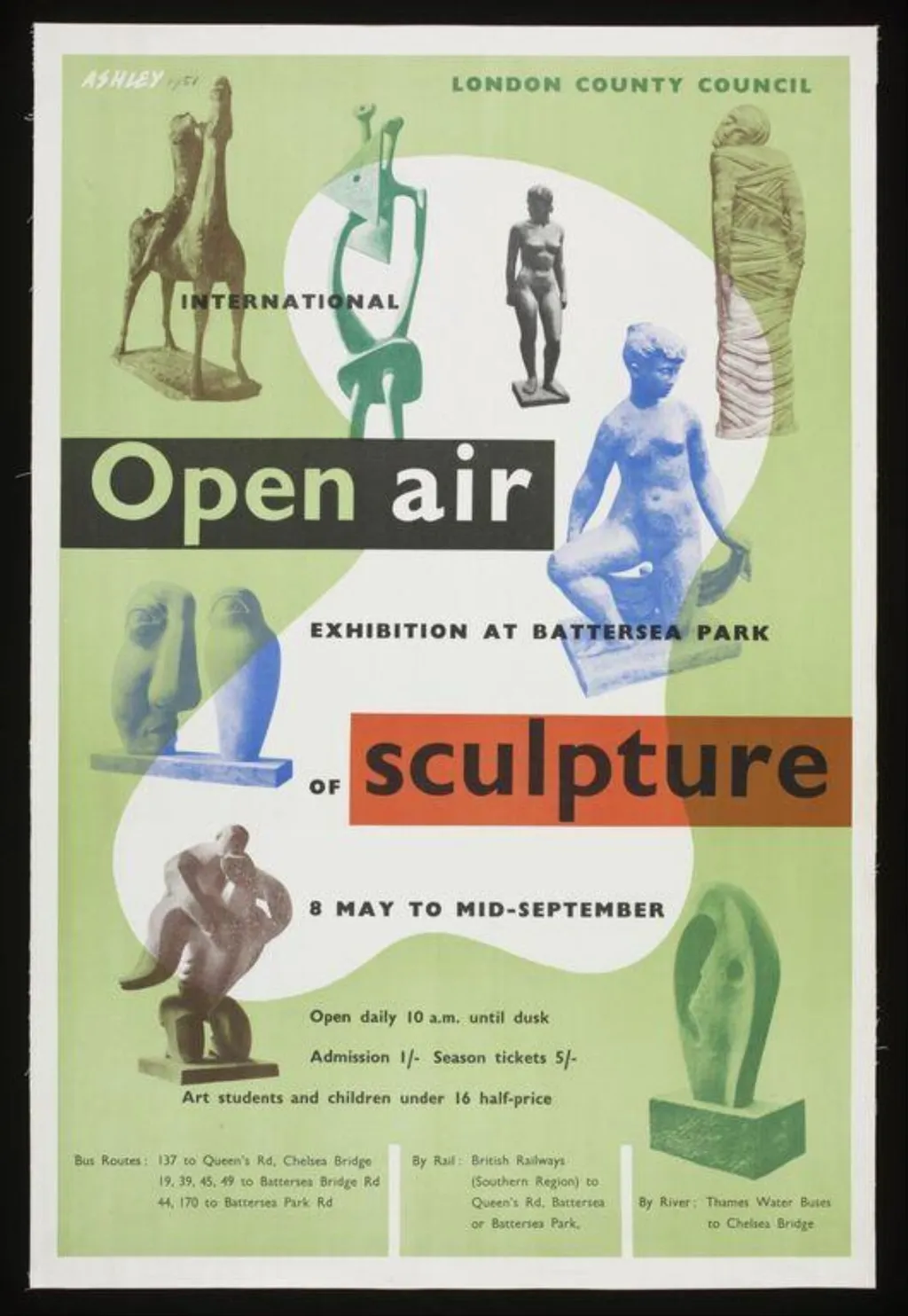
Open air exhibition at Battersea Park of sculpture is a poster by Ashley Havinden. It dates from 1951 and is held in the collection of the Victoria and Albert Museum. This 1951 poster was commissioned by the London County Council to publicize an open-air sculpture exhibition in Battersea Park.
About this work
" The poster advertises a free outdoor sculpture show at Battersea Park in London, running from May to September 1951.
This poster shows six simple sculptures arranged around the edges. A giraffe stands tall on the left, a wrapped figure sits on the right, and four others, two abstract shapes, a standing person, and a seated nude, fill the rest. The background is pale green with bold black and orange text reading "Open air exhibition of sculpture."
The poster advertises a free outdoor sculpture show at Battersea Park in London, running from May to September 1951. It includes bus, rail, and river routes for visitors.
Check out the Victoria and Albert Museum to see this poster in person.
Overview
This 1951 poster was commissioned by the London County Council to publicize an open-air sculpture exhibition in Battersea Park. Designed by Havinden and Ashley, it uses offset lithography to present a clean, graphic layout. The poster announces free public access to the show, which ran from May to September, and includes transportation details to encourage attendance from across London.
Subject & Meaning
Six simplified sculptures are arranged around the poster’s edges, representing the diversity of works on display. A giraffe, a seated nude, a wrapped figure, and abstract forms suggest a range of styles, from figurative to modernist. The composition implies an immersive, park-wide experience, inviting viewers to encounter art as part of the natural landscape rather than within institutional walls.
Technique & Style
The poster employs bold, flat colors and strong black outlines typical of mid-century graphic design. Pale green background contrasts with vibrant orange and black typography, ensuring legibility at a distance. The sculptures are rendered in minimal silhouette, prioritizing clarity over detail. This restrained aesthetic reflects the era’s emphasis on functional, accessible public communication.
History & Provenance
Created for the 1951 exhibition, the poster was part of a broader postwar effort to bring art into public spaces. It was produced in quantity for widespread distribution and is now held in the Victoria and Albert Museum’s collection. The inclusion of artists’ signatures and the year confirms its role as an official promotional document, not a commercial advertisement.
Context
The exhibition occurred during the Festival of Britain, a national celebration of recovery and innovation after World War II. Open-air displays like this one aimed to democratize culture, making sculpture accessible to all social classes. Public transport routes were emphasized to ensure broad reach, aligning with the festival’s ethos of civic engagement and renewal.
Legacy
The poster stands as a record of early postwar public art initiatives in Britain. Its design influenced later efforts to integrate art into urban environments. Though the exhibition itself was temporary, the poster endures as a document of how institutions sought to redefine the relationship between art, space, and the public in the modern city.
Artist & collection
Artist
This British designer made bold, graphic posters for outdoor art shows in the 1950s.