Artwork
Two Chinese Pigs
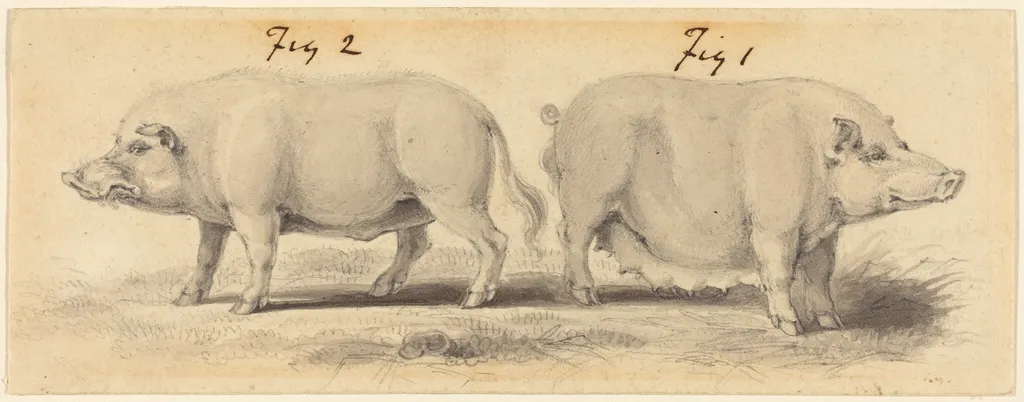
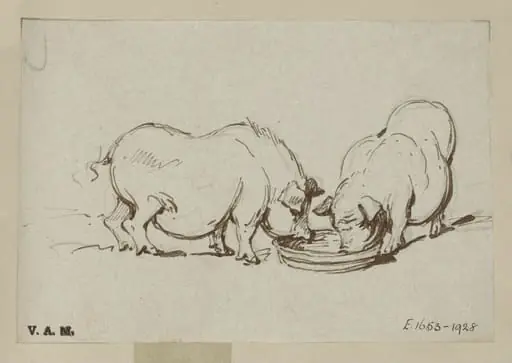
Two Chinese Pigs is a graphite drawing by the Romanticist artist Samuel Howitt. It dates from 1794 and is held in the collection of the National Gallery of Art.
- Inscription
- Inscribed:by later hand, upper left in pen and brown ink: Fig. 2; by later hand, upper right in pen and brown ink: Fig. 1; by later hand, center verso in graphite: Chinese Pigs
About this work
Overview
The piece reflects his ability to capture the specific physical characteristics of domesticated animals with both scientific observation and artistic economy.
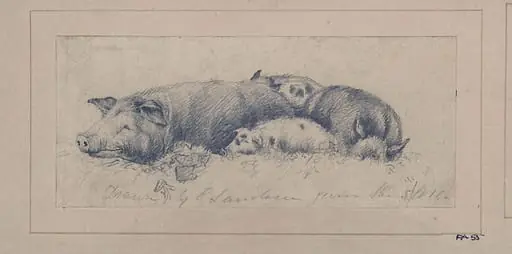
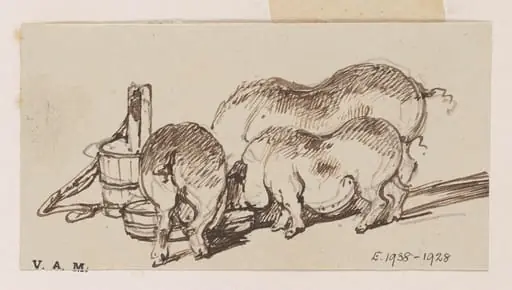
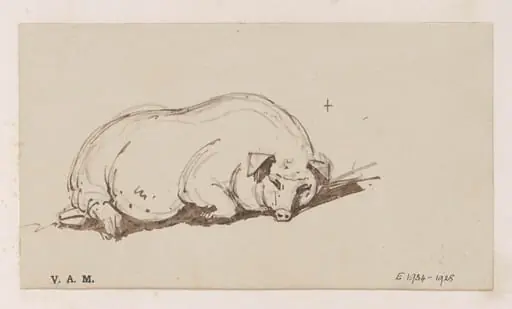
Created in 1794, Two Chinese Pigs is a study by the English artist Samuel Howitt, executed in gray wash over graphite on wove paper. The composition features a pair of plump pigs positioned nose-to-nose on a narrow strip of grass, framed by a simple fence and scattered foliage in the background. Howitt employs quick, loose lines to define the animals' forms, using sharp strokes to render the texture of their thick bristles and the play of light across their bodies.
This work exemplifies Howitt's specialization in animal illustration, a field in which he produced numerous studies of birds and beasts for natural history publications. The piece reflects his ability to capture the specific physical characteristics of domesticated animals with both scientific observation and artistic economy. As part of his broader output during the late eighteenth century, this drawing demonstrates the artist's contribution to the visual documentation of fauna, bridging the gap between scientific record and independent artistic study.
Subject & Meaning
The image depicts a pair of stout pigs positioned nose‑to‑nose on a grassy patch, their bristled coats highlighted by crisp strokes that catch the light. A low fence and a scattering of leaves suggest a simple rural setting, emphasizing the animals’ natural behavior and interaction.
Technique & Style
Howitt employs a rapid, gestural graphite sketch complemented by a muted gray wash, a method characteristic of his animal studies. The loose, energetic lines convey a sense of immediacy, while the wash adds tonal depth without obscuring the underlying drawing.
History & Provenance
Created as part of Howitt’s extensive output for natural‑history publications, the drawing reflects his role as a prolific illustrator of fauna in the late eighteenth century. It was likely produced as a study for inclusion in a printed work on domestic animals.
Context
During the 1790s, there was growing public interest in scientific illustration and the documentation of animal species. Howitt’s work contributed to this trend, providing detailed yet lively representations that served both educational and aesthetic purposes.
Artist & collection