Artwork
View of Venice
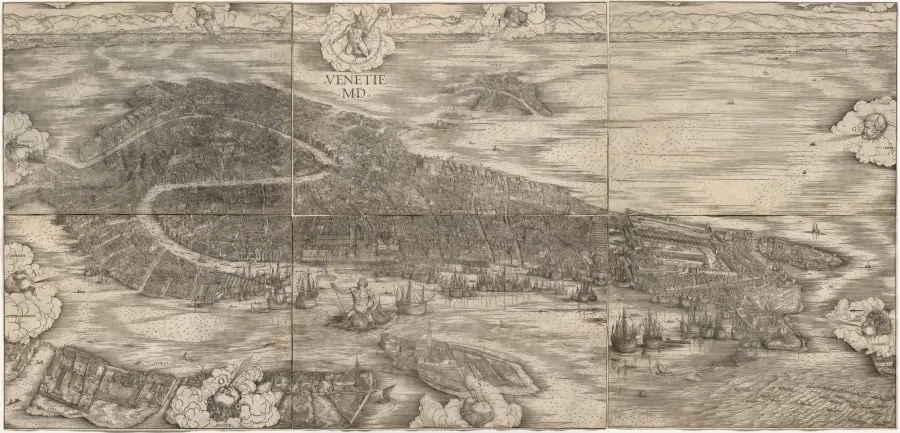
View of Venice is a print by the Renaissance artist Jacopo de' Barbari. It dates from 1500 and is held in the collection of the Cleveland Museum of Art. Created around the turn of the 16th century, this expansive woodcut presents a panoramic, bird’s‑eye representation of Venice.
- Accession no.
- 1949.565
- Credit line
- Purchase from the J. H. Wade Fund
About this work
Overview
Created around the turn of the 16th century, this expansive woodcut presents a panoramic, bird’s‑eye representation of Venice. Composed of six separate sheets that together cover an area comparable to a wall mural, the image was intended to convey the city’s layout, architecture, and bustling waterways in a single, unified view.
Subject & Meaning
The print depicts Venice from an elevated perspective, integrating numerous landmarks, canals, palaces, and tiny vessels, into a cohesive urban map. Central to the composition is Mercury, the Roman deity of commerce, who presides over the scene, underscoring the city’s role as a dominant maritime trading hub.
Technique & Style
Executed in woodcut, the work required carving six massive blocks, each printed by hand with brown ink. Unlike typical devotional or book‑illustration woodcuts of the period, this piece employs a complex, albeit inconsistent, system of perspective, merging multiple viewpoints gathered from various high points across the city.
History & Provenance
Only twelve impressions of the original edition are known to survive, three of which reside in American collections. The blocks were likely assembled on canvas or directly on walls, a practice that contributed to the rarity of extant copies.
Context
By the late 1400s Venice had become Europe’s leading center for printing, producing books in many languages for global distribution. In this environment, the woodcut evolved from modest devotional imagery to a medium capable of ambitious, large‑scale projects such as this urban map.
Artist & collection
Artist
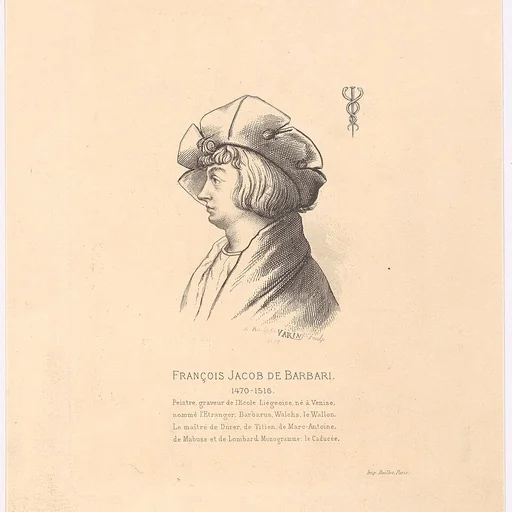
Jacopo de' Barbari, sometimes known or referred to as de'Barbari, de Barberi, de Barbari, Barbaro, Barberino, Barbarigo or Barberigo (c.

![View of Venice [lower right block], by Jacopo de' Barbari](https://artifactworldgallery.com/img/jacopo-de-barbari--view-of-venice-lower-right-block--371460ae957995b9-w320.webp)
![View of Venice [upper left block], by Jacopo de' Barbari](https://artifactworldgallery.com/img/jacopo-de-barbari--view-of-venice-upper-left-block--5b60543442b987bc-w320.webp) View of Venice [upper left block]
View of Venice [upper left block]![The Siege of Breda [plate 4 of 6], by Jacques Callot](https://artifactworldgallery.com/img/jacques-callot--the-siege-of-breda-plate-4-of-6--3e777c648194dcba-w320.webp) The Siege of Breda [plate 4 of 6]
The Siege of Breda [plate 4 of 6]![View of Venice [upper center block], by Jacopo de' Barbari](https://artifactworldgallery.com/img/jacopo-de-barbari--view-of-venice-upper-center-block--d86966306960219b-w320.webp) View of Venice [upper center block]
View of Venice [upper center block]![View of Venice [lower left block], by Jacopo de' Barbari](https://artifactworldgallery.com/img/jacopo-de-barbari--view-of-venice-lower-left-block--b7faa7641398e98e-w320.webp) View of Venice [lower left block]
View of Venice [lower left block]![View of Venice [lower center block], by Jacopo de' Barbari](https://artifactworldgallery.com/img/jacopo-de-barbari--view-of-venice-lower-center-block--909bde027368571e-w320.webp) View of Venice [lower center block]
View of Venice [lower center block]![The Siege of La Rochelle [plate 12 of 16; set comprises 1952.8.97-112], by Jacques Callot](https://artifactworldgallery.com/img/jacques-callot--the-siege-of-la-rochelle-plate-12-of-16-set-comprises-1952-8--11aa44a7ba7b84a3-w320.webp) The Siege of La Rochelle [plate 12 of 16; set comprises 1952.8.97-112]
The Siege of La Rochelle [plate 12 of 16; set comprises 1952.8.97-112]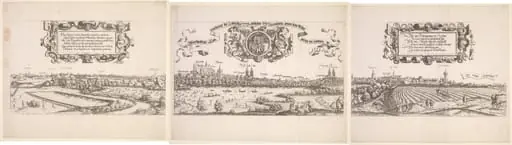 Panoramic View of Nuremberg
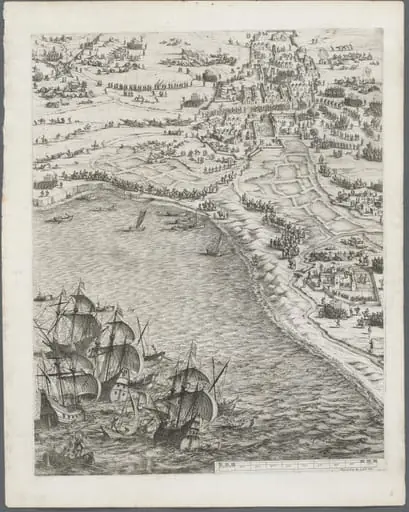 The Siege of La Rochelle: Plate 12
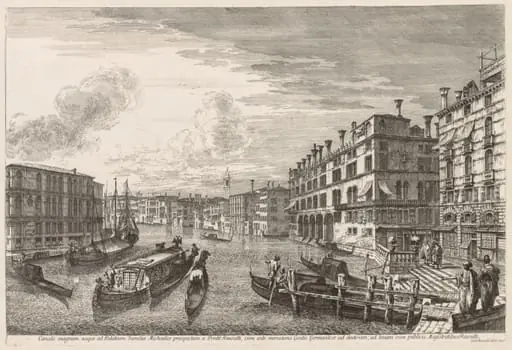 Views of Venice: Grand Canal
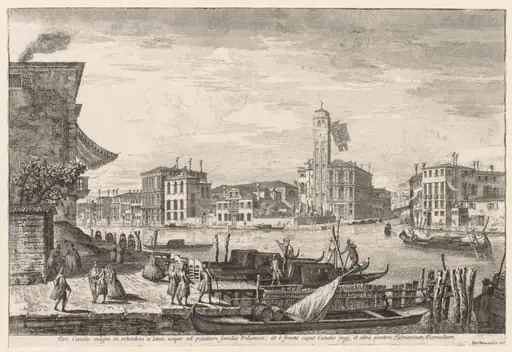 Views of Venice: Cannaregio
- Views of Venice: The Basin of St. Mark's