Artwork
Untitled
Untitled is an ink print by John Battan. It dates from 1968 and is held in the collection of the Museum of Modern Art.
About this work
The text feels like a mix of humor and wordplay, with no traditional art style here, just type and simple designs.
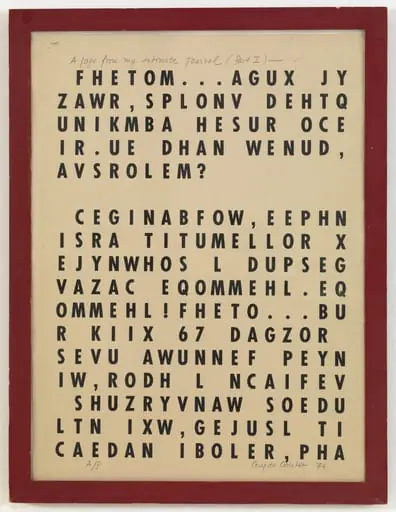
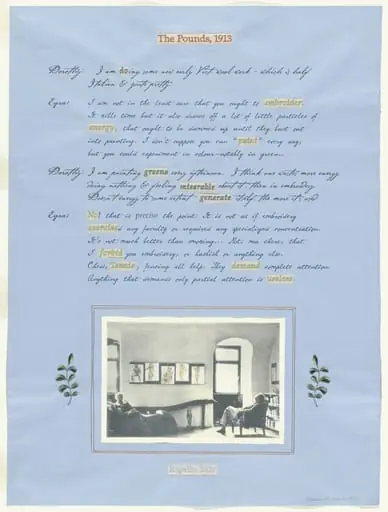
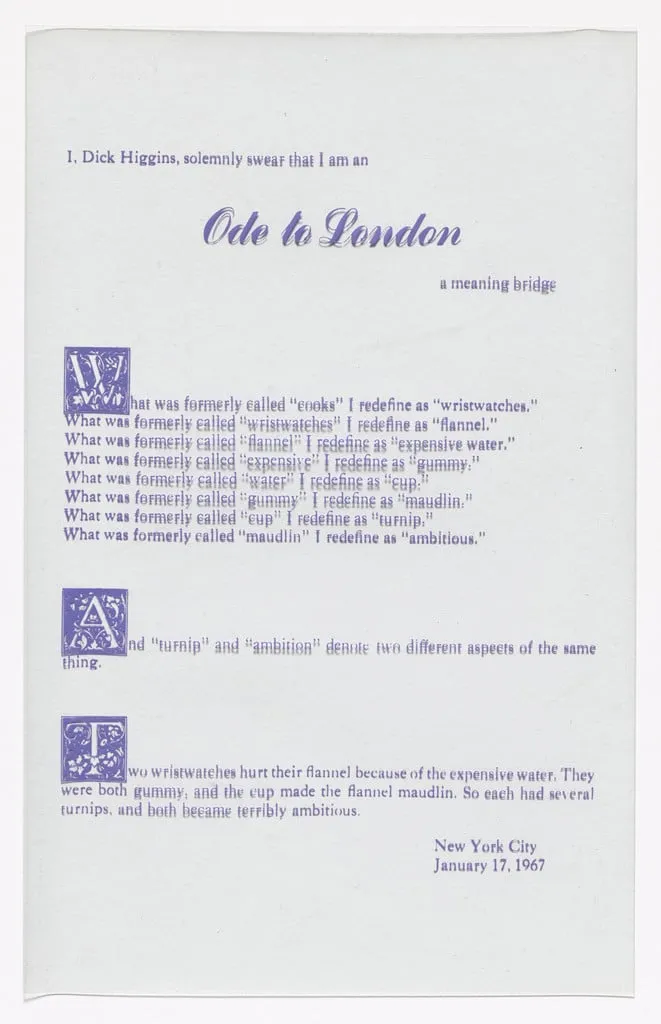
This image is a printed page with text and small purple decorative boxes. The title reads "Ode to London" with the subtitle "a meaning bridge." Below it, a list redefines everyday words, like calling "cooks" "wristwatches" and "water" "cup."
There’s also a short story about two characters and their struggles, dated "New York City / January 17, 1967."
The words are arranged in a playful, almost game-like way. The text feels like a mix of humor and wordplay, with no traditional art style here, just type and simple designs.
If you like this kind of creative wordplay, look up lithography.
Overview
Created in 1968, this offset lithograph by John Battan is part of The Museum of Modern Art’s collection. It presents a printed page composed entirely of text and minimal graphic elements, small purple rectangular shapes and typographic arrangements. No illustrative imagery is present; the work derives its form from language and layout, functioning as a visual poem rather than a conventional print.
Subject & Meaning
The piece, titled 'Ode to London' with the subtitle 'a meaning bridge,' redefines common words through absurd substitutions, 'cooks' become 'wristwatches,' 'water' becomes 'cup.' A brief narrative follows, set in New York City in January 1967, detailing the quiet struggles of two unnamed figures. The work interrogates language’s instability, using humor and dislocation to challenge fixed meanings and the assumptions embedded in everyday speech.
Technique & Style
Executed in offset lithography, the print relies on typographic precision and restrained graphic intervention. The text is arranged with deliberate irregularity, mimicking the rhythm of thought rather than conventional formatting. Purple boxes serve as visual pauses or markers, offering structure without ornamentation. The style rejects traditional artistic representation, prioritizing conceptual play over aesthetic polish.
History & Provenance
Produced in 1968, the work entered The Museum of Modern Art’s collection shortly after its creation. It reflects Battan’s engagement with experimental publishing and conceptual writing of the late 1960s, a period when artists increasingly used print media to explore language as a medium. Its preservation in a major institution underscores its significance within the broader movement of artist-made publications.
Context
This work emerged during a time when artists and writers were dismantling boundaries between literature and visual art. Influenced by Dada, concrete poetry, and Fluxus, Battan’s piece aligns with contemporaneous efforts to destabilize meaning through linguistic disruption. It shares affinities with the work of artists like Robert Watts and Ian Hamilton Finlay, who treated text as both image and idea.
Legacy
Though not widely known outside niche circles, the piece contributes to a lineage of typographic art that privileges semantic play over visual spectacle. Its inclusion in MoMA’s collection affirms its role in expanding the definition of printmaking to include linguistic experimentation. It remains a quiet but persistent example of how language can be reshaped into visual experience.
Artist & collection