Artwork
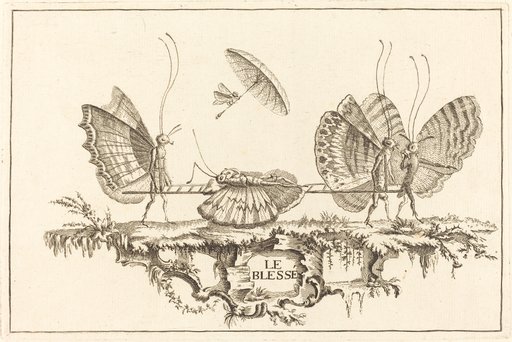
Le Blessé (The Wounded)
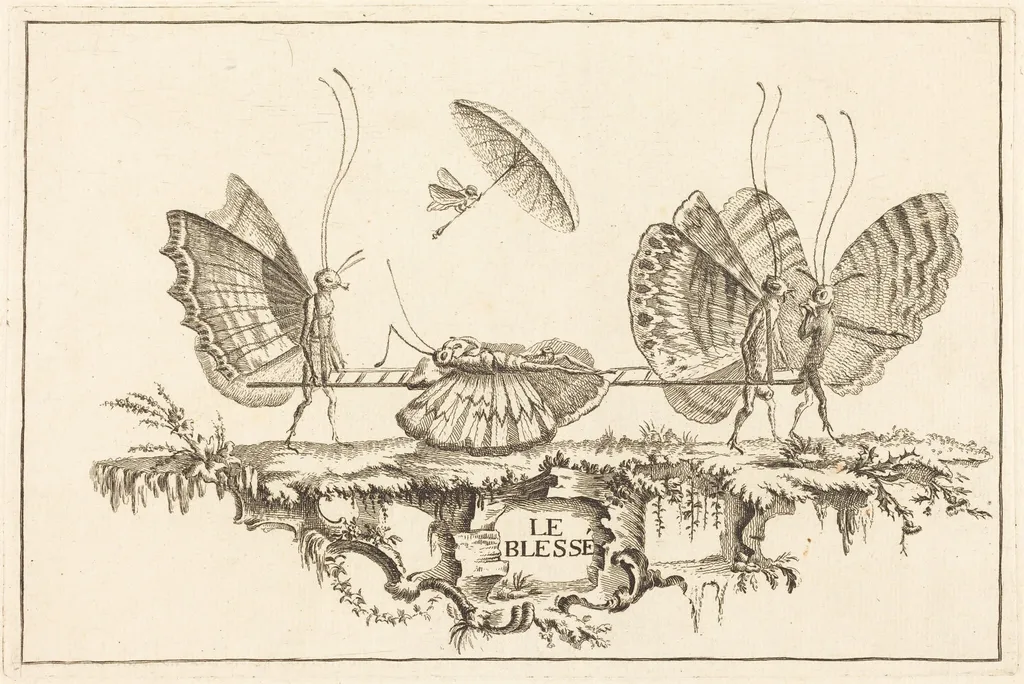
Le Blessé (The Wounded) is an ink print by the Baroque artist Henri M. Petiet. It dates from 1748 and is held in the collection of the National Gallery of Art.
- Inscription
- Inscribed:recto: in plate, in image, at lower center: LE / BLESSÉ; verso: at center in brown ink in 18th-century hand: No 95 [?]
- Markings
- Marked:recto: none; verso: National Gallery of Art
About this work
Overview
The composition centers on a slender branch bearing three butterflies, each in a distinct posture, with a handwritten inscription beneath.
Le Blessé (The Wounded) is an etching by Henri M. Petiet, dated around 1748. Executed on laid paper, it presents a delicate natural scene rendered in fine black lines. The composition centers on a slender branch bearing three butterflies, each in a distinct posture, with a handwritten inscription beneath. The work exemplifies 18th-century printmaking’s precision and its engagement with subtle, symbolic naturalism.
Subject & Meaning
The image depicts three butterflies on a branch: one at rest, one in motion, and one with visibly damaged wings. The inscription 'Le Blessé' directly references the injured insect, transforming a moment in nature into a quiet metaphor. The contrast between vitality and impairment invites contemplation of fragility, without overt narrative or moralizing. The title anchors the viewer’s attention on vulnerability within the natural order.
Technique & Style
Petiet employed fine, controlled etching lines to render the butterflies’ wing patterns, the branch’s texture, and the sparse foliage. The inked lines are crisp and deliberate, capturing the translucence of wings and the sinuous curve of vines. The absence of tone or shading emphasizes linear clarity, characteristic of detailed botanical and entomological illustrations of the period. The scroll beneath adds a textual layer, reinforcing the image’s thematic intent.
History & Provenance
The etching was produced in mid-18th-century France, likely as part of a series of natural studies or decorative prints. Petiet’s work was not widely circulated, and few impressions of Le Blessé are documented. Its survival suggests it may have been collected by amateur naturalists or connoisseurs of scientific illustration. No known institutional records trace its early ownership with certainty.
Context
In the 1740s, European artists and scientists increasingly turned to close observation of nature, driven by Enlightenment curiosity. Etchings like Petiet’s served both aesthetic and educational purposes, bridging art and natural history. While not part of a major published work, Le Blessé reflects the era’s fascination with minute detail and the poetic potential of small, overlooked creatures.
Legacy
Le Blessé remains a modest but evocative example of 18th-century printmaking’s capacity for quiet symbolism. Though Petiet is not widely remembered, this work endures as a testament to the period’s sensitivity to natural forms and the expressive potential of fine line. It contributes to a broader tradition of nature studies that valued precision over grandeur.
Own this work as a print
Artist & collection