Artwork
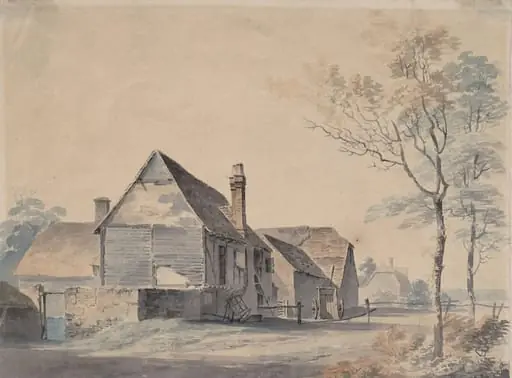
Ruins of a Tavern, Petersburg, Virginia
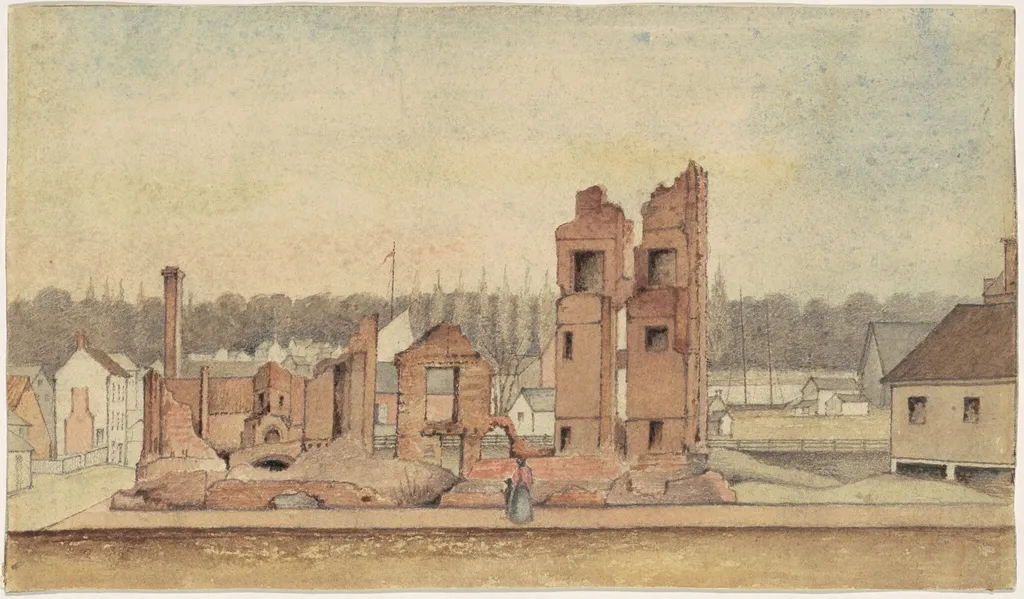
Ruins of a Tavern, Petersburg, Virginia is a graphite drawing by the Romanticist artist Simpson, William Skinner, Jr.. It dates from 1845 and is held in the collection of the National Gallery of Art.
- Inscription
- Inscribed:verso in graphite: The ruins of a tavern which [crossed out] which / once stood at the corner of Bollingbrook + 3rd streets / the site now + for many years past occupied / by a block of 3 story private [crossed out] brick residences. / The building was destroyed by fire in the year / --- On the right is seen this [crossed out] a portion of / the framed Carpenter Shop of Drinkard / + Mc Car[?] - and above + beyond that can / be seen a small bit of the Old / Petersburg Theatre, the interior of / which was considered in its day a model / to be one of, if not the best arranged as its [crossed out] its / stage + auditorium appearance of any / other in the Country. The elder Booth, if he did / not make his debut here played one of his / first engagements in this house [crossed out], if not as / elaborate in ornamental architecture, of any / similar building in the Country. This was also / burnt early in the first half [crossed out] present Century.
About this work
Overview
Ruins of a Tavern, Petersburg, Virginia is a watercolor drawing executed over graphite on wove paper by William Skinner Simpson, Jr., circa 1845. The work depicts a serene, abandoned scene of a crumbling tavern in Petersburg, Virginia.
Subject & Meaning
The subject is a dilapidated brick tavern, partially roofless, with vines encroaching on its walls, set amidst sparse, bare trees. The absence of human figures emphasizes the passage of time and natural decay, evoking a contemplative atmosphere.
Technique & Style
Simpson employed watercolor over graphite, utilizing thin, translucent glazing layers to achieve a soft, realistic light effect. The overall style conveys a sense of quiet realism, characteristic of Romantic-era depictions of solitude and nature's reclamation.
History & Provenance
Created around 1845, the drawing's provenance and exhibition history are not detailed here, focusing instead on its creation context within the mid-19th century American artistic landscape.
Context
The work aligns with Romanticism's emphasis on emotion, solitude, and the sublime in nature. Its focus on decay and the interplay of nature and human abandonment reflects common Romantic themes of transience and the power of the natural world.
Artist & collection