Artwork
A Donkey House in Tunis
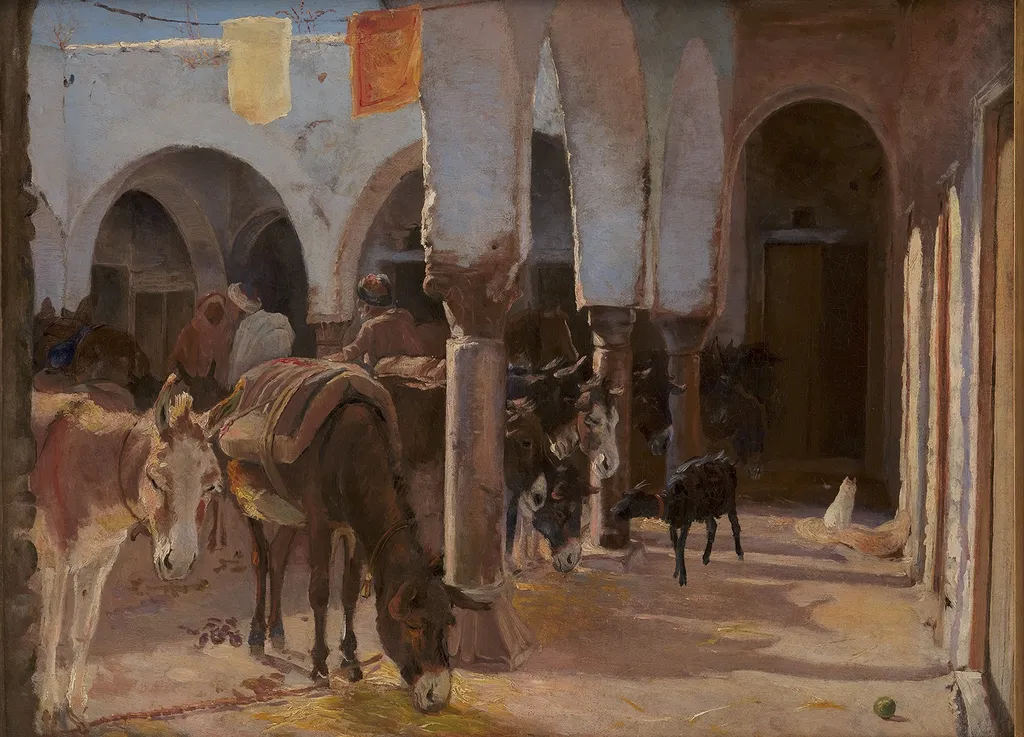
A Donkey House in Tunis is an unspecified painting by the Impressionist artist Theodor Philipsen. It dates from 1892 and is held in the collection of the Statens Museum for Kunst.
About this work
Subject & Meaning
The inclusion of specific North African fauna and structural motifs reflects the artist's engagement with the local environment of Tunis during his travels.
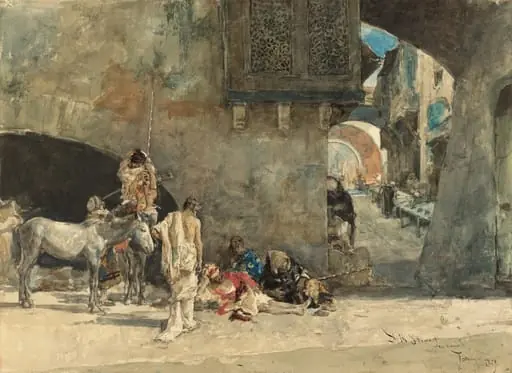
The painting depicts a scene in Tunis featuring a donkey and a goat situated within or near an arcade. These architectural and animal elements form the primary visual subject of the work. The inclusion of specific North African fauna and structural motifs reflects the artist's engagement with the local environment of Tunis during his travels.
The composition focuses on the everyday presence of these animals within the urban or semi-urban landscape, capturing a moment of daily life rather than a mythological or allegorical narrative.
Technique & Style
A Donkey House in Tunis is classified as a painting, executed on a support measuring 40 by 53 (height by width). The work is held by the Statens Museum for Kunst. Beyond the classification and dimensions, the available sources do not document the specific medium, technique, handling, condition, or stylistic qualities of the work.
History & Provenance
A Donkey House in Tunis was painted by Theodor Philipsen in 1882, as recorded in both the artist’s dated oeuvre and the work’s Wikidata entry.
The canvas entered the collection of Statens Museum for Kunst, Copenhagen, where it remains held. No intervening ownership chain or commission records are documented in the provided sources.
A Donkey House in Tunis is held in the collection of the Statens Museum for Kunst. The work was created in 1882 by Theodor Philipsen and depicts a scene featuring a donkey, an arcade, and a goat in Tunis.
The painting has been included in the exhibition "1880-erne i nordisk maleri" (The 1880s in Nordic Painting).
Context
Theodor Philipsen's 1882 painting A Donkey House in Tunis, depicting a donkey, arcade, and goat, is housed in the Statens Museum for Kunst collection. It was exhibited in 1880s Nordic art exhibitions and reflects Orientalist themes through its Tunisian subject rendered by a Danish artist. Philipsen's work occupies a transitional space between Danish academic traditions and emerging European modernism, situating his painting within broader 19th-century European artistic engagements with North African subjects.
Overview
In 1892 the Danish artist Theodor Philipsen painted a scene titled A Donkey House in Tunis. The work captures a sun‑dappled courtyard in North Africa, where an arched arcade frames a donkey laden with bags, a goat grazing nearby, and a few figures seated in the shade. The composition balances light and shadow across the weathered stone walls.
Artist & collection
Artist
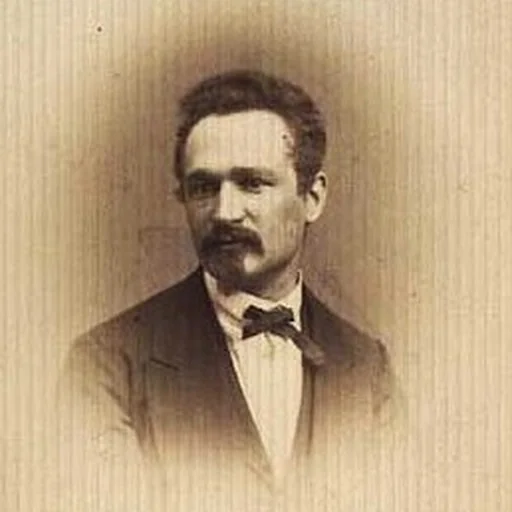
Theodor Esbern Philipsen (10 June 1840 – 3 March 1920) was a Danish painter of Jewish ancestry, known for landscapes and animal portraits. He also did small figures in wax and clay.