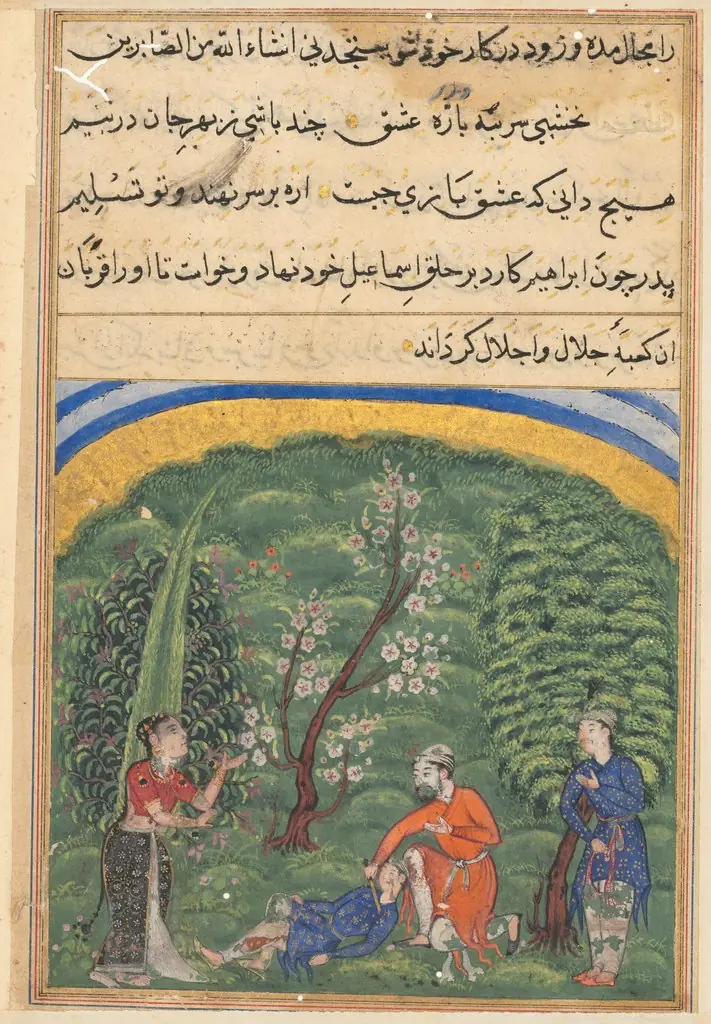
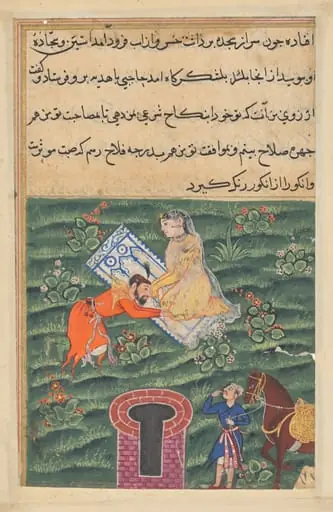
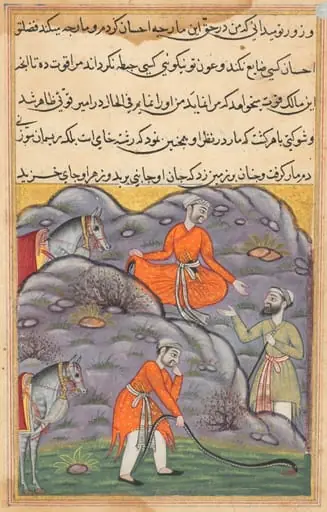
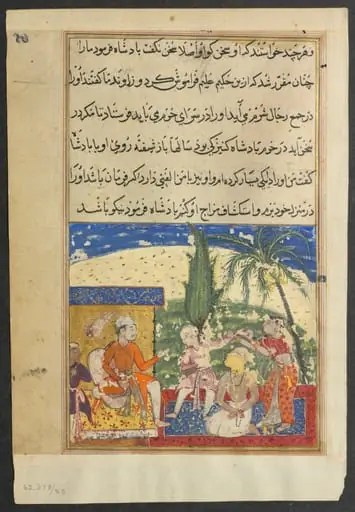
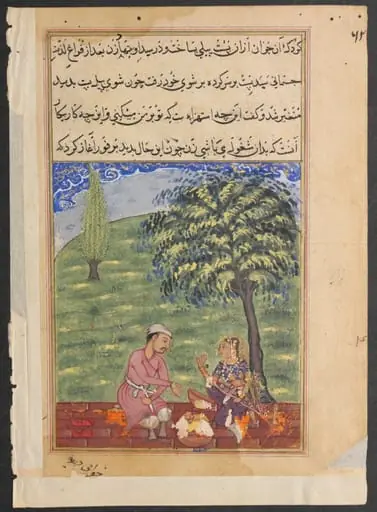
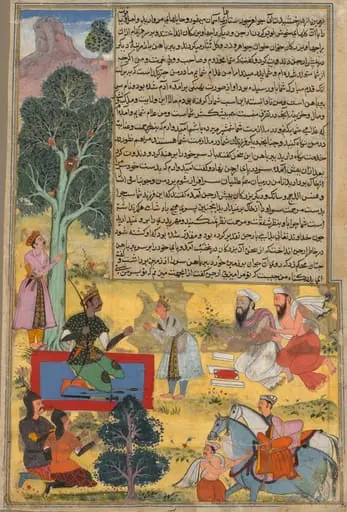
The sentinel in the employ of the Shah of Tabaristan prepares to sacrifice his son to the ghost of the Shah’s soul, from a Tuti-nama (Tales of a Parrot): Second Night
1560
unspecified
From the collection of Cleveland Museum of Art
1560
unspecified
From the collection of Cleveland Museum of Art
The sentinel in the employ of the Shah of Tabaristan prepares to sacrifice his son to the ghost of the Shah’s soul, from a Tuti-nama (Tales of a Parrot): Second Night is a 1560 unspecified by Unknown, a Mughal Painting work, held at Cleveland Museum of Art.
A man in orange presses a knife to his son’s neck while a ghostly figure floats above, arms outstretched. A king watches from behind a tree, his face half-hidden. The scene is crowded with bright colors and tiny details—flowers, birds, and patterned robes. This painting comes from a book of parrot tales made for Emperor Akbar’s court. The story is dark: a guard must kill his son to save his ruler, but the ruler’s spirit stops the sacrifice at the last moment. The artist packed the scene with life, even in a moment of horror. Look up more paintings from Mughal India, court of Akbar (reigned 1556–1605) to see how artists told stories like this.
The loyal sentinel, in orange, holds a knife to his son’s throat, ready to sacrifice him to save the life of his dying king, the shah. The shah himself watches from behind the tree on the right. At the left, the female personification of the shah’s soul intervenes, saving both the shah and the sentinel’s son.
The near sacrifice of the sentinel’s son parallels the Qur'an’s story of Abraham and Ishmael.
Read the full account in the museum source.
Your cart is empty
Explore artworks →