Artwork
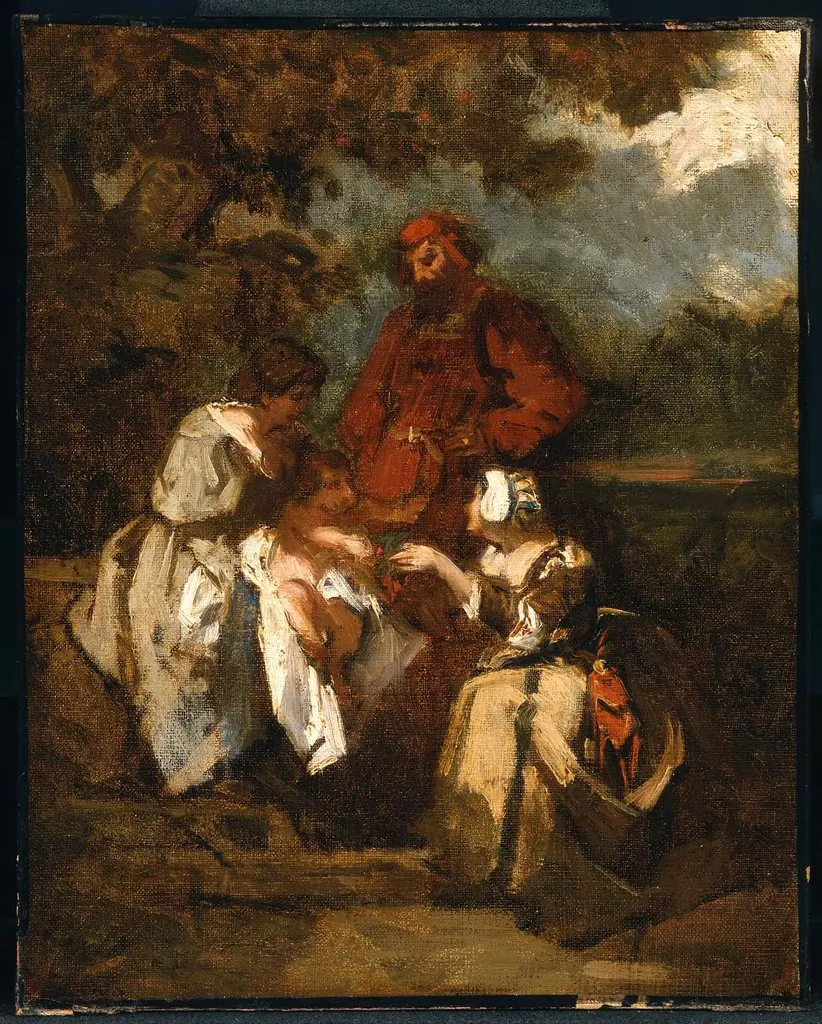
The Holy Family with Saint Elizabeth and Saint John the Baptist

The Holy Family with Saint Elizabeth and Saint John the Baptist is an oil painting by the British Romanticist artist David Wilkie. It dates from 1841 and is held in the collection of the National Gallery of Art.
- Inscription
- Inscribed:lower right: David Wilkie ft. / 1841.
About this work
Technique & Style
Executed in 1841, the work is an oil painting on canvas mounted on a wood support, measuring 25.
Executed in 1841, the work is an oil painting on canvas mounted on a wood support, measuring 25.7 × 19 cm. Wilkie’s handling combines smooth, blended modeling of flesh and drapery with crisply observed detail in faces and hands, using a restrained, luminous palette of ivory, umber, and muted crimson. The composition is tightly framed, with the Holy Family and attendant saints arranged in a shallow, stage-like space that emphasizes intimate gesture and quiet interaction. Subtle glazing enhances the soft transitions of light across the figures, while a velvety impasto defines highlights on drapery folds and the Christ Child’s skin.
History & Provenance
The painting was created in 1841 by Sir David Wilkie. Its early provenance is documented with Frank Bulkeley Smith (1864–1918) of Worcester, Massachusetts, who owned the work until his death. Smith’s estate sold it at the American Art Association in New York on 22–23 April 1920 (second day, lot no. 80), where it was mistakenly catalogued as Camping Gypsies.
William R. Timken (1866–1949) of New York acquired it; after his death it passed to his widow, Lillian Guyer Timken (1881–1959). She bequeathed the painting to the National Gallery of Art in 1960.
The painting is held by the National Gallery of Art in Washington, D.C., where it is accessioned as part of the museum’s collection (bequest of Lillian G. Timken, 1960). Its provenance traces from Frank Bulkeley Smith (d. 1918) through sale at the American Art Association in 1920 to William R. Timken, then to his widow Lillian Guyer Timken, and finally to the National Gallery of Art. No exhibition records are cited in the available sources, indicating that the work has not been listed in major exhibition catalogues up to the present.
Overview
Sir David Wilkie's painting, The Holy Family with Saint Elizabeth and Saint John the Baptist, dates from 1841. This oil on canvas, mounted on wood, presents a traditional religious scene. The composition brings together key figures from Christian narratives, illustrating a moment of familial connection and spiritual significance.
Subject & Meaning
The artwork portrays the Holy Family, consisting of the Virgin Mary, Saint Joseph, and the infant Jesus. They are joined by Saint Elizabeth, Mary's cousin, and her son, the young Saint John the Baptist. This gathering emphasizes the close relationship between the two families, a common theme in Christian art that foreshadows John's later role in preparing the way for Christ.
Context
Created in 1841, this painting emerged during a period when artists were re-evaluating and reinterpreting established religious subjects. Rather than merely replicating past formulas, painters sought innovative methods to infuse traditional scenes with fresh perspectives. Wilkie's work exemplifies this broader artistic movement, demonstrating an engagement with both historical themes and evolving aesthetic sensibilities.

Own this work as a print
Artist & collection

Artist
Sir David Wilkie (18 November 1785 – 1 June 1841) was a Scottish painter, especially known for his genre scenes.