Artwork
Untitled
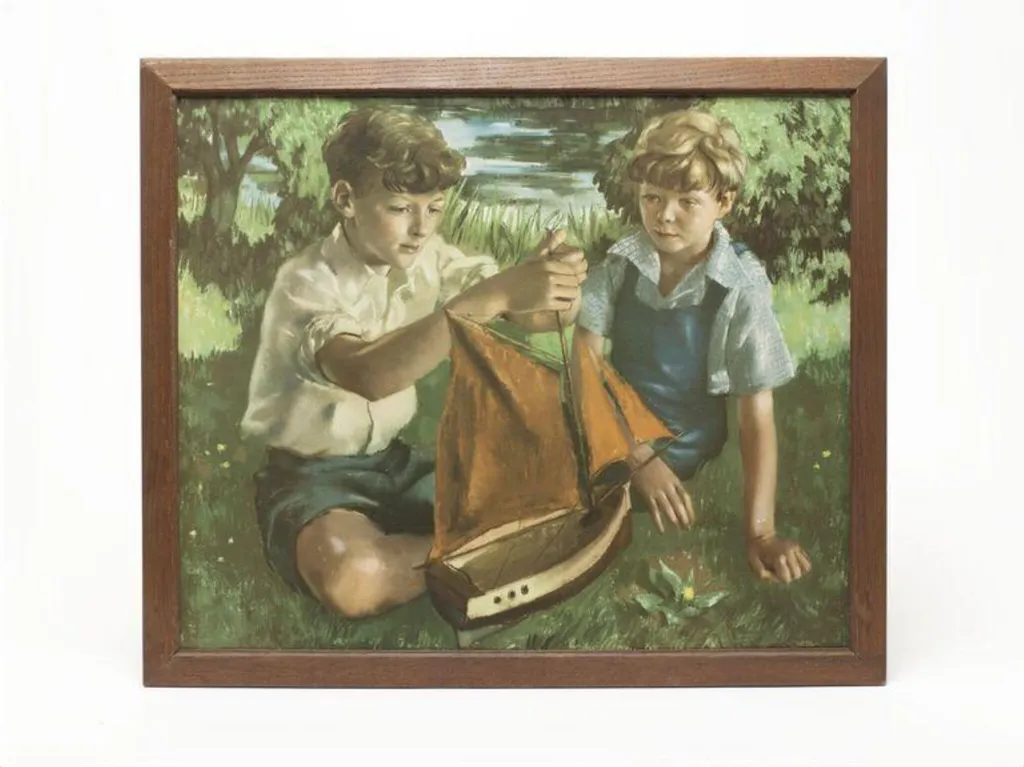
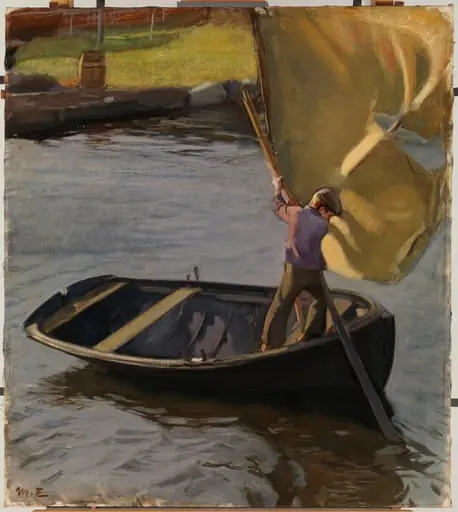
Untitled is a print by William Dring. It dates from 1945 and is held in the collection of the Victoria and Albert Museum.
About this work
Overview
Executed as a reproductive print from an earlier drawing, it reflects the artist’s interest in intimate, everyday scenes.
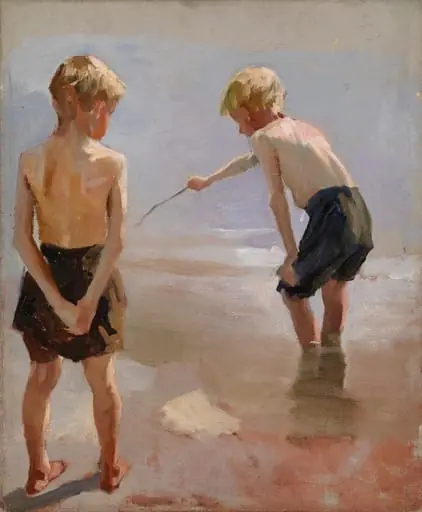
Created in 1945, this print by William Dring captures a quiet moment between two boys beside a rural stream. Executed as a reproductive print from an earlier drawing, it reflects the artist’s interest in intimate, everyday scenes. The composition centers on the boys’ interaction with a small wooden boat, rendered with careful attention to posture and clothing details that suggest a specific, documented subject.
Subject & Meaning
The figures are identified as David and Peter Cobb, sons of a client who commissioned the original drawing. Their engagement with the toy boat, one adjusting its line, the other observing closely, conveys a sense of shared focus and childhood curiosity. The scene avoids narrative drama, instead emphasizing quiet companionship and the subtle rituals of play in a natural setting.
Technique & Style
Dring employed fine linear detail and subtle tonal gradations to render texture and form. Light falls softly across the boys’ skin and the grass, suggesting natural daylight without dramatic contrast. The clothing is rendered with precise patterning, stripes and dashes, while the wooden boat’s surface is suggested through restrained shading, enhancing its tactile presence without overt realism.
History & Provenance
The print derives from a preparatory drawing made in 1945, later confirmed by the artist’s daughter as a commissioned portrait of the Cobb brothers. It was not intended as a standalone work but as a reproduction of a private commission, reflecting Dring’s practice of translating observational drawings into printed form for broader circulation.
Context
Produced in post-war Britain, the image resonates with a cultural longing for tranquility and continuity. Rural childhood scenes like this one offered a counterpoint to recent upheaval, valuing stillness and domestic intimacy. Dring’s focus on ordinary moments aligned with broader artistic trends that sought dignity in unremarkable life.
Legacy
Though not widely exhibited during Dring’s lifetime, the print remains a documented example of his observational approach to portraiture. Its significance lies in its quiet authenticity and the rare confirmation of its subjects, offering insight into how private commissions informed public-facing print work in mid-20th-century British art.
Artist & collection