Movement
Ethiopian Iconography
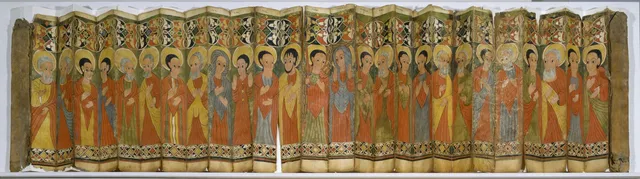
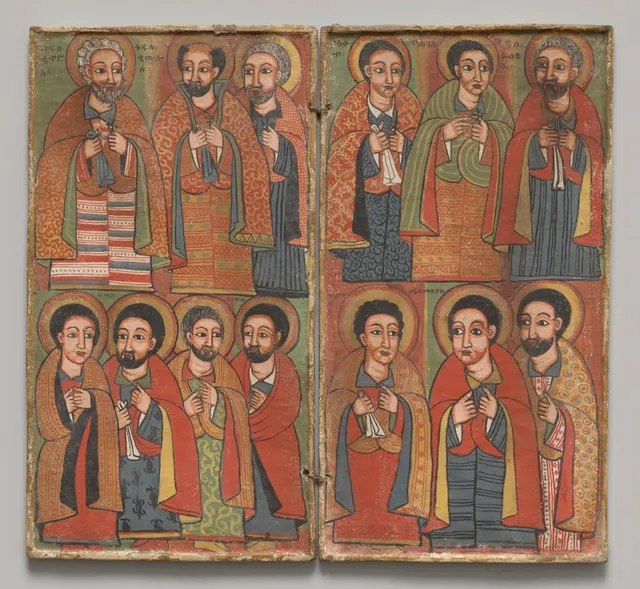
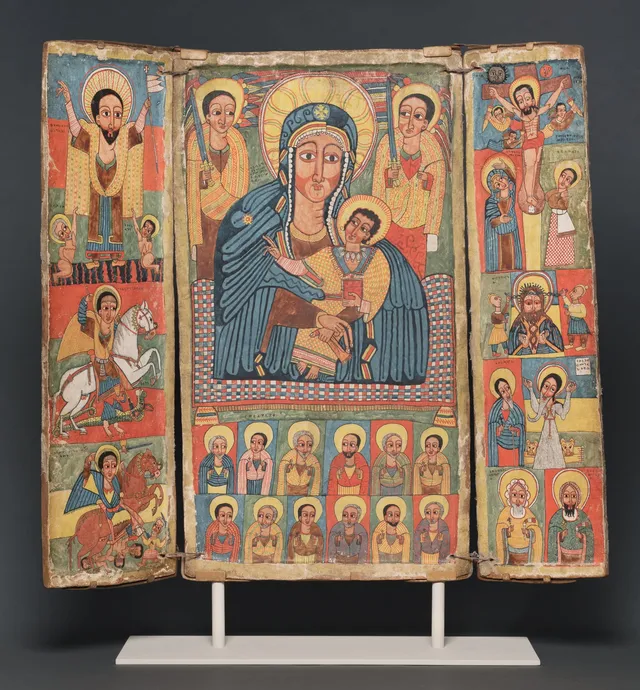
Ethiopian Iconography is an art movement. The gallery holds 3 works in this movement, including works by Workshop or Circle of Wäldä Maryam. Browse Ethiopian Iconography paintings, portraits, pictures and artworks from the world's public-domain museum collections.
Ethiopian iconography is the Christian sacred-painting tradition of the Ethiopian Orthodox Tewahedo Church, one of the oldest continuous Christian art traditions in the world. Its roots reach back to the Christianization of the Aksumite kingdom in the fourth century, but it crystallized into a distinctive visual language during the medieval Solomonic era. Painting served devotion at every scale: illuminated Geʿez gospel manuscripts on vellum, panel icons carried in the hand or in procession, and the painted walls of rock-hewn and built churches. Because much of the faithful could not read, images were a primary vehicle of scripture and miracle, prizing legible spiritual narrative over naturalistic illusion.
The style is instantly recognizable. Figures face the viewer frontally with large, wide almond eyes and arched brows, set against flat fields of bold, unmodeled color—red, yellow, blue, and a vivid green—drawn in firm dark outline. Ethiopian painters rarely used gold grounds or background text, and saints wear painted rather than gilded halos. Profile views were reserved for the wicked, so that Judas or the soldiers at the Crucifixion are shown sideways while the holy gaze straight out. Favored subjects include the Virgin and Child flanked by the archangels Michael and Gabriel, Saint George (patron of Ethiopia) spearing the dragon, the Flight into Egypt, and indigenous holy men such as the thirteenth-century monk Täklä Haymanot.
The first named master is Fre Seyon, who worked between roughly 1445 and 1480 at the court of Emperor Zärʾa Yaʿqob and signed a large panel at the island monastery of Daga Ǝsṭifanos; his Marian icons set the standard for later devotion. A second flowering came after Emperor Fasilädäs founded Gondär in the 1630s. Scholars divide the resulting Gondärine school into a First style (from the 1650s, bright and unshaded) and a Second style (mid-eighteenth century, with softer modeling, darker flesh tones, and broad horizontal bands of color), the latter inflected by European Baroque and Renaissance prints introduced by Jesuit missionaries. The painter Wäldä Maryam, active from the late 1600s into the early 1700s, is among the period's identifiable hands; works from his workshop or circle—such as the Diptych with Twelve Apostles and Saint Paul held in this collection alongside a folding processional fan icon and a Triptych Icon—exemplify Gondärine craft.
Though it absorbed Byzantine, Coptic, and later European elements, Ethiopian iconography remained resolutely its own, and it continues to shape Orthodox devotional painting in Ethiopia today.
Key artists
Works
Frequently asked questions
What is Ethiopian Iconography?
Ethiopian Iconography is an art movement. The distinctive Christian painting tradition of Ethiopia, with bold color, wide-eyed frontal figures, and rich symbolism.
Who are the key Ethiopian Iconography artists?
Key Ethiopian Iconography artists in the collection include Workshop or Circle of Wäldä Maryam.
Where can I see Ethiopian Iconography works?
Ethiopian Iconography works in the collection are held by Cleveland Museum of Art, Art Institute of Chicago and Walters Art Museum.