Movement
Fayum mummy portraits
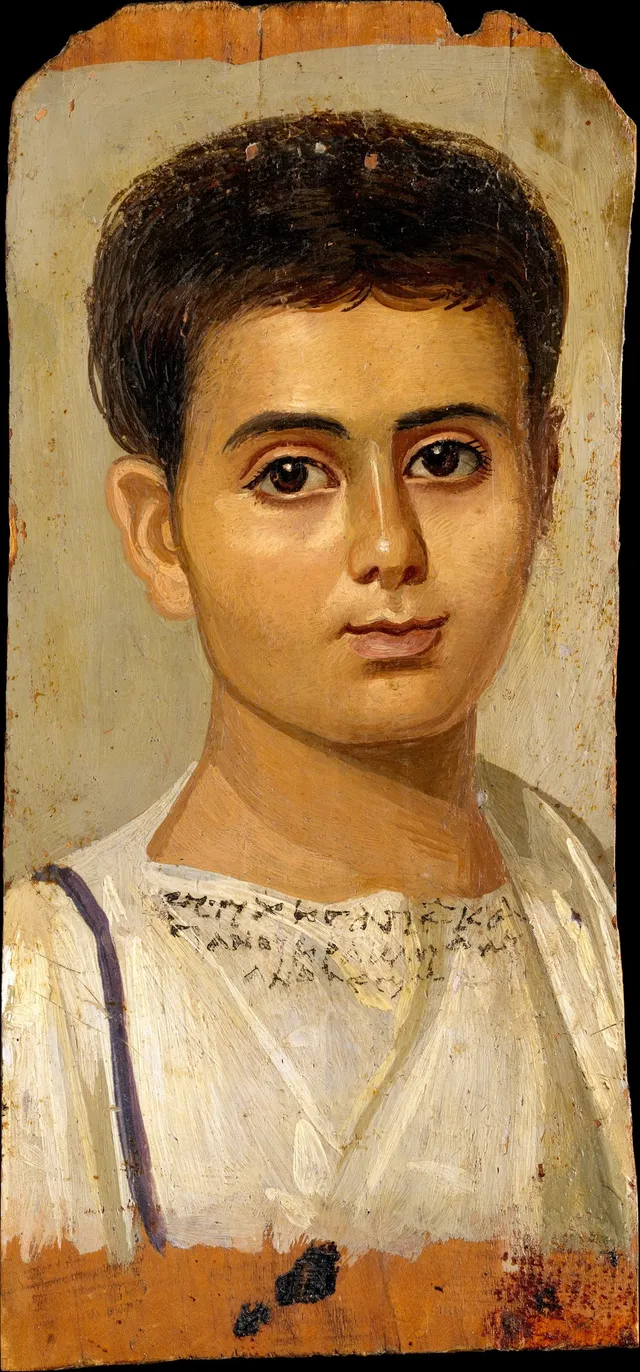
Fayum mummy portraits is an art movement. The gallery holds 1 work in this movement. Browse Fayum mummy portraits paintings, portraits, pictures and artworks from the world's public-domain museum collections.
Fayum mummy portraits are naturalistic painted likenesses fixed over the faces of mummies in Roman-era Egypt, produced from roughly the late 1st century BC or early 1st century AD until about the middle of the 3rd century. They take their name from the Faiyum Basin southwest of Cairo—especially the sites of Hawara and the Hadrianic city of Antinoopolis—where most surviving examples were found, though related panels turn up across Egypt. The tradition arose from a distinctive cultural fusion: a Greek-speaking, Romanized provincial elite descended from Ptolemaic settlers adopted Egyptian mummification while commissioning portraits in the Greco-Roman idiom, so that the dead might be both eternally preserved and individually recognized.
The portraits belong to the classical tradition of panel painting—one of antiquity's most esteemed art forms, and the only large body of it to survive. They were executed on thin boards of imported limewood or native sycamore, in one of two techniques: encaustic, in which pigments are bound in hot or cold beeswax and worked into thick, luminous strokes, or the cheaper tempera, using egg as a binder. Encaustic examples are generally finer. The results are arrestingly direct: frontal or three-quarter faces with large, glistening eyes, modelled flesh, individualized features, and contemporary Roman hairstyles and jewelry that help date them. Some panels, like the British Museum's mummy of Artemidorus, are heightened with gold leaf.
The painters are anonymous, working in regional workshops rather than as named masters. Canonical surviving works include the Portrait of the Boy Eutyches (about 100–150 AD, encaustic on wood, Metropolitan Museum of Art), inscribed for "Eutyches, freedman of Kasanios," and numerous panels recovered by the British archaeologist Flinders Petrie, who excavated the Hawara cemeteries and exhibited his finds in London in 1888. The Austrian dealer Theodor Graf assembled and toured another major group, fueling European fascination.
About 900 such portraits are known today. Their legacy is twofold: they are prized as the most vivid likenesses to survive from the ancient world, prefiguring later European portraiture, and their frontal, spiritualized faces are widely seen as a formative influence on the development of Byzantine and Coptic devotional icons, whose standardized saintly gazes echo these Roman-Egyptian funerary panels.
Works
Frequently asked questions
What is Fayum mummy portraits?
Fayum mummy portraits is an art movement. Strikingly lifelike painted portraits attached to mummies in Roman-era Egypt (1st-3rd centuries).
Where can I see Fayum mummy portraits works?
Fayum mummy portraits works in the collection are held by Metropolitan Museum of Art.