
Movement
Haitian Folk Painting
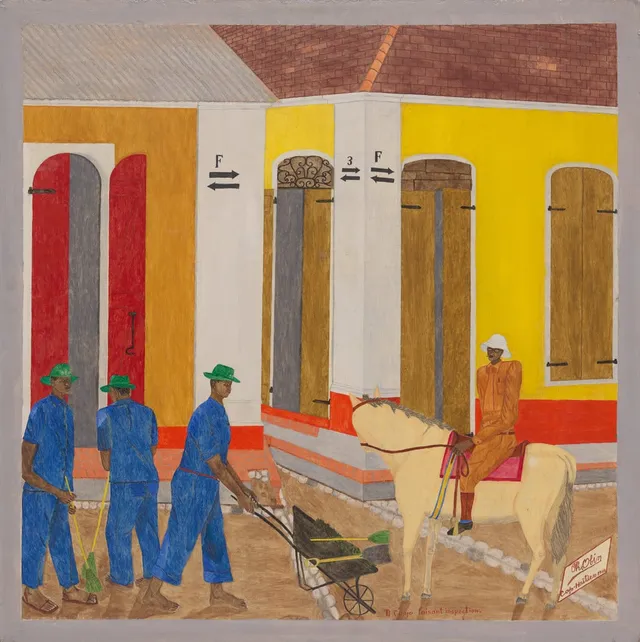
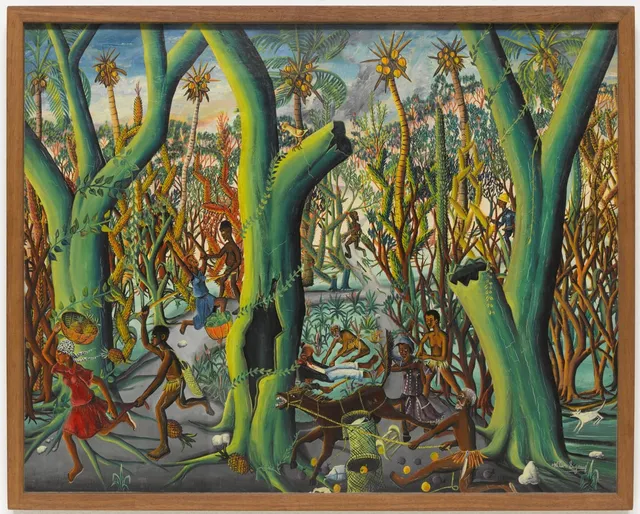
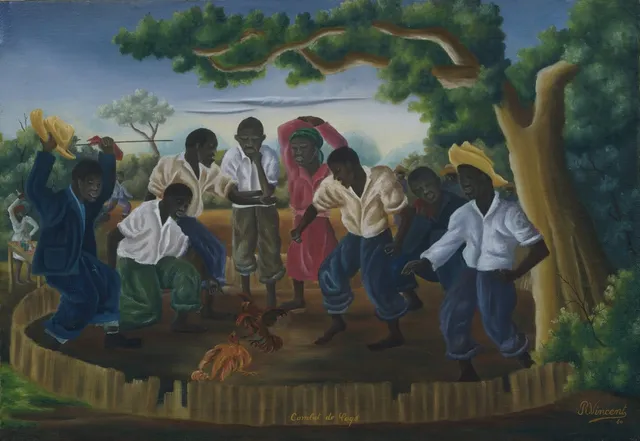
Haitian Folk Painting is an art movement of the 1940–1980 period. The gallery holds 3 works in this movement, including works by Wilson Bigaud, Philomé Obin and René Vincent. Browse Haitian Folk Painting paintings, portraits, pictures and artworks from the world's public-domain museum collections.
Haitian Folk Painting—often called Haitian "naïve" or self-taught painting—emerged in the mid-1940s as one of the twentieth century's most celebrated outpourings of vernacular art. Its institutional spark was the Centre d'Art, founded in Port-au-Prince in 1944 by the American watercolorist DeWitt Peters together with a circle of Haitian intellectuals. Conceived as a workshop and gallery, the Centre drew in untrained painters—tradesmen, Vodou priests, and laborers—whose work flourished from roughly 1945 onward. The movement crystallized a distinctly Haitian visual language rooted in the nation's African heritage, its revolutionary history as the first Black republic, and the living spirituality of Vodou.
The style is immediately recognizable: brilliant, saturated color applied in flat planes, frontal and densely populated compositions, and a flattened perspective that privileges narrative legibility over illusionistic depth. Subjects range from teeming marketplaces, harvests, and village rituals to scenes of national history and the loa (spirits) of the Vodou pantheon. The painters worked largely without academic training, and critics—most famously the Surrealist André Breton—prized exactly this directness, seeing in it an unmediated visionary power.
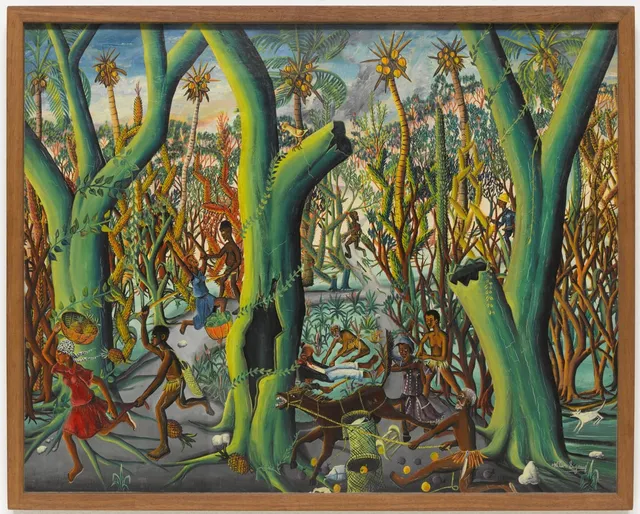
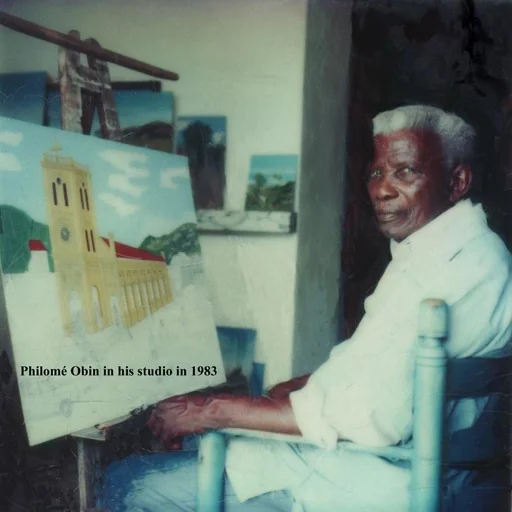
The acknowledged "grand maître" was Hector Hyppolite (1894–1948), a third-generation Vodou houngan whose spiritually charged canvases astonished Breton during his 1945–46 visit. Philomé Obin (1892–1985), working from Cap-Haïtien in the north, brought a precise, documentary clarity to historical and civic subjects; his depictions of Charlemagne Péralte and Haitian political life remain canonical. Wilson Bigaud (1931–2010), Hyppolite's one-time assistant, won international notice when New York's Museum of Modern Art acquired his "Murder in the Jungle" around 1951, painted when he was barely nineteen. Alongside Castera Bazile, Rigaud Benoit, and Préfète Duffaut, these masters executed the famous biblical murals of the Episcopal Cathedral of Sainte-Trinité (Holy Trinity) in 1950–51, under Peters and the American writer Selden Rodman—works that set Haitians in scripture and proved both beloved and controversial. Most were destroyed in the 2010 earthquake, with only three murals surviving.
The movement carried Haitian art to MoMA, UNESCO, and collectors worldwide, and its influence radiated to later schools such as Saint-Soleil and to broader Caribbean and self-taught traditions. Long discussed under the contested label of "naïve" or "primitive" art, it is now understood as a sophisticated modern movement that gave Haiti an enduring place in twentieth-century painting.
Key artists
Works
Frequently asked questions
What is Haitian Folk Painting?
Haitian Folk Painting is an art movement. A vivid 20th-century Haitian movement of self-taught painters.
Who are the key Haitian Folk Painting artists?
Key Haitian Folk Painting artists in the collection include Wilson Bigaud, Philomé Obin and René Vincent.
When did Haitian Folk Painting take place?
Haitian Folk Painting dates from 1940–1980.
Where can I see Haitian Folk Painting works?
Haitian Folk Painting works in the collection are held by Museum of Modern Art.