Movement
Maori Carving Painting
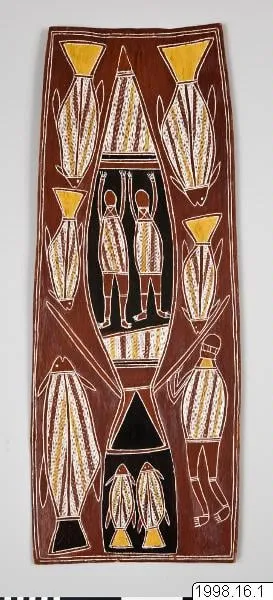
Maori Carving Painting is an art movement. The gallery holds 1 work in this movement. Browse Maori Carving Painting paintings, portraits, pictures and artworks from the world's public-domain museum collections.
Kōwhaiwhai is the painted dimension of classical Māori art, the flowing scrollwork that animates the interior of the whare whakairo (carved meeting house) of Aotearoa New Zealand. Where whakairo (carving) gives the house its bones, painting clothes them: the most important designs run along the heke (rafters) and the tāhū (ridgepole), surfaces understood as the ribs and spine of the ancestor whom the building personifies. Some of the earliest surviving examples appear not on architecture but on hoe (canoe paddles) and the bows of war canoes, before the tradition flowered on the rafters of nineteenth-century tribal houses. The patterns are never merely decorative: a ridgepole's kōwhaiwhai can encode the whakapapa (genealogy) of the iwi, and the rhythmic repetitions along each rafter count the generations linking living people to a founding ancestor.
The visual language is built from a small set of elements endlessly recombined. Foundational is the koru, or pītau—a curved stalk and bulb evoking the unfurling fern frond—together with the double spiral, the crescent-and-indentation kape, and the rauru spiral. From these grow named motifs carrying their own meanings: the mangōpare (hammerhead shark) for strength and tenacity, and the pātiki (flounder) for generosity and hospitality. Classical palettes are austere and deliberate: red ochre (kōkōwai, a haematite pigment), black from soot, and a white-blue-grey from clay, traditionally bound with shark oil. Red was no casual choice—kōkōwai was tapu (sacred), tied in tradition to Tāne shaping the first woman from the red earth of Kurawaka.
Much of the canon is communal and anonymous, the work of tohunga whakairo, but individual masters are remembered. Raharuhi Rukupō led the carving and decoration of Te Hau-ki-Tūranga, built in the early 1840s near Gisborne and now the oldest surviving whare whakairo, held by the Museum of New Zealand Te Papa Tongarewa. In the twentieth century the koru migrated into modernist painting: from 1956 Gordon Walters (1919–1995), encouraged by the Dutch émigré Theo Schoon, distilled the motif into hard-edged, geometric canvases—a contested but defining episode in New Zealand abstraction. Kōwhaiwhai thus bridges ancestral architecture and contemporary art, remaining a living, evolving tradition rather than a closed historical style.
Works
Frequently asked questions
What is Maori Carving Painting?
Maori Carving Painting is an art movement. The painting traditions tied to Māori art of New Zealand, seen in the rafter patterns (kōwhaiwhai) of meeting houses.
Where can I see Maori Carving Painting works?
Maori Carving Painting works in the collection are held by ethnographic museum.