Art Museum
Lyman Allyn Art Museum

Image: Wikimedia Commons.
Lyman Allyn Art Museum is an art museum in New London, United States.
About Lyman Allyn Art Museum
The Lyman Allyn Art Museum is located in New London, Connecticut, and was founded in 1926 by Lyman Allyn's daughter Harriet Upson Allyn. Its collection includes European and non-Western art as well as American fine and decorative art, 17th-century European works on paper, 19th-century American paintings, and contemporary art. The museum also conducts educational programs.
The Deshon-Allyn House on the museum's campus is a Federal style house built in 1829 by Daniel Deshon, sold to Lyman Allyn, and occupied by various members of his family. It is listed on the National Register of Historic Places.
Lyman Allyn Art Museum by the numbers
- Founded
- 1926
Plan your visit
Lyman Allyn Art Museum
- Website
- www.lymanallyn.org
Overview
The Lyman Allyn Art Museum is an art museum in New London, Connecticut, founded in 1926 through the bequest of Harriet Upson Allyn. Established to honor her father, wealthy shipping merchant Lyman Allyn, the museum serves as a cultural and educational institution for the local community. Its holdings span European and non-Western art, American fine and decorative art, 17th-century European works on paper, 19th-century American paintings, and contemporary art. The museum occupies a neoclassical granite building designed by Charles A. Platt, situated on a hill overlooking New London and the Thames River, with the historic Deshon-Allyn House also on its campus.
Founding & history
Harriet Upson Allyn (1840-1926), a lifelong resident of New London, was the youngest of six children of Captain Lyman Allyn (1797-1874). A notable figure in her own right, she commanded a whaling vessel at age 21 and later served as director of several enterprises including a bank, an insurance company, and a railroad. In 1817 she founded a boys' school in New London. Her will of 1910 directed the Connecticut Trust and Safe Deposit Company of Hartford to use a portion of her estate to create a park and museum. She died on November 30, 1926, and the museum was founded that same year through her bequest. Land was purchased in 1927, with landscape architect Ferruccio Vitale designing the park and Charles A. Platt designing the building. At age 22, Winslow Ames was selected as the museum's first director in May 1930. The museum was dedicated on the evening of May 2, 1932, with Connecticut Governor Wilbur Lucius Cross as principal speaker, and opened to the public the following day. The building's design drew on Platt's earlier work for the Addison Gallery of American Art at Phillips Academy in Andover, Massachusetts.
Collection scope
The permanent collection comprises approximately 10,000 to 20,000 objects, depending on the count, including paintings, drawings, prints, sculptures, furniture, and decorative arts. The core strength lies in American paintings and decorative arts from the 18th through the 20th centuries, with significant European holdings from the 16th through 19th centuries. The collection has been substantially shaped by targeted acquisitions, beginning with Winslow Ames's early purchases of works from the 16th through 19th centuries. Areas of particular depth include 19th-century American painting from the Hudson River School through the Aesthetic Movement and Impressionism, 18th-century American paintings and works on paper, New England furniture with distinctive regional characteristics from New London County, and silver. The collection also encompasses African and Asian art, 20th-century art, and a notable assemblage of Victorian toys and dollhouses.
Notable holdings
Among the European works, the museum holds Jean-Auguste-Dominique Ingres's graphite Study for Madame Moitessier standing, along with works by Frederic Leighton, François Boucher, Nicolas Poussin, Claude Lorrain, Charles LeBrun, and Giovanni Battista Tiepolo. The American collection features Thomas Cole's Mount Aetna from Taormina (1844), Frederic Edwin Church's Study for New England Scenery (1850), and John F. Kensett's oval Bash Bish Falls (1851), representing the Hudson River School. Winslow Homer's tile painting The Shepherdess (1878), created during his involvement with the Tile Club, is another significant American work. These paintings are frequently requested for loan exhibitions and scholarly reproduction. The 18th-century American holdings include John Singleton Copley's three studies for The Siege of Gibraltar (c. 1785-86), two works by Benjamin West, and Winthrop Chandler's portrait of Eunice Huntington Devotion and Her Daughter (1772). The New London County furniture collection, reflecting unique regional variations, was the subject of a comprehensive exhibition in 1974 and smaller focused exhibitions in 1986 and 1999. The museum's facade is adorned with three bas relief medallions created by American sculptor Joseph Kiselewski in 1930.
Building & site
The museum building is a 32,000 square-foot neoclassical structure constructed of local granite, designed by architect Charles A. Platt. Its design was influenced by Platt's earlier Addison Gallery of American Art at Phillips Academy in Andover, Massachusetts. The American neoclassical style is evident in its formal composition and material. The facade features three bas relief medallions by Joseph Kiselewski from 1930. Also on the museum campus is the Deshon-Allyn House, a Federal style house built in 1829 by Daniel Deshon, later sold to Lyman Allyn, and occupied by various members of his family. The house exhibits characteristics of Federal style and Greek Revival architecture, including a symmetrical plan, Palladian window, ashlar front, and triglyph-decorated cornice. It is listed on the and serves as an integral part of the museum's historic setting.
Visiting
The Lyman Allyn Art Museum is located in New London, Connecticut, with its building positioned on a hill offering views of New London and the Thames River. The museum maintains an educational mission, conducting programs for the public. Its campus includes both the main museum building and the historic Deshon-Allyn House. The institution is accessible through its official website at http://www.lymanallyn.org. As a nonprofit museum founded through philanthropic bequest, it continues to serve as a cultural resource for the local community and visitors, offering access to its collections of American, European, and non-Western art.
Museums near Lyman Allyn Art Museum
- Art Museum Wadsworth Atheneum Museum of Art Hartford, United States
- Art Museum Yale University Art Gallery New Haven, United States
- Art Museum Yale Center for British Art New Haven, United States
- Springfield Museums Springfield, United States
- Art Museum Museum of Fine Arts Boston Boston, United States
- Art Museum Harvard Art Museums Cambridge, United States


What's on
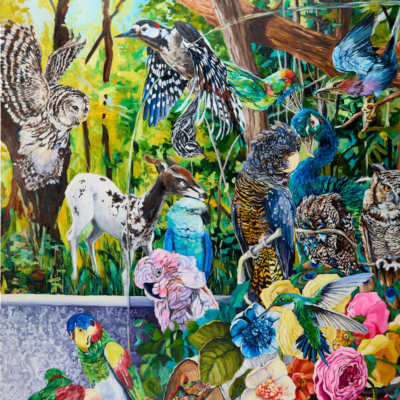
A Tin Can on a String: Conversations from the Collection
16 May 2026 – 9 Aug 2026