To understand the painter Jan van Scorel, start with the bills. He carried a Romanized way of building a picture back to the Low Countries in the mid-1520s, and for the next thirty years he sold it to whoever could meet his price: a Dutch pope, the canons of a Utrecht chapter, Haarlem burghers rich enough to want their own faces fixed on a panel, the old landed nobility of Holland. The survey-book version makes him a hinge, the man who brought the Italian Renaissance north. That is accurate and nearly useless. The sharper story is a commercial one. Scorel's pictures shifted because his clientele shifted, and you can read the second fact straight off the first.
So the argument here is simple and a little contrarian: patronage explains Scorel better than influence does. Ask not only where he learned a pose but who commissioned the panel it sits in, and the career snaps into focus. The devotional pictures answer to clergy and pious laymen. The portraits answer to a new buying public that wanted to look modern. The print designs answer to a market for images at a lower price point than any painting. Scorel was born on 1 August 1495 in Schoorl, north of Alkmaar, and died on 6 December 1562, and the standard biographies credit him with introducing aspects of Italian Renaissance painting into Dutch and Flemish art (Wikipedia). Hold that credit at arm's length. He introduced what his customers were willing to fund, and not one brushstroke more.
Rome, and a Dutch pope who happened to need a painter
Scorel's training reads like a tour of the workshops that mattered. He passed through the orbit of the leading Netherlandish masters of the generation above him before he ever crossed the Alps. He absorbed the polished, sculptural figure-drawing that Jan Gossaert was pushing in the same years, and the dense narrative panels of Jacob Cornelisz van Oostsanen, the Amsterdam workshop that anchored painting in Holland before Scorel's own rose. These were not abstract lessons. They were the going commercial styles, the things a young painter learned because patrons paid for them.
Then came the journey. Scorel went to Venice, on to the Holy Land, and finally to Rome, and his luck there was the kind no talent can engineer. The cardinal from Utrecht who had been his region's most powerful churchman became Pope Adrian VI, the last non-Italian pope for centuries. A Dutch pope wanted Dutch people around him. Scorel was made court painter and put in charge of the papal collection of antiquities, succeeding Raphael as Keeper of the Belvedere (Wikipedia). Sit with what that position meant. For roughly a year a painter from a village near Alkmaar had the keys to the Vatican's ancient marbles, the Apollo and the Laocoön among them, free to draw the bodies that every ambitious artist in Europe was straining to copy from prints. He did not absorb antiquity from a book. He measured it with his own eyes, on the patronage of a man who happened to share his accent.
The Roman years left a paper trail in chalk and ink. The Getty holds a double-sided sheet attributed to him, a landscape with shepherds by a river and a town beyond on one face, figure studies and Roman ruins on the other, dated around 1525 to 1530 (J. Paul Getty Museum). That is the working method of the whole career condensed onto a single piece of paper: ruins on one side as raw material, a saleable landscape composition on the other. He looked at the antique not to worship it but to mine it for parts he could resell at home. Adrian died in 1523, the commissions in Rome evaporated, and Scorel went north carrying a sketchbook full of inventory.
Utrecht: a workshop built like a business
He settled permanently in Utrecht in 1530 and set up a large workshop organised on the Italian model (Wikipedia). That phrase deserves unpacking, because the organisation is the point. An Italian-style bottega meant division of labour, replicable compositions, assistants who could carry a master design to completion, and a steady output that did not depend on the master's hand for every square inch. Scorel held a canonry at the Utrecht chapter of St. Mary's, which gave him income, social standing, and a direct line to exactly the clientele a religious painter wanted. He was a cleric who painted and a painter who held a benefice. The two roles funded each other.
Run the workshop forward a few years and you can watch its most famous product walk out the door. The young Maarten van Heemskerck trained under Scorel before making his own pilgrimage to Rome and turning the Romanism into something harder and more muscular. The teacher's style was portable enough to hand on, which is precisely what a commercially organised workshop is for. Patrons in Utrecht and Haarlem could buy a Scorel, a Scorel-shop panel, or a Heemskerck, and they were buying variants of one idea about what a modern picture should look like.
Close looking: the Magdalene as a luxury good
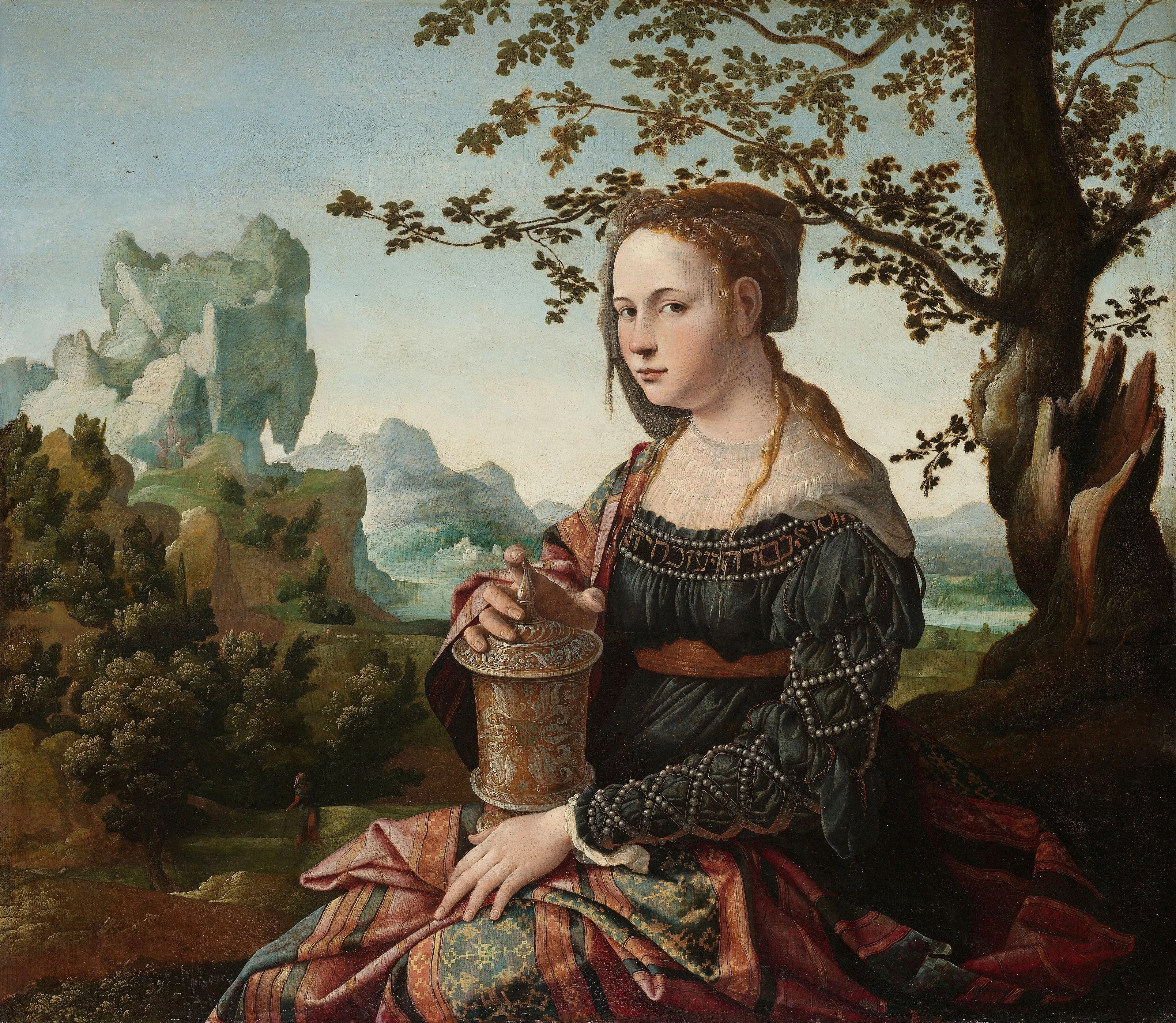
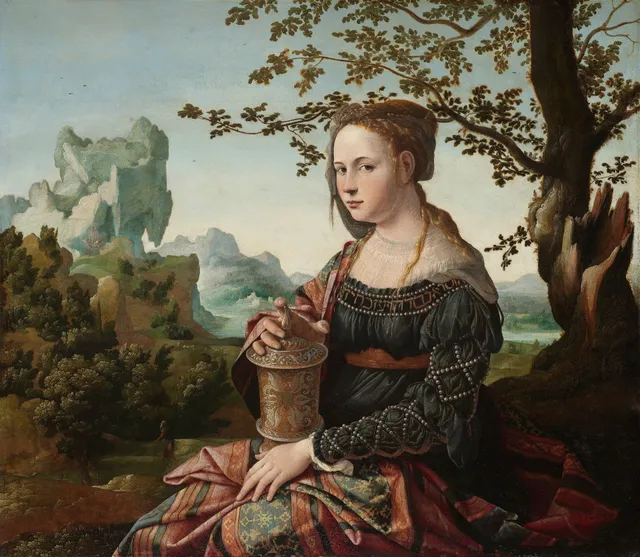
Look hard at the Mary Magdalene in the Rijksmuseum, painted around 1530 and catalogued as SK-A-372. The saint sits in the foreground, turned three-quarters toward us, and she is dressed like money. The sleeve is a slashed, brocaded affair worked in gold thread, the kind of garment a Utrecht patron's wife might have owned. Her fingers rest on the lid of the alabaster ointment jar, her single fixed attribute, the jar that tells you this richly turned-out woman is the penitent who anointed Christ's feet. Behind her the land opens into a broad, luminous distance: pale crags catching light, a thread of road, a sky that thins from blue to a haze at the horizon, exactly the kind of panoramic landscape Scorel had been drawing on those Roman sheets.
Now read the picture as a transaction. The theology asks for a repentant sinner, a woman stripped of vanity. Scorel gives the buyer a woman swathed in costly fabric, smooth-skinned, composed, set against a view that doubles as a demonstration of the painter's range. Penitence is the subject. Status is the delivery. The contradiction is not a failure of the painting. It is the whole commercial proposition. A devotional panel like this let a wealthy lay owner perform piety and display taste at once, and Scorel built the object to do both jobs without visible strain. The handling is cool and deliberate, the modelling rounded toward something sculptural, the surface polished so the gold reads as gold. He learned that finish in part from Gossaert, and he aimed it at a customer who wanted the holy and the sumptuous in the same frame.
Faces for hire: the portrait business
If the devotional panels answered to old money and the Church, the portraits answered to a newer kind of demand. A portrait is the purest patronage object there is. Nobody paints a stranger's face on speculation. Someone sat, and someone paid, and the painting exists only because of that arrangement. Scorel's surviving portraits map the social ladder he served.
At the civic rung sits the Portrait of a Haarlem Citizen. The very title is a social fact. This is a burgher, not a baron, a man whose standing came from the town and who could now afford to be recorded the way the nobility had always been. Scorel was, in fact, a pioneer of the group portrait of Haarlem's confraternities of Jerusalem pilgrims, men bound by a shared journey to the Holy Land that Scorel himself had made. Those panels lined up plain, particular faces in a row, each sitter likely paying his share of the commission. It is one of the earliest engines of the Dutch group portrait, and it was funded the way a club funds a banquet, by subscription.
Climb a rung and you reach the Portrait of Reinoud III of Brederode. The Brederodes were among the oldest noble houses of Holland, a family that traced itself back to the medieval counts and was not shy about saying so. A portrait of a Brederode is a different commercial register from a Haarlem burgher: dynastic, image-conscious, meant to assert lineage in paint. Set it beside the anonymous Male portrait, whose sitter we can no longer name, and you have the two ends of the trade in one glance. Scorel could record a count or a nobody, and the brush did roughly the same work either way. What changed was who signed the cheque.
Below the painting: prints for a wider purse
Patronage has a floor as well as a ceiling, and Scorel worked that floor too. A painted panel was a luxury. A woodcut was a commodity, printed in quantity and sold to people who would never commission an oil. Scorel supplied designs for exactly this market. The Metropolitan Museum holds a large two-sheet hand-colored woodcut of The Deluge after him, dated around 1524, the flood rendered as a churning mass of drowning bodies (The Metropolitan Museum of Art). The National Gallery of Art in Washington keeps another sizeable woodcut, cut by Willem Liefrinck after a Scorel composition, the printed sheet measuring roughly 47 by 67 centimetres (National Gallery of Art).
The economics here are worth stating plainly. A painter designs once and a block-cutter and printer multiply the image many times over, spreading the cost across many buyers. Scorel the canon, the man with a benefice and a Roman pedigree, was also a man content to put a design into the cheaper channel and reach a customer who could spare a few coins for a printed flood. The reach of his style across the Low Countries owes as much to that decision as to any panel. The print market carried his compositions into houses that would never see an original.
The corpus, counted
Patronage leaves a measurable footprint, and our own holdings let you take its measure. Artifact World Gallery carries 27 works under Scorel's name, scattered across 14 venues, clustering roughly between 1519 and 1549. Two numbers in that line tell the story. Thirty years of dated production matches a working life, not a brief flare. And a spread across fourteen institutions is the signature of an artist whose output was dispersed by sale and commission rather than locked into one princely collection. A court painter who served a single master ends up concentrated in one place. Scorel's work scattered because his patrons scattered: a chapter here, a confraternity there, a noble house, a print buyer, a museum that later bought the remains.
Set that dispersion against the standard claim that Scorel was the man who brought Italy north, and the counting refines the claim. He did not broadcast a movement from a single throne. He seeded a manner across a buying public wide enough to fill fourteen venues with surviving panels and drawings. The reach is the evidence of the business model. He sold to many, at many prices, in many formats, and the catalogue four centuries later still wears the shape of that strategy.
Works discussed in this article
Sacred narrative, sized to the wall it would hang on
The larger religious pictures show the same logic at full scale. Consider the Solomon and the Queen of Sheba. The subject is a meeting of royalty, a scene of gifts and tribute and architectural splendour, and it is exactly the kind of theme that lets a painter stage the antique columns and ample figures he learned to draw in Rome. A patron who bought a Solomon was buying a sermon about wisdom and a display of Italianate grandeur in one panel. The narrative subject is the cover; the imported style is the luxury underneath.
The Baptism of Christ makes the case quietly. The river, the kneeling Christ, John pouring water, the dove above, all set in one of those wide Scorel landscapes that owe their air to the drawings he made by the Tiber. A scene every chapel needed, painted with the spaciousness no local rival could yet match. That combination is the product. Familiar enough to be commissioned without hesitation, modern enough to justify the fee. Scorel found the seam between what patrons already wanted and what they did not yet know they could have, and he worked it for three decades.
Why the money matters
The influence story flatters everyone. It makes Scorel a torchbearer and the Low Countries a grateful audience, and it skips the awkward middle where pictures get ordered, priced, and paid for. The patronage story is less tidy and more honest. A Dutch pope handed him the keys to the Belvedere, and the antique entered his vocabulary. A canonry and a workshop in Utrecht gave him both a guaranteed income and a captive market of clergy. Haarlem's confraternities and Holland's nobility wanted their faces preserved, and he built a portrait practice to take their commissions. A print public wanted images at a lower price, and he designed for the block. Strip out the patrons and there is no career left to admire.
This is the lesson the corpus keeps teaching once you start reading museum labels as receipts. The next time you stand in front of a Scorel, run the old two-part question across it. Who painted it is the easy half, answered by the wall text and a thousand handbooks. Who paid for it is the half that changes what you see: the gold sleeve on a penitent saint, the count's profile and the nameless burgher's, the flood printed cheaply for a crowded house. Find the buyer behind each one, and the panels stop being monuments to a movement. They become the working record of a man who knew his market street by street, and sold it the future a little at a time.
Sources & further reading
- Jan van Scorel — Wikipedia
- Landscape with Shepherds (recto); Figure Studies and Roman Ruins (verso) — The J. Paul Getty Museum
- The Deluge (hand-colored woodcut, ca. 1524) — The Metropolitan Museum of Art
- Woodcut after Jan van Scorel, cut by Willem Liefrinck — National Gallery of Art
- Carel van Mander, Het Schilder-boeck (digitized early edition) — Internet Archive (Getty Research Institute copy)