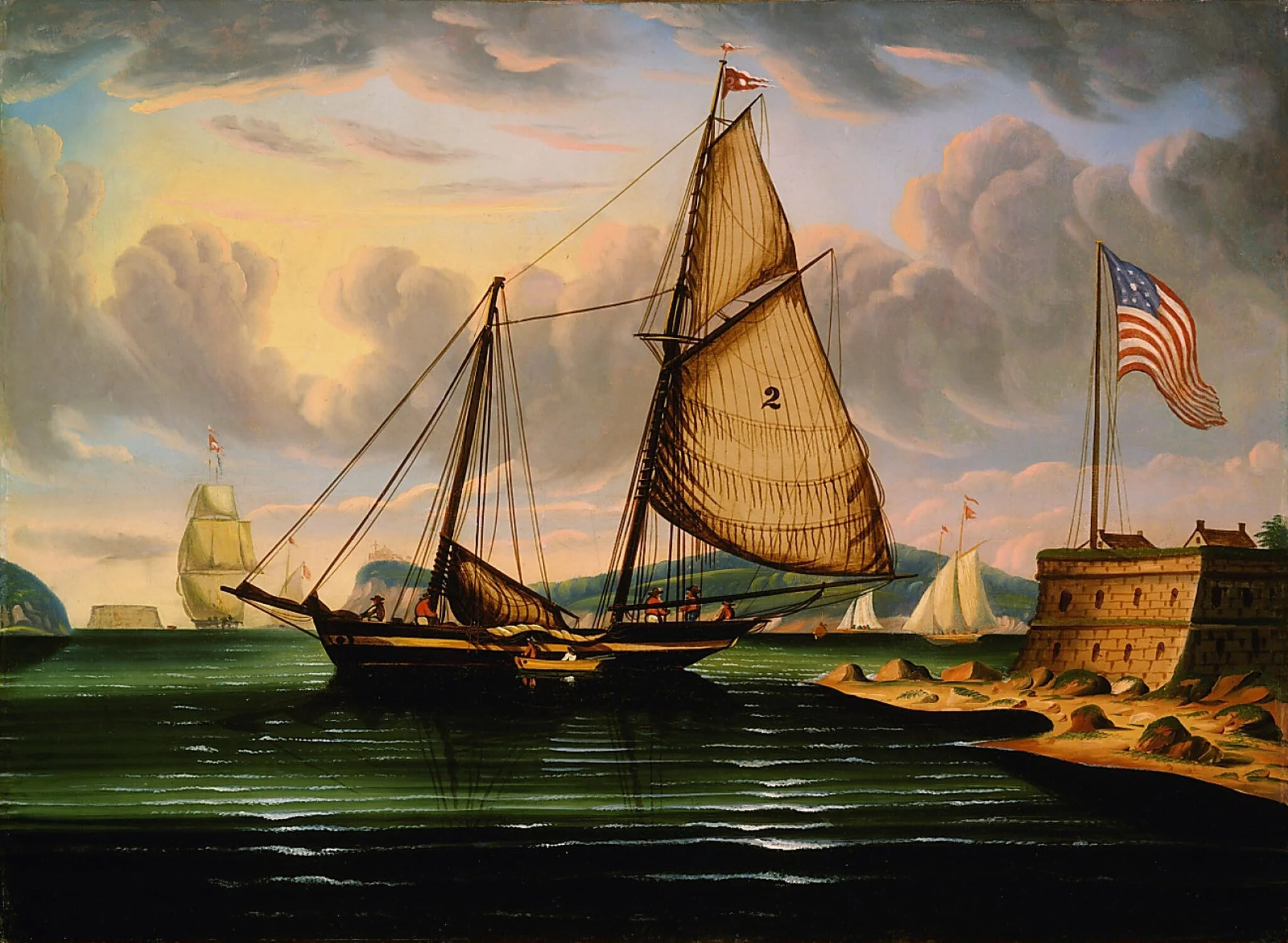
The paintings filed under Thomas Chambers, marine and landscape painter, almost never record a place the painter stood in front of. They record a place someone else had already framed: engraved, printed, sold as a topographical view, and carried up a river or across the Atlantic before it ever reached his easel. Chambers worked from other people's pictures. He took a harbor a navy painter had composed, or a lake a French traveler had sketched, and he ran it through his own hand until it came out flatter, brighter, and far louder than the source. That habit is usually held against him. I think it is the whole point of him.
So this essay reads Chambers through a single idea. Every picture he made is a record of an image in transit, and the changes that happen during the journey are where the art actually lives. The man kept moving, from a North Sea whaling town to New Orleans, then New York, Albany, and Boston, and finally back home to Yorkshire. His images kept moving too, from copperplate to lithograph to his own canvas. The argument here is that what looks like the clumsiness of a self-taught primitive is better described as a translator's method: a consistent, decisive set of choices about what to keep and what to discard when a printed view becomes a painted one. Chambers is not a failed academic. He is a very good editor of other people's compositions.
A Yorkshire hand in an American harbor
The biographical outline is short and was, for a long time, almost entirely lost. Chambers was born in Whitby, Yorkshire, in 1808, and he died there in 1869, but the productive middle of his life belonged to the United States, where he spent most of his working years (Wikipedia: Thomas Chambers). Kathleen A. Foster's 2008 Philadelphia Museum of Art monograph fixes the American arrival: Chambers landed in New Orleans in 1832, then worked his way north through the busy port cities before disappearing from the documentary record in the mid-1860s (Foster, Thomas Chambers (Internet Archive)). Foster's larger contribution was to take Chambers off the shelf marked folk curiosity and put him back among working professionals: a man who advertised, who priced his pictures, who chose subjects he could sell.
For decades nobody could have made that argument, because nobody knew his name. Chambers went virtually unacknowledged until 1942, when the discovery of one signed painting let scholars work backward and attribute a scattered body of anonymous marine and landscape pictures to a single hand (Wikipedia: Thomas Chambers). Think about what that means for our subject. The pictures had been circulating, hanging, changing owners, traveling, for roughly a century before the author caught up with the work. His paintings were in transit even as objects, anonymous goods passing from parlor to parlor, long before anyone could say who had painted them. The recovery of Chambers is itself a story of an image that moved and changed status along the way.
Looking hard at one harbor
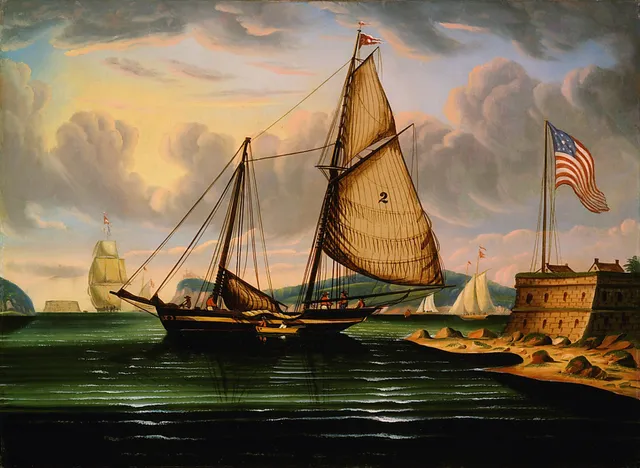
Start with the picture that gives this essay its hero, New York Harbor with Pilot Boat "George Washington". Stand close. The first thing you notice is that the water is not really water. Chambers builds the sea out of long, ridged, parallel strokes, each wave given a hard pale crest, so the surface reads as a stack of curved metal shavings rather than a moving liquid. The sky behaves the same way: the clouds are scrolled and modeled into firm, sculptural lumps with bright rims, more like carved relief than vapor. Between them sits the pilot boat, heeled over and crisp, its sails caught at the exact theatrical angle a stage designer would choose. Nothing dissolves. Nothing is atmospheric in the Turner sense. Every element has an edge.
That edge is the decision. A trained marine painter of the 1840s would have softened the meeting of sea and sky, let the light bleed, blurred the far shore into haze. Chambers refuses. He keeps each zone separate and legible, and he tilts the whole scene slightly up toward us so the bay spreads like a map you can read rather than a distance you fall into. The result is a picture that prefers clarity to illusion. You always know where the boat is, where the horizon is, where the weather is coming from. He has taken a genre built on mood and rebuilt it as signage. This is what his hand does to a borrowed view: it organizes, it sharpens, it turns observation into pattern.
Working from the print
Chambers rarely invented a composition. He found one, usually already printed, and adapted it. Many of his pictures are loosely based on engravings by other artists, the topographical printmaker William Henry Bartlett chief among them (Wikipedia: Thomas Chambers). Bartlett's steel engravings of American scenery were everywhere in the 1830s and 1840s, bound into gift books and sold cheap, and they functioned as a kind of national stock library. A painter in a port city did not need to travel to the Hudson Valley or the White Mountains; he needed the right book. The view arrived already composed, already cropped, already lit. Chambers' job began at the moment the print landed on his table.
The lineage is documented work by work. His upstate scene Lake George and the Village of Caldwell derives from a lithograph by the French traveler-artist Jacques Milbert (The Metropolitan Museum of Art). So the actual route of that image runs: a Frenchman travels the Hudson corridor, draws the lake, the drawing becomes a lithograph, the lithograph crosses into the print trade, and an English emigrant in an American city turns it into an oil painting for an American buyer who may never see Lake George. Four hands, three media, two countries, one view. The painting is the last stop on a long itinerary, and at each stop the picture lost some information and gained some emphasis.
His most aggressive act of editing is a battle piece. The Constitution and the Guerriere was based on an engraving by Cornelius Tiebout after a painting by Thomas Birch, and Chambers did not copy it faithfully. He advanced the action, pushing the moment forward in time so that H.M.S. Guerrière is shown with all of its masts already broken (The Metropolitan Museum of Art). That is a storyteller's choice, not a copyist's. Birch and Tiebout gave him a sea fight; Chambers chose the second when the British frigate is unmistakably beaten, the masts down, the outcome no longer in doubt. He edited a picture the way an editor cuts to the decisive frame.
Look at how he paints that wreckage. The fallen rigging becomes a tangle of dark, calligraphic lines laid over the bright hull, and the smoke is given the same firm, scrolled modeling as the clouds in his harbor scenes, so that gunsmoke and weather are made of the same stuff. The water again rises into ridged metallic swells. The two ships sit high and frontal, presented for inspection rather than glimpsed across a real distance. A naturalistic painter would have used the smoke to hide and confuse. Chambers uses it to decorate. The disaster is rendered with the same tidy, pattern-loving hand that draws a pleasure boat on a calm day, and that flatness of affect is exactly what makes the image so direct. He is not after the terror of battle. He is after a clear, sellable emblem of an American victory.
What the archive shows
Our own holdings give a small but telling map of this practice. Artifact World Gallery holds 17 works attributed to Thomas Chambers across 4 venues, all by the one artist, with catalog dates that spread across nearly a century, from roughly 1757 to 1854. That date range is worth pausing on, because Chambers was not born until 1808. A painter cannot have observed a 1757 scene. What the spread really records is the age of his sources: he was painting events and views first fixed in older prints, so the dates attached to the images run far ahead of the dates he held the brush. The corpus, in other words, quietly confirms the thesis. These are pictures of other pictures, and their timestamps belong to the journey, not to the easel.
The spread across four venues matters too. A folk eccentric working for a single local clientele tends to stay put in one collection's story. Chambers is dispersed, which fits a man who moved between port cities and sold to a market rather than to a patron. His pictures scattered because they were made to be portable goods in the first place.
How it changed in transit
If you lay a Chambers painting beside the print it came from, the same alterations recur, and together they amount to a signature. He raises the color temperature. Steel engravings are gray by nature, all tonal hatching, and Chambers answers that grayness with saturated greens, hot oranges in the sky, and chalky whites on every wave and sail. He hardens the contours, so soft printed transitions become firm painted boundaries. He simplifies the middle distance, dropping the fussy small detail an engraver could afford and a brush could not. And he tilts the ground plane up, trading recession for legibility.
You can watch the method shift register with the subject. In Threatening Sky, Bay of New York, the same scrolled clouds that read as decorative elsewhere are pressed into drama: the sky darkens to a bruised mass over a bay still lit, and the contrast does real emotional work. In Packet Ship Passing Castle Williams, the fortress and the vessel are arranged with an almost diagrammatic balance, the painting functioning partly as a proud civic record of New York's busy gateway. And in Boston Harbor, the city profile is laid out as a clean horizontal band beneath the rigged ships, a portrait of a port as much as of the water. Same hand, same tics, different jobs.
Here is the judgment I will defend. These changes are not deficiencies. A painter who could not do soft atmospheric recession would fail unevenly, sometimes blurring, sometimes botching. Chambers fails the same way every time, in the same direction, toward clarity and pattern and heat. Consistency at that scale is style, not incompetence. He developed a reliable procedure for converting the gray, detailed, tonal language of the print into the bright, flat, emphatic language of the popular oil, and he applied it with discipline across marine fights and quiet lakes alike.
Works discussed in this article
The trouble with the word "naïve"
Chambers is conventionally sorted under naïve art, the broad category Tate defines as work made by artists with no formal training in an art school or academy (Tate art terms: naïve art). The Met's Heilbrunn Timeline places him in the same neighborhood through its survey of nineteenth-century American folk art, the self-taught tradition that so often built finished pictures out of prints (Met Heilbrunn: Nineteenth-Century American Folk Art). Both labels are accurate as far as training goes. The problem is what they imply about intent. Naïve suggests innocence, an artist who simply did not know better. The print-copying habit suggests the opposite: a shrewd professional who knew exactly which images sold and how to make them efficiently.
The print-based working method was, in fact, ordinary across this whole tier of nineteenth-century picture-makers. It connects Chambers to a much older European trade in reproductive engraving, where skilled printmakers spent careers translating paintings into circulating sheets. The engraver Hubert François Gravelot and the portrait-engraver Georg Friedrich Schmidt built reputations on exactly this act of carrying an image from one medium to another, and the marine and battle prints of Carle Vernet show how readily a dramatic scene could be packaged for wide distribution. Chambers sits at the consumer end of that long supply chain. He was the man who turned the circulating sheet back into a unique, colored object for a wall. Calling him naïve flattens a job that was really about distribution and translation.
Where it lands
Read this way, Chambers stops being a charming footnote and becomes a useful case study in how images actually moved through the nineteenth-century world. The grand history of American landscape is usually told through the artists who stood on the spot and looked: the painters who hiked the mountains and recorded the light. Chambers tells the other half of the story, the half about reproduction, circulation, and the cheap colored picture that put a version of that scenery in an ordinary household. His Lake George is not a record of a lake. It is a record of how a lake became a commodity image and traveled into a parlor.
There is something fitting in the shape of his own life closing the loop. He came across the ocean as a young man, made American views from European-style prints for American buyers, and then carried himself back to the same Yorkshire coast he had started from, where he died. The career is a round trip, and so are the pictures, images that left their origins, picked up color and force and confidence in transit, and arrived somewhere new without ever pretending to be the original. The next time one of his bright, ridged seas turns up in a sale, look past the question of whether it is good drawing. Ask instead where the image had already been before it reached him, and what he decided to change on its way through his hands.
Sources & further reading
- Thomas Chambers (painter) — Wikipedia
- Thomas Chambers: American Marine and Landscape Painter, 1808-1869 (K. A. Foster) — Internet Archive / Philadelphia Museum of Art
- The Constitution and the Guerriere, object record — The Metropolitan Museum of Art
- Lake George and the Village of Caldwell, object record — The Metropolitan Museum of Art
- Nineteenth-Century American Folk Art — The Metropolitan Museum of Art (Heilbrunn Timeline)
- Naïve art (art term) — Tate