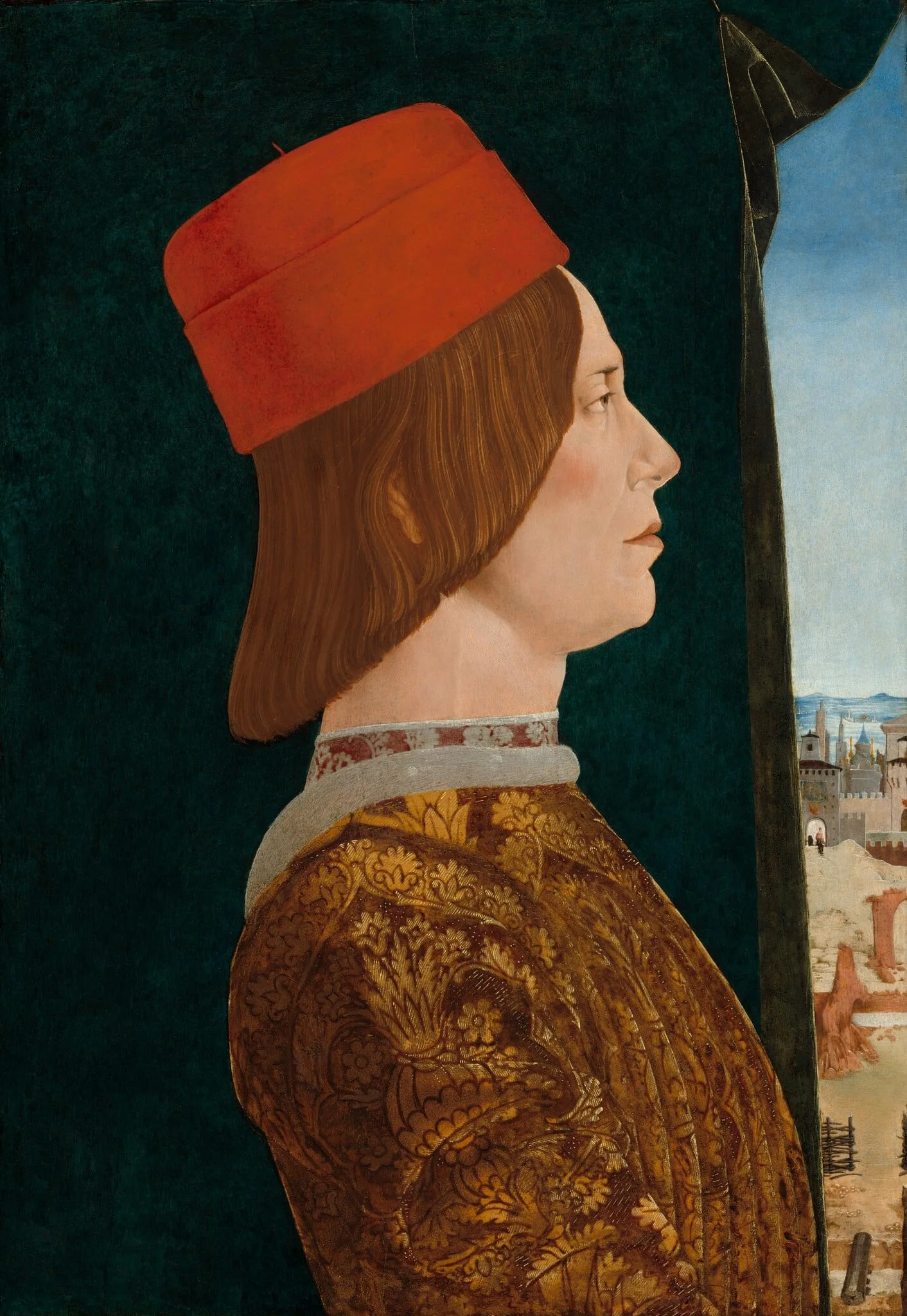
The paintings of Ercole de' Roberti, the Ferrarese court painter, look like the work of someone who did not trust paint to behave on its own. Where his Venetian contemporaries let a figure settle into atmosphere, Ercole pulls everything taut. Edges are cut, not blurred. A jaw, a sleeve, the rim of a halo: each is drawn with a wiry, deliberate line that holds the form the way a goldsmith's setting holds a stone. This is the argument of the present essay. Ercole's style was not discovered by looking softly at the world. It was built, plane by hard plane, out of a method he carried from a Bologna workshop into the service of the Este dukes, and that method, more than any subject he painted, is the thing his pictures are about.
Take the lens seriously and a different painter appears than the one the surveys describe. The surveys file him under the School of Ferrara, between Cosmè Tura and Francesco del Cossa, and leave it there. Material and method ask a harder question: what did he actually do with a panel, a piece of charcoal, a pot of azurite? The answer runs through everything here. He treated drawing as the armature of the picture and color as a hard, enamelled skin laid over it. He built figures as if they were carved, then lit them so the carving showed. He worked for patrons who wanted surfaces that read as expensive, and he gave them a finish that looks worked rather than glimpsed. The Smarthistory account of his career traces a Bolognese training and Este employment, with his manner shaped first by Tura and later loosened by Giovanni Bellini.
A doorkeeper's son in the Este court
The biography is short on documents and long on inference, which is normal for a fifteenth-century painter who left almost no signed work. He was born around 1451 and died in 1496, an Early Renaissance master of the Ferrarese school, according to the standard reference summary of his life. The same record reports that he was the son of the doorkeeper at the Este castle, which is worth pausing on. He did not arrive at the court as a name from elsewhere. He grew up inside its walls, in service, and rose through the household to become its painter. That trajectory matters to the method. A man raised among the craft trades of a ducal residence learns to make things to specification, on time, in materials chosen for their cost. The discipline of the Ferrarese line is, in part, the discipline of a workshop that had to deliver, and Ferrara under the Este was a place where delivery counted: a small, ambitious court that spent on spectacle to look larger than it was.
By 1473 he had left Ferrara for Bologna and was working in the studio of Francesco del Cossa, the older Ferrarese painter who had already broken with Tura's hothouse manner toward something firmer and more sculptural. This apprenticeship is the hinge of the whole story. Cossa gave him the planar, almost masonry-like construction of bodies and drapery, and Ercole pushed it further, into a line so charged it can look agitated. Tura founded the Ferrarese school; Cossa and Ercole joined him as the second generation, and between the three of them they fixed what we now recognize as the Ferrarese look: metallic, linear, brilliantly colored, allergic to vagueness.
The Ferrarese line: drawing as armature
Look at a head by Ercole and you can usually feel the drawing underneath. The Kopf des Erzengels Michael, a study of the archangel Michael's head, is built around contour first. The curls are not soft masses of hair. They are described, ringlet by ringlet, with a line that turns and tightens like wire bent by hand. The brow, the bridge of the nose, the set of the mouth: each plane meets the next at a defined edge rather than dissolving into the one beside it. This is the armature laid bare. Color and light come afterward, fitted to a structure already fully decided in the drawing. A painter who works this way has, in effect, finished the picture before he opens his pigments.
The same logic governs his standing figures. He liked to set a body against an open background so the silhouette does the work, the outer edge reading as a single continuous line from shoulder to hem. The drapery does not fall in soft folds. It breaks into facets, each catching light on a flat plane and dropping into shadow at the crease, so that cloth ends up looking less like wool than like beaten metal or carved stone. This is the inheritance from Cossa, and it is the reason Ercole's saints can feel tense even when they stand still. The figure is held under pressure by its own outline.
Looking at Giovanni II Bentivoglio
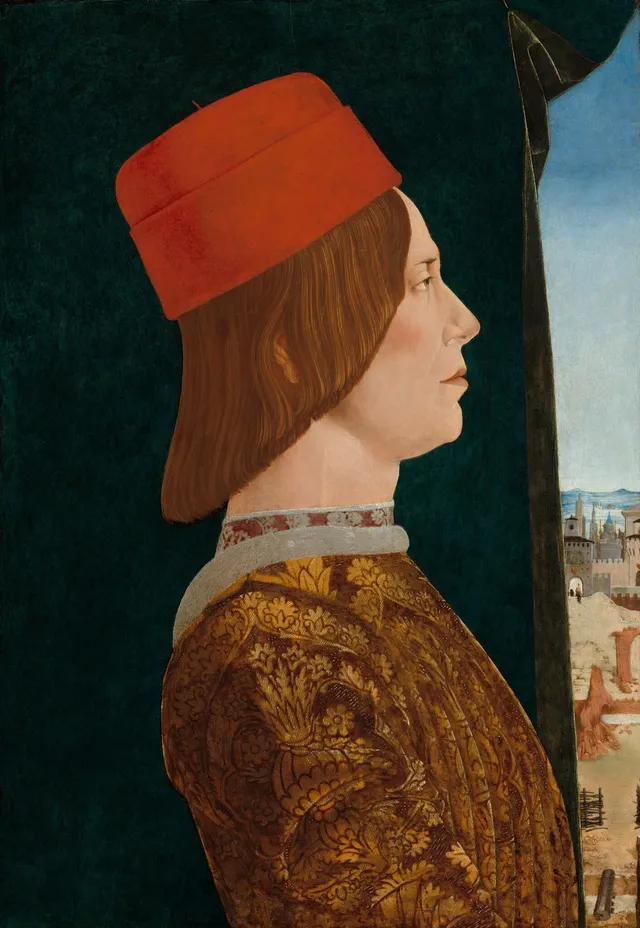
The portrait of Giovanni II Bentivoglio shows the method doing its most concentrated work. The sitter, the de facto lord of Bologna, is given in strict profile, the format Ferrarese painters borrowed from antique coins and medals because it flatters power. The head is cut against the open ground with an edge so clean it could have been struck from metal. Follow that edge: the line runs from the high forehead down the long ridge of the nose, kicks out at the lips, tucks under the chin, and drops into the heavy neck without a single soft passage. There is no atmospheric easing where face meets sky. The contour is the portrait.
Inside that hard boundary, the modelling is dense and dry. The cheek is built from close tempera hatching, the kind of patient, accumulated stroke that gives the skin a faintly weathered grain rather than a polished glow. The hair is laid in tight individual locks, each one drawn before it was colored. Against all this hardness the painter sets one passage of openness, the landscape or sky behind the head, which lets the profile read as a dark, decisive shape. The portrait was made as one of a pair, the pendant being his wife Ginevra, and the National Gallery of Art dates the two panels to about 1474 to 1477, the years just after the Bologna apprenticeship. The dating is telling. This is the style at the moment it was being forged, the Cossa lesson fully absorbed and pushed toward something colder and more exact than the teacher ever attempted.
Set the two panels side by side, as they were meant to be seen, and the discipline reads as a system. Ginevra Bentivoglio faces her husband across the gap between the frames, her profile answering his, the two silhouettes locked into a single composition that only completes itself when the panels hang together. Look closely at her costume and the method holds even in the ornament: the patterned brocade is stated with the same unblinking line that cut the duke's profile, each unit of the weave given as a discrete mark rather than a soft suggestion of richness. A dynastic marriage is being asserted in the geometry. Ercole did not need allegory to make the point. He made it with two outlines and the space between them.
Color as material
If the line is the skeleton, color is the skin, and here Ercole had no peer in his school. Edmund G. Gardner, in his period study of the Ferrarese painters, judged him the supreme colorist of the fifteenth-century group, a verdict that has held up. What Gardner was responding to is partly chemical. The Ferrarese palette leaned on costly, intense pigments, the deep azurites and ultramarines, the copper greens, the lead-tin yellows, and Ercole used them at full saturation, withholding the muddy intermediate tones that would have softened the picture. The result is a surface that behaves like enamel or stained glass, each color zone clear and bounded, glowing against its neighbor instead of melting into it.
The hardness of the line and the brilliance of the color are the same decision seen twice. Because Ercole keeps every color inside a drawn boundary, he can let each one burn at its own pitch without the picture turning garish. A softer painter would have to mute his hues to keep them from clashing. Ercole keeps them apart with line, the way leading keeps the colors of a window apart, and so he can afford the most expensive, the most uncompromising pigments his patrons could buy. The method and the materials reinforce each other. A blue is not nudged toward the green beside it to ease the join; it stops dead at the contour and lets the green begin. This is why his color does not read as decoration laid on top of form. It reads as the form's own substance.
The devotional panels: line under pressure
The portraits show the method in its coolest register. The devotional pictures show it under emotional load, which is where Ercole becomes more than a brilliant technician. In the Virgin and Child panels he keeps the hard Ferrarese construction but bends the line toward feeling. The contour that defines the Virgin's hands or the infant's limbs is the same wiry, exact line as in the portraits, yet it is made to carry tenderness rather than authority. The drapery still facets like stone, but the faces soften, and you can feel the later contact with Bellini's Venice working against the Ferrarese rigor, warming it without abandoning it.
Compare that with the second Virgin and Child composition, where the figures press close to the picture plane and the modelling tightens again. Ercole returns to the same subject the way a craftsman returns to a familiar form, varying the construction while holding the underlying method fixed. And in the single saints, the discipline turns expressive. His Saint John the Baptist is a gaunt, wiry figure whose every tendon and rib is described by the same charged line that drew Giovanni Bentivoglio's nose. The asceticism of the saint and the asceticism of the technique are one thing. A painter who refuses soft transitions makes a natural Baptist, all bone and resolve, with no spare flesh anywhere in the drawing.
The thread runs back to the small study heads. The archangel Michael and the Saint John belong to the same family of drawing, where bone and sinew are stated as facts rather than coaxed out of shadow. Place a Virgin and Child beside them and the range becomes clear. One line is asked to be commanding, tender, and ascetic in turn, and it answers each demand without ever giving up its essential hardness. That is the consistency a hand reveals, and it is what makes the attributions arguable in the first place: the manner is so particular that a single passage of drawing can carry the case.
What the workshop made: chests, frescoes, court labor
It distorts Ercole to imagine him producing only the panels that hang in museums today. A court painter was a producer of objects, and the objects were various. The most vivid surviving record of this is the role he played in a wedding. As the Ferrarese court artist he decorated the thirteen chests that traveled in Isabella d'Este's 1490 bridal procession from Ferrara to Mantua, painted furniture meant to be carried through the streets as a public display of the marriage's wealth, as a Metropolitan Museum essay on Italian Renaissance weddings records. Painted cassoni, fresco cycles, ephemeral festival work: this was the daily substance of the job, and most of it is lost. The method was forged to serve it. A man who could draw a hard, legible figure that read at a distance and held bright color was exactly the man a duke wanted decorating the surfaces of his power. The panels we prize were the smallest, most durable fraction of an output built mostly for the eye of a crowd and the span of a single festival.
Knowing this changes how we read the portraits. The strict profile of Giovanni Bentivoglio is not only an aesthetic choice. It is the visual language of rule, the same language stamped on coins and medals, deployed by a painter whose whole training was in making authority legible. The line that looks so personal, so much Ercole's own signature, was also a tool of the office he held. The style was made, in the most literal sense, by the work it was made for.
Works discussed in this article
What survives, and where
The surviving body of work is small, which sharpens the value of every panel that comes to light. Artifact World Gallery holds ten works attributed to Ercole de' Roberti spread across six venues, all from this single hand, spanning roughly 1470 to 1496, very nearly the full length of his documented career. Set that count against the museum record and the scarcity is plain. The major holdings are scattered: the pendant Bentivoglio portraits in Washington, where the National Gallery of Art preserves both halves of the pair, and a Saint Jerome in the Wilderness panel at the J. Paul Getty Museum among them. A painter who ran a busy court workshop for two decades left so few secure panels that scholars still argue over attributions, and that gap between the volume he must have produced and the handful that remains is itself part of his story.
Return, at the end, to the thing the eye actually meets: an edge. More than the iconography, more than the patron, the made fact of Ercole's pictures is that drawn boundary holding bright, costly color in place. He learned it in Cossa's Bologna, hardened it in Este service, and carried it to a pitch no other Ferrarese painter reached. When the next attribution is debated, it will be settled the way it always is with him, by someone tracing a contour with their eye and asking whether a hand this exact, this unwilling to soften, could have drawn it.
Sources & further reading
- Ercole de' Roberti — Wikipedia
- Ginevra Bentivoglio (with its Giovanni II pendant) — National Gallery of Art, Washington
- The Painters of the School of Ferrara — Internet Archive (Edmund G. Gardner)
- Ercole de' Roberti — Smarthistory
- Weddings in the Italian Renaissance — The Metropolitan Museum of Art
- Saint Jerome in the Wilderness — The J. Paul Getty Museum
- Renaissance in Ferrara — Wikipedia