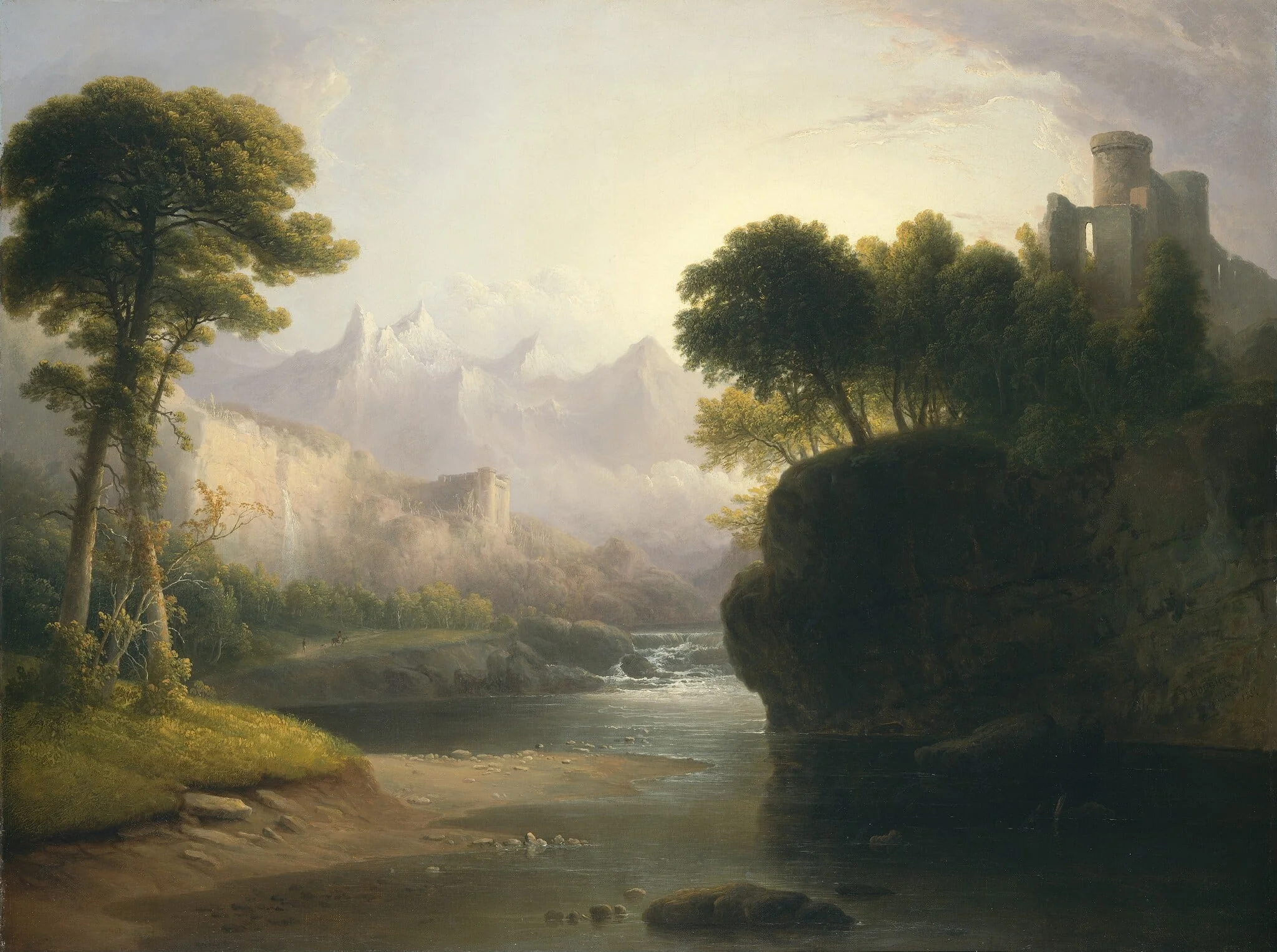
When Thomas Doughty's landscapes reached their first audiences in the 1820s and 1830s, viewers did not take them as reports on particular acres of American ground. They read them. A sheet of still water, a screen of dark trees at the edge of the canvas, one small figure at the lip of a clearing, a valley opening toward warm light in the distance: these were not neutral scenery to a person raised on sermons, emblem books, and the engraved pastorals that hung in parlors. They were signs. The argument of this essay is that Doughty's pictures carried a legible moral vocabulary, and that his early fame rested less on accuracy of place than on his audience's fluency in reading cultivated nature as a token of providence, refinement, and a young nation's claim to its own ground.
Put plainly: Doughty was not painting where a viewer might go. He was painting what a viewer should feel about being there. The stillness in his water is a moral stillness. The angler who recurs across his canvases is a figure of patience and quiet stewardship, not a record of a man who happened to be fishing. The cleared middle distance, with its glint of a roofline or a thread of road, tells the viewer that the wilderness has been received, tended, and made fit for a Christian republic. To recover what these pictures meant to their first owners, we have to stop asking whether a given hill is the right hill and start asking what an 1830 Philadelphian or Baltimorean believed a well-ordered landscape was for.
The man who chose to paint only the land
Doughty was born in Philadelphia in 1793 and died in 1856 (Wikipedia). He came to painting sideways. He worked as a leather currier, taught himself by copying, and first showed a landscape at the Pennsylvania Academy of the Fine Arts around 1816 while still earning his living from hides. In 1820 he made the decision that matters most for his meaning: he gave up the trade and committed himself to landscape full time (National Gallery of Art). That decision was, at the time, slightly eccentric. He is often called the first American artist to work exclusively as a landscapist, and the phrase is worth pausing on, because in the United States of the 1820s landscape was the low rung of the ladder. Portraits paid. History painting carried prestige. To stake a career on scenery was to bet that American audiences would learn to want pictures of their own country for reasons that were not flattery and were not biblical narrative.
The bet paid. By 1827 the National Academy of Design in New York had elected Doughty an Honorary Academician, and between 1826 and 1850 it hung twenty-two of his canvases (Wikipedia). William Dunlap, the first real historian of American art and a man who knew the studios firsthand, listed Doughty among the country's most distinguished landscape painters in his 1834 survey of the arts of design (Internet Archive). Doughty was, for a stretch of the 1820s and 1830s, the leading name in a field he had helped to invent. His later years were harder, and the rising generation of Thomas Cole and his followers would out-paint him in scale and ambition, but the iconographic habits the public learned to read in his work fed directly into what we now call the Hudson River School.
A grammar of signs: how the pictures spoke
Doughty worked from a compact set of motifs, and he repeated them on purpose. Once you have looked at a dozen of his canvases the grammar declares itself. There is almost always water, and the water is almost always calm. There is a dark mass of foreground trees, usually pushed to one side, that frames the view and pulls the eye inward. There is a luminous recession in the center, a valley or river bend that carries the light back into haze. And there is, very often, a single human figure: an angler on a bank, a herdsman, a walker on a path, scaled small against the land.
To a modern eye this can read as formula. To Doughty's first viewers it read as meaning. The calm water was the oldest sign in the Protestant visual vocabulary, the still waters of the psalm, and it told the viewer that this was a place of rest and right order rather than danger. The lone angler was not loneliness. He was the contemplative man, the citizen who has withdrawn from the marketplace to be improved by nature, a figure the period's sermons and conduct books endorsed without irony. The cleared, lit middle distance was the most loaded sign of all. It said that the land had been entered and tamed without being ruined, that cultivation and beauty could coexist, and that the American wilderness was on its way to becoming a garden. For a generation anxious about whether a commercial republic could also be a virtuous one, that was a reassuring picture to own.
The framing trees and the lure of the middle distance
Look closely at Fanciful Landscape. The title is the first clue to how Doughty wanted it taken. This is not a view. It is a composition, an arranged ideal, and Doughty admits as much. A heavy stand of trees rises on one flank and throws the foreground into shadow, a dark green-brown screen that the eye must pass through before it can reach anything pleasant. That darkness is doing work. It sets the price of admission. Beyond it the ground drops to still water, and the water becomes a flat mirror that doubles the light and steadies the whole picture. The far bank softens into blue distance, where the paint thins and the hills lose their edges in atmosphere. Somewhere in that arrangement Doughty places the human note small, a figure or a structure scaled so modestly that you register the vastness of the setting before you find the person in it.
The grammar here is the grammar of the picturesque, learned from European prints and from the canvases Doughty copied, but the moral is American. The dark repoussoir trees are not menacing wilderness. They are the frame, the proscenium, through which the cultivated distance is offered as a reward. The eye travels from shadow to light, from tangle to clearing, from foreground difficulty to a far valley that promises safety and habitation. A viewer of 1830 did not need the journey explained. The trip the eye takes across the canvas is a small allegory of the national project itself, the passage from raw forest to ordered settlement, and Doughty stages it so gently that it feels like pleasure rather than propaganda.
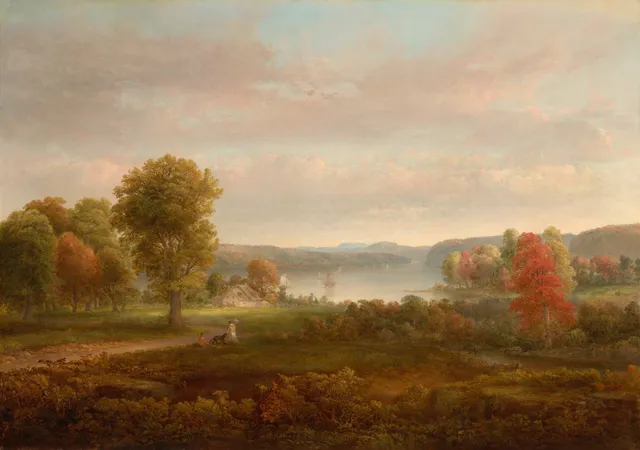
The same reading carries the river pictures. In On the Hudson and View on the Hudson in Autumn, the river is not a navigational fact. It is the artery that ties the foreground to the far light, a path the eye and the imagination follow inland. Autumn, in particular, was a charged season for Doughty's audience. The turning leaves carried the old emblem of mortality and harvest, the year's late ripeness before its end, and a buyer who hung an autumn river scene in his parlor was hanging a meditation as much as a souvenir. Spring Landscape sits at the opposite pole of the same emblem, with its promise of renewal, and the two seasons together form the kind of moral pairing that the period loved.
Ruisdael in Baltimore: the borrowed devotional past
Doughty was largely self-taught, and he learned by copying the European landscapes he could reach, above all in the Baltimore collection of his early patron Robert Gilmor, Jr. (National Gallery of Art). This is not a footnote about training. It is central to what his pictures meant. When Doughty titles a canvas Landscape after Ruisdael, he is naming his ancestry out loud, and he is importing a whole inherited iconography along with the composition.
Jacob van Ruisdael's seventeenth-century Dutch landscapes were themselves moral pictures. Their broken trees, their ruins, their low horizons under enormous skies were read by Dutch and later by English collectors as meditations on time, transience, and divine order in nature. By aligning his American scenery with Ruisdael, Doughty did two things at once. He claimed for raw American material the dignity of an old and respectable European tradition, and he told his viewers exactly which devotional register to listen in. A buyer who knew his Gilmor pictures would recognize the citation and feel the flattery of recognition. The American valley became legible as a successor to the Dutch one, a new theater for the same providential drama. This is the quiet ambition under Doughty's modest surfaces. He was not only making pictures of his country pleasant. He was arguing that they belonged in the company of the masters, and that the moral weight of the old landscape could be transferred to the new world.
What the first viewers brought to the picture
Meaning is a transaction. Half of it is in the paint and half of it is in the head of the person looking, and to recover what Doughty's pictures meant we have to reconstruct what his first audience carried into the room. They carried, first, a Protestant habit of reading the natural world as a second scripture, a book of God's works to be studied alongside the book of his words. A still valley under clear light was, to that habit, not merely attractive. It was edifying. To own such a picture was to keep a small devotional aid on the wall, a prompt to the kind of contemplation the culture prized.
They carried, second, a sharp anxiety about national identity. The republic was young, its cities were growing fast, and educated Americans worried openly that commerce and luxury would corrupt the civic virtue the founders had banked on. Landscape offered a way out of that worry. If the nation's distinction lay not in its art or its history, which were thin, but in the sublime abundance of its land, then a picture of that land was a patriotic object. Doughty's clearings and tended valleys answered the anxiety in the gentlest possible key. They showed a country that could be settled without being spoiled, prosperous and still innocent. The middle distance with its glint of habitation is the precise pictorial form of that hope.
They carried, third, a class aspiration. To buy a landscape, to recognize a Ruisdael citation, to take pleasure in atmosphere and tone rather than in a flattering likeness of one's own face, was to perform a kind of refinement. Doughty's pictures gave the rising merchant and professional class of Philadelphia, Baltimore, and Boston a way to display taste. The angler in the picture, withdrawn and contemplative, was a figure the owner could imagine himself to be, a man whose wealth had bought him the leisure for higher things. The painting was a mirror held at a flattering angle, and the flattery was moral rather than physical.
The archive's evidence
There is a way to test these claims against the run of the work rather than a single famous canvas, and our own holdings make that possible. Artifact World Gallery holds forty-two paintings by Doughty drawn from eleven different collections, spanning roughly 1820 to 1854, which is very nearly the whole arc of his independent career from the year he left the leather trade. Laid side by side, that group does not behave like the output of a topographer. Titles repeat the moral words rather than the place names: river, spring, autumn, view, the fanciful and the after-Ruisdael. The same compositional engine runs through canvas after canvas, the framing trees and the mirrored water and the lit recession, varied in season and weather but constant in structure. An artist documenting specific American sites would give us more proper nouns and fewer moods. Doughty gives us moods, repeated and refined, which is exactly what we would expect from a painter building a vocabulary of feeling rather than a catalogue of places.
The institutional spread matters too. These pictures sit today in major public collections, and the kind of canvas that earned that place is telling. A River Glimpse, now in the Metropolitan Museum of Art (The Metropolitan Museum of Art), wears its meaning in its very title. A glimpse is a partial, framed, withheld view, water seen between leaves, and the word itself describes the picturesque transaction Doughty staged everywhere: the reward of distance offered through the screen of the foreground. The title is an instruction in how to look.
Works discussed in this article
Consider Spring Landscape against View on the Hudson in Autumn as a pair, and the corpus starts to look like a deliberate system. The two canvases are not competing records of two rivers. They are the spring and the autumn of the same moral year, freshness and harvest, and a collector could read them as the period read its devotional almanacs, by the turning of the seasons toward an end. The wonder of Doughty is how lightly he carries all this. Nothing in the surface preaches. The argument is conducted entirely through stillness, framing, and light, which is why a hurried modern viewer can mistake the work for pretty and miss that it is also, quietly, a sermon.
Why the meaning faded, and why it should be recovered
Within Doughty's own lifetime the code began to change. Thomas Cole and the painters who followed him raised the stakes of American landscape, pushing toward the sublime, the operatic, the explicitly allegorical sequence of canvases. Against their thunder Doughty's quiet pools came to look tame, and his reputation cooled while he was still alive. The irony is that the later painters were building on ground he had cleared. The very idea that an American valley could carry moral and national weight, that a buyer should want such a picture and know how to read it, was a habit Doughty had spent the 1820s teaching. The Hudson River School inherited an audience that already knew the grammar.
The meaning faded for a second reason, which is that codes die when their readers do. The Protestant habit of reading nature as scripture loosened. The anxiety about whether a republic could stay virtuous gave way to other anxieties. The picturesque vocabulary became invisible through familiarity, then through neglect, until Doughty's canvases could be filed under generic nineteenth-century scenery and passed without a second look. To stand in front of Fanciful Landscape today and see only a pleasant view is to read a sentence in a language you have forgotten you once spoke.
Recovering the language changes the pictures. The angler stops being staffage and becomes the contemplative ideal of an entire culture. The dark trees stop being mere framing and become the price of admission to a tended distance. The calm water stops being decoration and becomes the still water of the psalm, a promise of order in a country that was not at all sure it would stay orderly. Doughty made small, courteous, deeply intelligent pictures for people who knew how to read them, and they read them as arguments about what their nation might become. The next time one of his quiet valleys catches the light across a gallery wall, the right response is not to admire the view and move on. It is to follow the eye from the shadow to the clearing and notice that the painter has walked you, gently, all the way into an argument.
Sources & further reading
- Thomas Doughty (artist) — Wikipedia
- Thomas Doughty, Artist Info — National Gallery of Art
- Thomas Doughty, A River Glimpse — The Metropolitan Museum of Art
- History of the Rise and Progress of the Arts of Design in the United States (1834) — William Dunlap / Internet Archive
- Hudson River School — Tate
- The Hudson River School — Smarthistory