The genre painter Eastman Johnson spent his working life in motion, and his pictures did too. He trained in Düsseldorf, copied in The Hague, and sketched in Paris, then carried that European discipline home to Maine, to Washington, and finally to a studio off Gramercy Park. The usual way to tell this story is as a homecoming: the American who learned abroad and came back to paint Americans. That version misses the more interesting fact. Johnson's art was shaped less by any one place than by what happened to it on the way between places.
Read his career as a sequence of crossings and the work snaps into focus. A German drawing manner loosened, in transit, into something softer and more atmospheric. A canvas of enslaved people in a Washington backyard left his studio as one kind of picture and arrived on a New York exhibition wall as another, fitted with a sentimental title its maker never chose. A family group commissioned as a status report on Wall Street money became, almost against its own intentions, a study of how children occupy a room. This essay takes Johnson at his most literal: an artist of transit, whose meaning kept changing in the gap between where a picture was made and where it was finally seen.
The crayon limner who went abroad
Before any of the crossings there was a boy with a box of crayons. Johnson began in the mid-1840s as a crayon limner, taking careful black-and-white likenesses of his New England neighbors, a trade documented in Patricia Hills's catalog for his Whitney retrospective. These were not art-school exercises. They were paid work, the period equivalent of the photographer's storefront, and they taught him the thing he never lost: how a face holds a likeness, and how much of a person sits in the set of the mouth and the tilt of the head.
When he sailed for Europe in 1849 he was already a competent draftsman in need of a vocabulary. He found it first in Düsseldorf, then more durably in The Hague, where he spent years copying Dutch and Flemish masters and earned the nickname the American Rembrandt. The National Gallery of Art calls him the foremost genre painter in the United States for many years, and notes that he was among the first American artists of his generation to receive extensive training abroad. What he absorbed in the Low Countries was not a subject but a temperature: warm shadow, a single source of light, paint that describes cloth and skin without bragging about it.
The route mattered as much as the destinations. He reached Düsseldorf when its academy drew ambitious American painters by the boatload, learned its tight narrative drawing, then grew restless with its hardness. The Hague taught him to let an edge go soft. A later spell in Paris loosened the brush further. By the time he recrossed the Atlantic he had filtered several national manners through one temperament, and that filtering, not any single lesson, is what he carried home. The lesson he kept rejecting is as telling as the ones he kept. Düsseldorf wanted every contour sharp and every anecdote legible; Johnson, after a few years of it, wanted the opposite, a picture that withholds as much as it shows.
Genre painting, the category he would make his own, is an old Dutch invention. The form depicts scenes of everyday life and matured in seventeenth-century Holland, which is exactly the school Johnson had gone to study. He took that inheritance across the ocean and pointed it at American material: a Maine cranberry bog, a maple-sugar camp, a Nantucket cornhusking, a child at a window. The manner was European. The weather was not. He was importing a Dutch way of seeing and using it to look at a young, raw country that had no settled picture of itself, and the friction between the polished method and the rough subject is where his best work lives.
A title that traveled
The clearest case of a Johnson picture changing in transit never had to leave the catalog. In 1859 he showed a large canvas of African American life set in the backyard of his own father's house in Washington. He titled it Negro Life at the South and first exhibited it at the National Academy of Design in New York. The painting was a sensation, and then the name slipped. As Wikipedia's account of the work records, the Home Journal ran a feature that retitled it Old Kentucky Home, after the Stephen Foster song, and the borrowed name stuck so completely that it has shadowed the picture ever since.
That re-titling is Johnson in miniature. He had painted a specific place, a Washington slum a few blocks from the Capitol, with documentary attention to its leaning fences and crowded yard. Audiences, reading from a distance, relocated the scene to a mythical Kentucky plantation and folded its ambiguities into a nostalgic ballad. The picture traveled the length of a single magazine article and arrived somewhere its maker had not sent it. Whatever Johnson intended, his most famous antebellum work became, in transit, a screen onto which a divided country projected the version of slavery it preferred to see.
The picture is still moving. It survives under a double name, the original title now usually printed beside the borrowed one, and the standard account of Johnson's life treats the episode as the hinge on which his early reputation turned. The lesson he seems to have drawn from it was practical. After 1859 the most charged of his subjects came wrapped in the safety of the domestic interior, where a viewer was less free to invent a story the paint did not support. He had learned what happens to a picture once it leaves the studio, and he started building his canvases to survive the trip.
Close looking: The New Bonnet
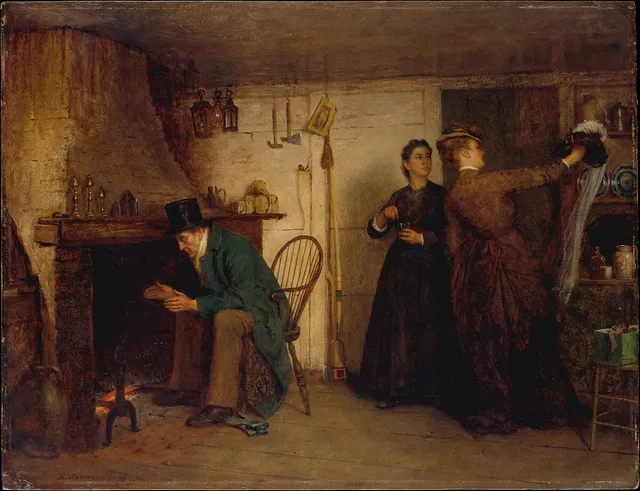
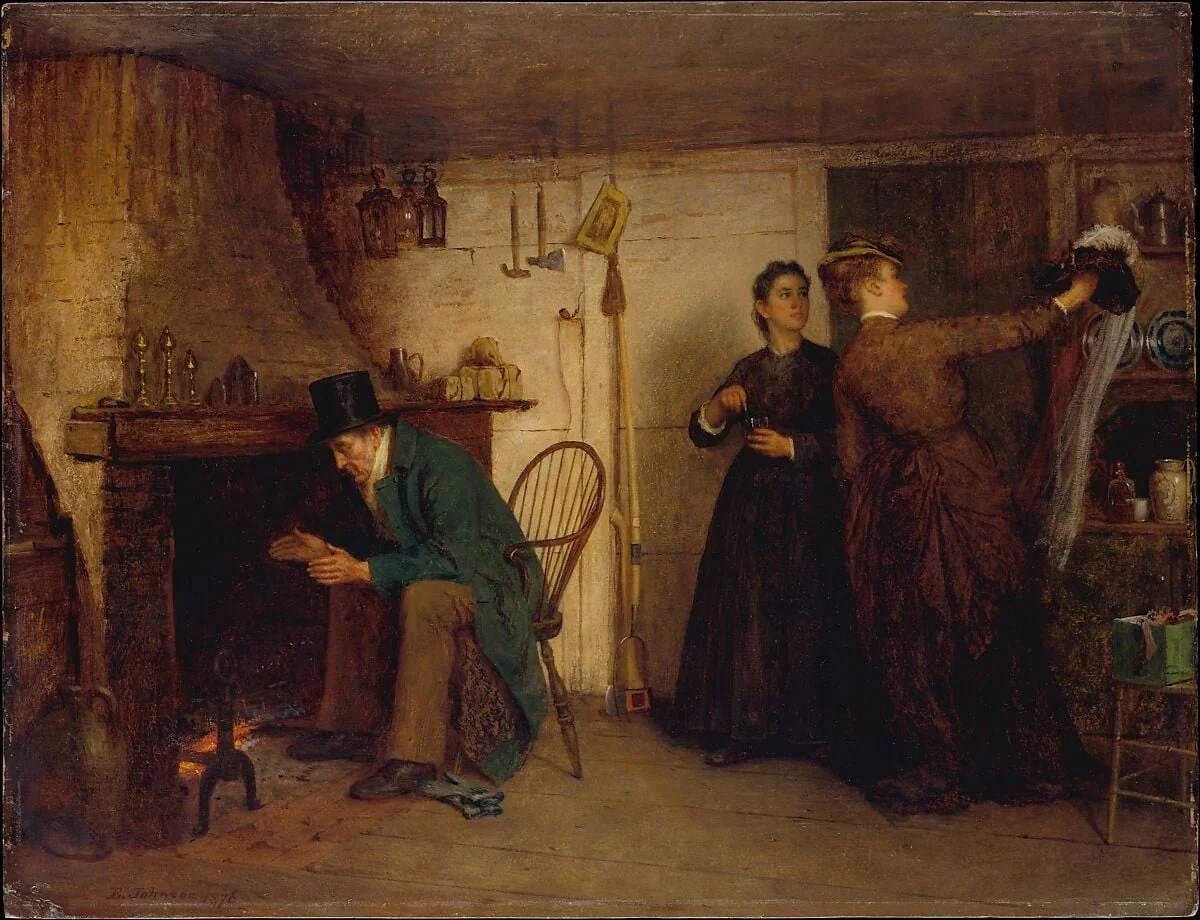
Watch how differently he behaves when the stakes are purely domestic. The New Bonnet, from the mid-1870s, sets a small drama in a plain interior. A young woman sits turned in her chair with the new bonnet held up in both hands, so the light catches its pale ribbon. An older woman leans in to inspect it, and an old man sits back, half in shadow, somewhere between indifferent and amused. Johnson stages the whole transaction along a diagonal of attention: the bonnet is the brightest object in the room, and every glance in the picture bends toward it.
The handling is where the European years pay off. The back wall dissolves into a warm brown nothing, the floorboards are barely indicated, and the paint thickens only where it has to: on the bonnet, on the white of a collar, on the lit edge of a cheek. He spends his detail like a man on a budget. A lesser genre painter would have itemized every chair and shelf. Johnson lets the room go soft so that the small vanity at its center, a woman pleased with a hat, reads as the only fact worth recording. Notice too how he refuses to mock her. The older woman's scrutiny could have tipped into caricature, the kind of broad village comedy the Düsseldorf manner encouraged, and Johnson holds it back to something gentler and harder to read. The picture is quiet about its own skill, which is the most Dutch thing about it.
A picture on horseback
The Civil War gave Johnson his other unforgettable image, and it too is about movement. A Ride for Liberty, The Fugitive Slaves, painted in 1862, shows an enslaved family on a single horse, riding hard toward Union lines at first light. Smarthistory's reading of the painting places the scene at a precise moment of the war, when nearness to the Union army turned flight into a plausible bid for freedom. Johnson said he based it on something he had witnessed near a battlefield in Virginia. The subject is transit as survival: a family in the act of changing where they live and, by crossing a line on a map, what the law says they are.
Set that canvas beside the re-titled Old Kentucky Home and the comparison does Johnson's arguing for him. One picture was softened by its audience into plantation nostalgia. The other refuses softening. The riders are not picturesque. They are urgent, low over the horse's neck, the woman's face turned back toward whatever they are fleeing. Johnson, who could trade in sentiment when it suited him, here paints a hard fact moving fast across the frame, and leaves the viewer no comfortable place to stand. The picture even resists the easy resolution of a destination. We never see the Union line. We see only the motion toward it, the family caught between one legal condition and another, which is exactly the kind of in-between state Johnson spent his career learning to paint.
The brokers and their families
After the war the commissions changed. The men paying Johnson were now the new money of a booming New York, and they wanted their households recorded in their parlors. His group portrait The Hatch Family, painted across 1870 and 1871, is the monument of this phase. It was commissioned by Alfrederick Hatch, a Wall Street broker who would go on to preside over the New York Stock Exchange, and, as the Metropolitan Museum notes, Johnson himself rated it his finest group portrait.
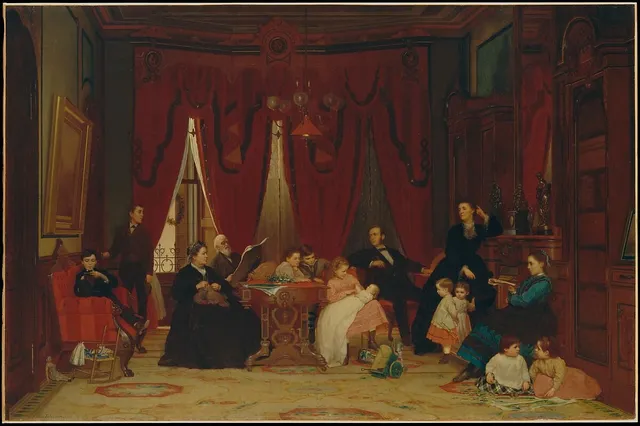
The painting gathers three generations across a single Park Avenue library, and the wonder of it is how unposed it feels. The grandfather reads near the window, children sprawl on the carpet, and the adults arrange themselves around the room's furniture as if Johnson had simply walked in and caught them. He has hidden the labor of the group portrait, which is its hardest trick. Coordinating that many figures in one believable space, each lit and weighted so no one reads as filler, is the sort of problem most painters solve by stiffening everyone into a row. Johnson solves it by pretending there was no problem at all. Our own holdings show how steadily this kind of work accumulated: Artifact World Gallery keeps sixty-eight works under Johnson's name, drawn from thirteen institutions and spanning roughly 1842 to 1896, half a century in which the crayon limner became the painter of choice for families who wanted their rooms to outlast them.
The same instinct drives Christmas-Time, The Blodgett Family, another interior built around the small business of a household at ease. These pictures are not flattering in the cheap sense. Johnson keeps the lesson he carried back from The Hague: light does the praising, and it falls only where he decides it should. A patron got his family, and posterity got a Dutch interior with American furniture. The bargain was a good one for both sides. The sitters secured the permanence they were paying for, and Johnson got to keep practicing the only thing he had ever really cared about, the behavior of light on people in rooms.
Close looking: a colleague's face
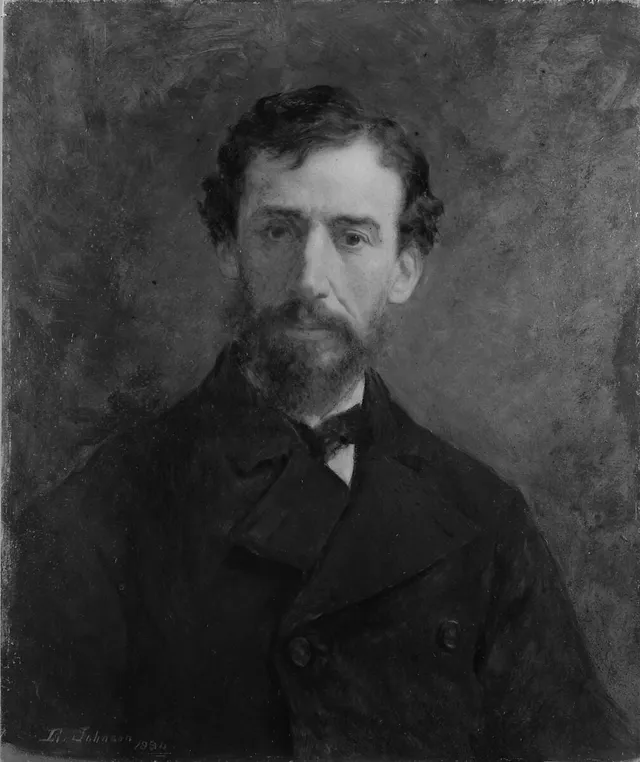
The portrait of the landscape painter Sanford Robinson Gifford is a different kind of likeness from the commissioned grandeur of the Hatch library. Here Johnson is painting an equal, and the picture carries the plainness of shop talk. The head sits close to the picture plane, the background kept to a low murmur of tone, and the light gathers on the brow and the bridge of the nose, the working parts of a man who looked at landscapes for a living. There is no setting to speak of, none of the parlor inventory the brokers wanted. Johnson trusts the face to do the work, the same wager he had made as a teenager with a box of crayons.
The economy is deliberate. A portrait like this stands closer to the crayon heads of the 1840s than to anything he learned in Europe, except that the European years taught him how little he needed. The brown ground that swallows the room in The New Bonnet does the same job behind Gifford, isolating the head so that character has nowhere to hide. When the subject is another painter, that nakedness becomes a kind of professional respect. Johnson is not dressing Gifford up. He is showing him the way one craftsman sizes up another, by the face and nothing else.
Back to the single head
Johnson never stopped painting single heads, the format he had started with as a boy. His portrait of the landscape painter Sanford Robinson Gifford is a colleague's likeness, made with the unfussy sympathy of one professional studying another. His Joseph Wesley Harper, Jr. records one of the publishing Harpers with the same economy. Late in life he painted Grover Cleveland, the sitting president, and the crayon limner's first question is still the operative one: where does the likeness live? In the Cleveland, it lives in the heavy, deliberate set of the jaw, and Johnson is content to let it stay there. He had been answering that single question for fifty years, and he had stopped needing anything else in the frame to help him answer it.
Gifford belonged to the same New York circle as landscape men like Thomas Moran and printmakers like James David Smillie, the professional milieu Johnson helped turn into an institution. These were artists who had also crossed the Atlantic for their training and brought European method to bear on American ground. Johnson's distinction within that company is that he kept the figure at the center while the landscapists chased the view. Where they went looking for the country, he stayed in the room and waited for the country to walk in.
Works discussed in this article
The early crayon portraits are mostly lost now, dispersed through New England attics, and there is a rightness to that. Johnson's work was always going somewhere, gathering and shedding meaning as it moved: a German style softened by an ocean, a Washington backyard rebranded as a Kentucky idyll, a broker's family quietly reclassified by the painter into a picture about light. The works that survive are the ones that landed, and they still carry the marks of the trip. Stand in front of any of them and you are looking at the end of a long journey, the place where a restless method finally held still long enough to fix a face.
Sources & further reading
- Eastman Johnson — Wikipedia
- Negro Life at the South — Wikipedia
- Eastman Johnson (Whitney Museum retrospective catalog, Patricia Hills, 1972) — Internet Archive
- Eastman Johnson, Artist Info — National Gallery of Art
- Eastman Johnson, A Ride for Liberty, The Fugitive Slaves — Smarthistory
- The Hatch Family (1870-71) — The Metropolitan Museum of Art
- Genre painting — Tate
- Eastman Johnson (ULAN ID 500008685) — The Getty Research Institute