Every portrait that the painter Adélaïde Labille-Guiard signed answers two questions at once: who held the brush, and who held the purse. Read across the thirty years she worked in Paris, her career is the record of an artist who grasped that the second question governed the first. She did not paint to please an open market of strangers. She painted named people who held rank, and she let the sitter's standing become part of the picture's argument. Born in Paris on 11 April 1749, dead there on 24 April 1803, she lived her whole working life inside a patronage economy that decided which women could even hold a Salon wall, and she spent that life bending the economy rather than waiting for it to change.
Here is the thesis this essay will defend, work by work. Labille-Guiard's achievement was not that she escaped dependency on patrons; it was that she converted dependency into authority. When she chose to sit at the easel for her own self-portrait, when she accepted the commission to paint the unmarried aunts of Louis XVI, when she kept working through the Revolution that beheaded several of her sitters, she was always doing the same thing: turning the identity of the person who paid into evidence for the standing of the person who paints. The two questions are not separate. The choice of sitter, the scale of the canvas, the genre invoked in a shadowed background, each is a decision about standing, and she made every one of them carry weight. To ask who paid for a Labille-Guiard is therefore not a footnote to looking at one. It is the way in.
A seat among four
The first patron in her story was an institution. On 31 May 1783 the Académie Royale de Peinture et de Sculpture received Labille-Guiard and her exact contemporary Élisabeth-Louise Vigée Le Brun on the same day, the first women admitted in that sitting (Wikipedia). Admission was not a courtesy. It carried the right to exhibit at the official Salon in the Louvre, which was the only stage in France where a portraitist could build a reputation that translated into commissions. Membership was the gate, and the gate had a count.
That count is the hard fact behind everything else. The Academy capped its female members at four at any one time, a ceiling the Met's Heilbrunn essay states plainly (The Met), and which Smarthistory frames as the institution's deliberate restriction on how many women it would ever seat (Smarthistory). Four. Two of those four slots filled in a single afternoon meant the supply of legitimacy was nearly exhausted at the moment two rivals walked through it together. The rivalry between Labille-Guiard and Vigée Le Brun that gossip turned into a catfight was, underneath, a fight over a scarce credential. Two seats remained, and every other ambitious woman in Paris knew it. Labille-Guiard answered the scarcity the way a strategist would: by making her membership visible, defended, and impossible to read as a favor.
She had trained partly under the miniaturist François-Élie Vincent and then more decisively in the orbit of his son, the history painter François-André Vincent, whom she would marry in 1800. The connection mattered for craft, but it also mattered for the politics of reputation. A woman who painted heads needed proof that she could do more than flatter, and the proof had to be the picture itself. No letter of recommendation, no studio pedigree, would settle the question of whether she could carry a wall. Only a canvas could.
The self-portrait as a sales pitch
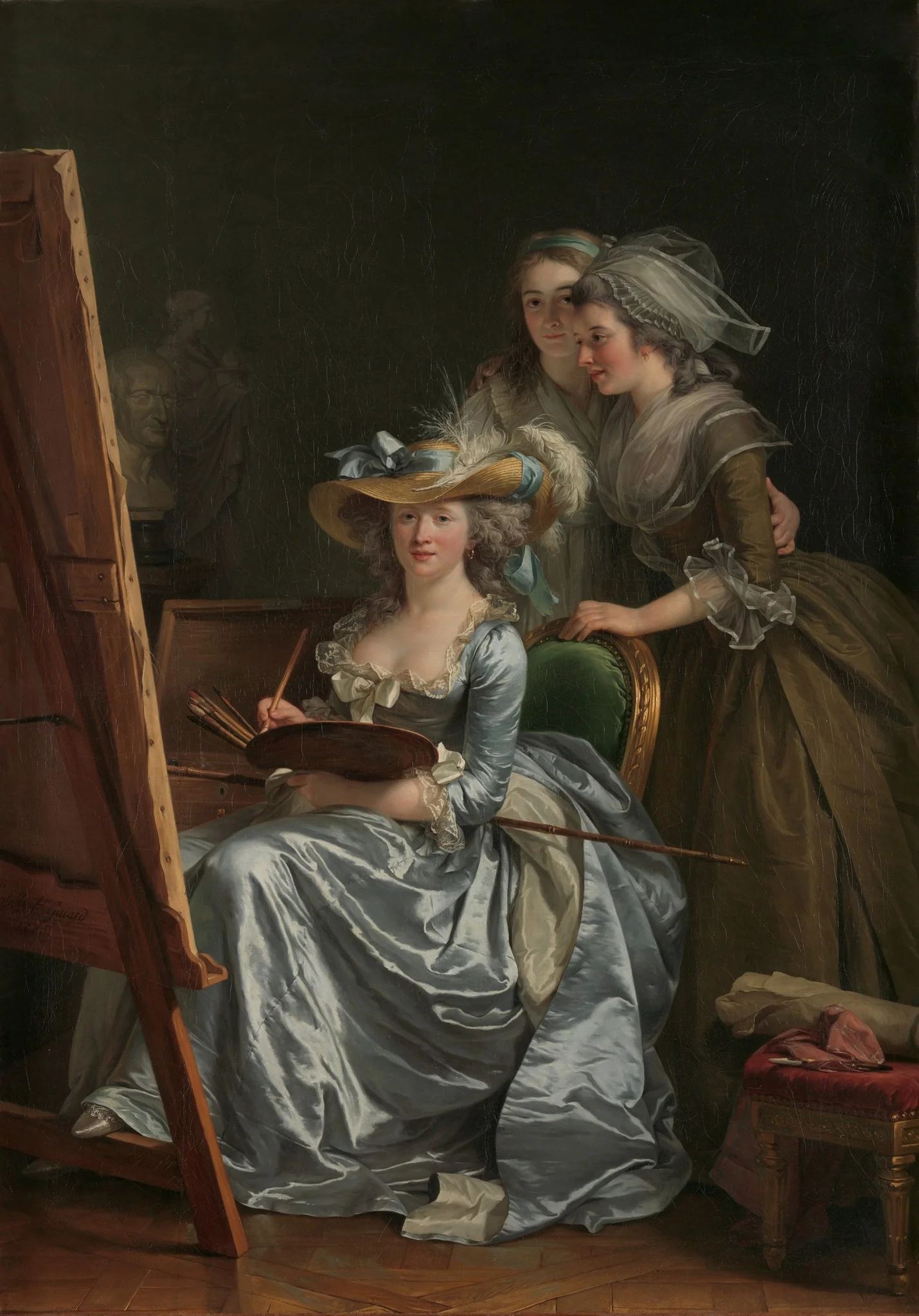
Two years after her admission she answered the whole problem in one canvas. The Self-Portrait with Two Pupils, painted in 1785 in oil on canvas and standing 210.8 by 151.1 centimetres, hung at that year's Paris Salon and now belongs to the Metropolitan Museum of Art (The Met). It is life-size. That decision is the first argument. A self-portrait at the scale reserved for grand commissioned portraits says, before a single brushstroke is read, that the woman shown is worth the wall space a duchess would get.
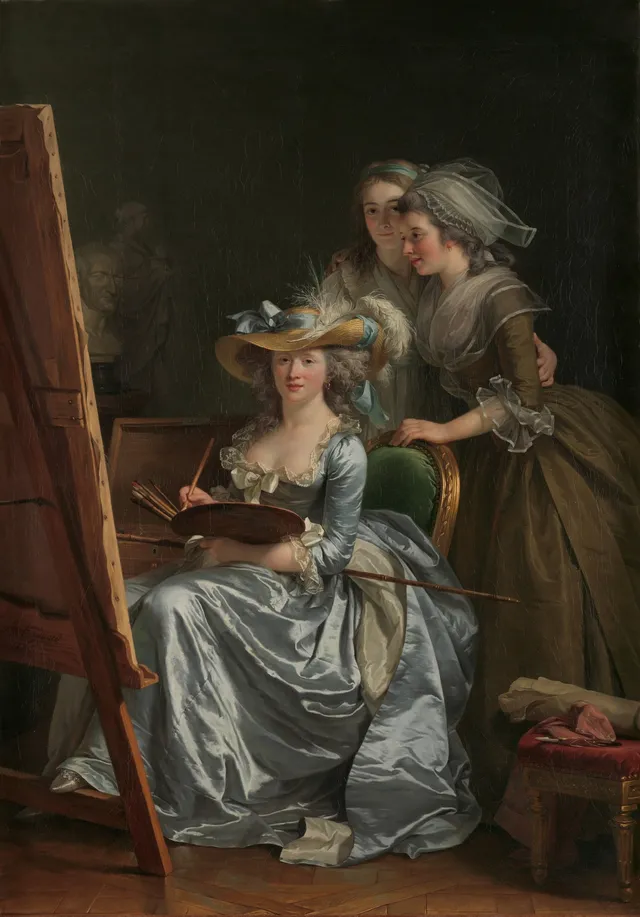
Look at how the canvas is built. Labille-Guiard sits turned toward us at her easel, the brush poised but not working, as if she has just looked up from the painting we cannot see. The skirt of her blue-grey satin dress spills across the lower third of the picture in a broad sheet of reflected light, and that mass of silk does real compositional labor: it anchors her to the floor, gives her bulk and gravity, and stops the figure from reading as a decorative bust. Behind her right shoulder two young women lean in. These are her pupils Marie-Gabrielle Capet and Marie-Marguerite Carraux de Rosemond, and they are not props. One peers around to study the canvas, the other watches the painter's hand. Their attention does the work that an inscription would do in a lesser picture: it certifies that this woman teaches, that students attend her, that an atelier exists around her. A glimpse of antique sculpture in the dim upper background drops the word that the Academy most wanted to hear, history, the elevated genre women were barred from practicing professionally. She cannot exhibit a history painting, so she paints herself as someone steeped in it.
Consider the handling of the dress against the handling of the flesh. The satin is laid in with broad, confident sweeps, the highlights dragged across the weave so the fabric reads as a single luminous plane, while the face and hands are built up slowly, in small touches that keep the skin from looking waxen. The contrast is deliberate. A painter advertises her range by showing two ways of moving the brush in one picture, the bravura passage and the patient one, the showpiece and the likeness. The plumed hat tips the figure toward fashion without surrendering the gravity the pose insists on. Nothing here is left to charm alone.
The face is the quiet center. It is lit cleanly, modeled without the powdered sweetness that sold so many fashionable portraits of the decade, and it meets the viewer with composure rather than charm. There is no flourish about mastery here; there is a woman at her trade, dressed expensively, watched by her students, declaring that she belongs in the room. The picture is a self-portrait in subject and a manifesto in function. Its true addressee is the patron who has not yet hired her, and its message is a single sentence: I can do this for you, at this size, at this level, and you will be in good company.
One of those two pupils, Marie-Gabrielle Capet, became a painter of standing in her own right and stayed close to her teacher for the rest of Labille-Guiard's life. The studio shown in the 1785 canvas was not a fiction arranged for the Salon. It was a working enterprise, and the women in it were the artist's own evidence.
Mesdames: painting the king's aunts
The manifesto worked. The patrons who answered were as high as a woman painter could reach short of the queen herself, whom Vigée Le Brun had already claimed. Labille-Guiard secured the aunts of Louis XVI, the unmarried daughters of Louis XV known collectively at court as Mesdames. To paint them was to be folded into the royal household's image of itself, and the commissions came with a guaranteed audience: portraits of the Mesdames would be seen, copied, and circulated as statements of dynastic continuity.
Her portrait of Marie-Adélaïde of France, known as Madame Adélaïde is the kind of picture that justifies the whole strategy. The princess is presented full length, in command of her space, surrounded by attributes that argue for the dynasty rather than for the woman's vanity. Every accessory points outward, away from private feeling and toward the house she stands for. The companion portrait of her sister, Madame Victoire of France, works the same register of seated authority. These are not intimate likenesses. They are state objects, and the painter who could deliver state objects at this scale had answered the doubt that hung over every woman in the Academy. A patron does not entrust the public face of the royal family to a flatterer; he entrusts it to a craftsman whose competence is beyond dispute.
The royal program reached backward in time as well. The Portrait of Elisabeth of France, Duchess of Parma records a daughter of Louis XV who had died in 1759, decades before Labille-Guiard could have seen her sit. A portrait of the dead is a portrait made entirely for the living patron's purposes, assembled from earlier images to complete a family set. It is patronage in its purest form, where the sitter contributes nothing and the buyer's wish for a coherent dynastic gallery supplies the entire reason the canvas exists.
Set beside the Bourbon princesses, the Portrait of Madame de Genlis shows the other half of her clientele. Stéphanie de Genlis was the governess to the children of the Duc d'Orléans and a writer of real ambition, a figure of the enlightened, reform-minded aristocracy rather than the throne. Labille-Guiard painted both camps. She took the king's aunts and she took the household of the Orléans branch that would soon supply the Revolution one of its princes. A painter who courts both sides of a coming rupture is reading the patronage map more carefully than her sitters are, and she is hedging the way a prudent professional hedges, by refusing to belong to any single faction's fortunes.
Works discussed in this article
From the crown to the Convention
Then the patrons started dying. Madame Élisabeth, the youngest sister of Louis XVI, sat for Labille-Guiard while she was still a princess of the blood with a private circle and the freedom to commission likenesses of her own. The artist's portrait of Madame Élisabeth dates her sitter, in the corpus record, to a life that closed in 1794. The princess went to the guillotine that May. A portrait that began as an aristocratic commission became, within a few years, a relic of an executed woman, and its market value flipped from celebration to memory.
This is the hinge of her whole story. A painter whose reputation was built on royal patronage faced ruin when the Revolution made royal association lethal. Labille-Guiard did not flee, and she did not pretend her past clients away. She adapted her clientele. She painted deputies of the new National Assembly, members of the political class that had replaced the court, and she kept her atelier running. In 1795, under the very Republic that had dismantled the monarchy she had served, she became the first woman artist permitted to set up a studio for herself and her students inside the Louvre (Wikipedia). The building that had housed the royal Salon now housed her teaching practice. The same competence that had served Mesdames served the Republic, because competence in portraiture is a transferable asset and Labille-Guiard treated it as one.
The ledger
What does the surviving body of work tell us when we count it rather than admire it? Artifact World Gallery holds nine works by Labille-Guiard, spread across seven different institutions and clustered in the decade from roughly 1789 to 1799. That distribution is itself an argument. A painter whose output had scattered into seven public collections, with the densest run of dated pieces falling on either side of 1789, is a painter the Revolution did not erase. The cluster around 1789 is telling on its own: her busiest documented years coincide exactly with the moment the political ground was shifting under everyone she painted. The Getty's scholarly monograph on her, pointedly titled to place her in the Age of Revolution, documents a patron base that ran from the aunts of Louis XVI all the way to the future American president Thomas Jefferson (Getty Publications). Hold that range against our seven-venue spread and the shape of the career sharpens: a portraitist who supplied courts, salons, reformers, and a visiting republican, then watched her work disperse to the museums that now keep it.
Her range of media reinforces the point. The National Gallery of Art in Washington holds her pastel of a fashionable noblewoman in a plumed hat, made around 1789 on blue laid paper mounted to canvas (National Gallery of Art). Pastel was the medium of the quick, lucrative society likeness, the kind of work that paid the studio's bills between grand oil commissions. A painter who could move between a two-metre Salon machine and an intimate pastel head was a painter who could serve a patron at any budget, and serving patrons at any budget is how an atelier with pupils stays open through a decade of upheaval. The blue paper is a working choice as much as an aesthetic one: it lets the chalk sit fast and bright, the kind of economy a busy professional builds into her process.
It is worth recovering how early this case was made. The baron Roger Portalis published the first substantial monograph on her, covering the years 1749 to 1803, back in 1902 (Internet Archive). More than a century of scholarship has refined the dates and re-attributed the doubtful pictures, yet the central reading has held: this was a professional who managed her patrons with the deliberateness of someone who knew the slots were scarce and the regimes were unstable.
Stand back from the catalogue and the lesson of these nine works is blunt. Labille-Guiard did not win her place by transcending the patronage system, and the romantic story of the lone woman genius does her a disservice by pretending she did. She won it by reading the system better than her competitors, by making her own face into the credential the Academy would not freely grant, and by keeping her clientele alive across a revolution that killed several of the people she had painted. Look again at the woman at the easel in the 1785 self-portrait, brush raised, two students at her shoulder, an antique cast dissolving into the dark behind her. She is not asking permission. She is quoting her own price.
Sources & further reading
- Self-Portrait with Two Pupils, Adélaïde Labille-Guiard — The Metropolitan Museum of Art
- Adélaïde Labille-Guiard (1749-1803), Heilbrunn Timeline of Art History — The Metropolitan Museum of Art
- Adélaïde Labille-Guiard — Wikipedia
- Adélaïde Labille-Guiard: Artist in the Age of Revolution — Getty Publications
- A Fashionable Noblewoman Wearing a Plumed Hat (c. 1789) — National Gallery of Art
- The Royal Academy in France — Smarthistory
- Adélaïde Labille-Guiard (1749-1803), Roger Portalis, 1902 — Internet Archive