John Constable's landscape painting is usually praised for what it feels like: damp Suffolk air, a sky about to turn, the particular green a meadow takes on after rain. The praise is fair, and it skips the question that actually matters. How was that feeling manufactured? Constable did not inherit it from a master and he did not dream it up at an easel indoors. He assembled it out of specific materials and a specific working routine, repeated for forty years until the procedure hardened into a style. The claim of this essay is plain. Constable is best understood as a maker rather than a seer, a craftsman whose celebrated naturalism is the visible residue of palette-knife scrapes, flecks of lead white, oil studies done outdoors in the weather he was painting, and a deliberate decision to work big.
That argument has a sharper edge than it first sounds. We tend to file Constable under feeling and his great rival Turner under technique, as if one man merely recorded and the other invented. The evidence runs the other way. Constable's pictures are heavily engineered. The looseness is achieved, not given, often laid down late over careful drawing and a full-scale rehearsal canvas the public never saw. What reads as a clear window onto Dedham Vale is in fact a built surface, and the building is the whole subject. Treat the brushwork as the story and the biography starts to make sense: the slow career, the late honors, the obsessive return to a few square miles of his father's country.
A painter who never left home
Constable was born on 11 June 1776 and died on 31 March 1837, the son of a prosperous Suffolk corn merchant who owned mills at Flatford and Dedham (biographical record). He grew up inside the machinery he would spend his life painting: the locks, the towpaths, the barges, the working water. He never travelled outside England, not once, while contemporaries crossed the Alps to Rome as a matter of course (as the Metropolitan Museum notes). His material was local and his ambition was not. He wanted landscape, the lowest rung of the academic ladder, to carry the seriousness of history painting, and he wanted to do it with the dirt of one English valley.
Recognition came grudgingly. His first real financial security arrived in 1819, when he sold The White Horse, the first of his large canvases, for one hundred guineas to his friend the clergyman John Fisher. He was elected a full member of the Royal Academy only in February 1829, at the age of fifty-two, an age at which most academicians were coasting on reputation. The lateness is usually told as a tale of neglect. It is better read as a symptom of method. Constable's pictures looked unfinished to a jury trained on smooth, varnished surfaces. The very handling that later generations would call truthful was, to his own, a problem of manners.
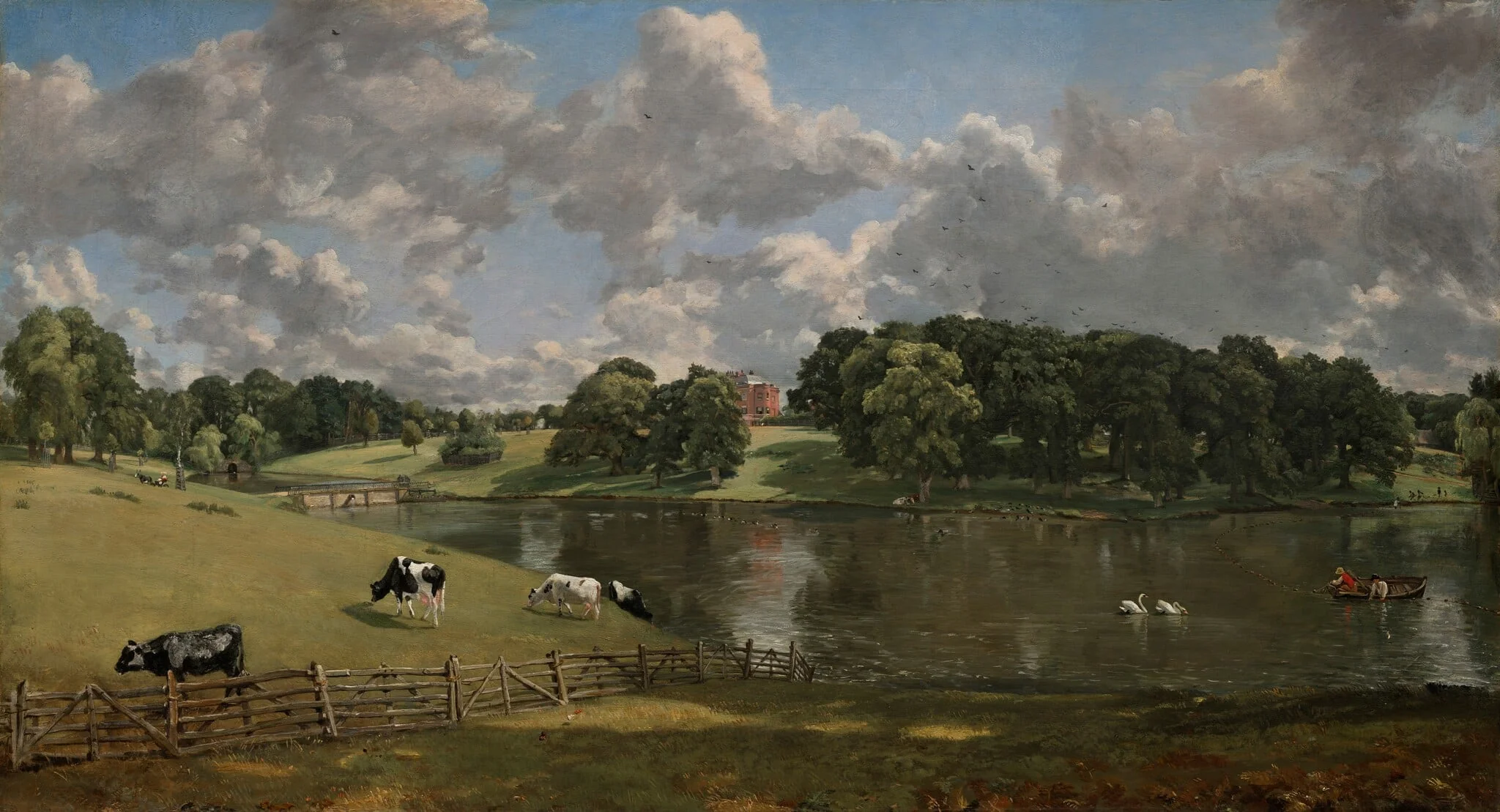
Look hard at Wivenhoe Park, Essex, painted in 1816 for General Rebow, and you can watch the procedure assemble itself. The picture is wide and low, the horizon pressed down so the sky takes most of the canvas. A dark line of cattle stands ankle-deep at the left, doubled by a flat reflection that Constable lays in with a few horizontal strokes rather than any careful mirroring. The water in the foreground is not blue. It is a worked grey-brown shot through with small commas of light, the paint sitting on the surface where the sun catches a ripple. Run your eye to the right and a swan glides toward a little bridge, and beyond it the house sits small and pale under a bank of cloud that is doing real meteorological work. The composition tilts the whole park gently up toward the viewer, so the field reads as something you could walk into. This is observation turned into a recipe: low sky, a band of trees, animals for scale, and a foreground built from broken touches of light on wet ground.
The oil sketch as the real laboratory
The single most important fact about Constable's craft is invisible in the finished pictures, because it happened before them. He painted oil sketches outdoors, in front of the thing, fast. Boards, paper, small canvases, often dated and timed on the back with the hour and the wind direction, as if he were keeping a weather log rather than making art. These were not studies in the genteel sense of preparatory drawings. They were the laboratory where the style was discovered. Working at speed, with the light moving on him, Constable was forced to abandon detail and find shorthand: a dab for a far tree, a dragged stroke for a shadow crossing a field, a scumble of grey for rain three miles off. The shorthand worked, and he spent the rest of his career importing it into pictures meant for the wall.
His cloud studies are the purest case. Across the early 1820s, working on Hampstead Heath, he produced sky after sky with the date, time, and weather inscribed on the reverse. He called the sky the chief organ of sentiment in a landscape, the thing that set the key for everything below it. To get it right he treated meteorology as a discipline, not a mood. The lesson he took back to the studio was that a sky cannot be invented convincingly. It has to be built from remembered observation, layer on layer, so that the highlight on a cumulus edge sits where physics would put it. He was not alone in this open-air instinct. Across the Channel the Munich painter Johann Georg von Dillis was making small plein-air oil studies in the same decades, part of a quiet European shift toward painting the actual visible world before composing it. Constable simply pushed the practice further and made it the engine of finished work.
The scale of his return to a few subjects is striking once you count it. Artifact World Gallery holds 425 works by Constable spread across twenty-three venues, ranging from drawings and sketches of around 1796 to the late canvases of the mid-1830s. That spread is the shape of an obsessive. A painter who travels collects new motifs. Constable instead re-walked the same towpath between Flatford and Dedham, the same view of Salisbury Cathedral, the same mill stream, painting them again and again across four decades. The archive of his output is less a tour of the world than a record of one man perfecting a way of seeing two or three places he already knew by heart.
Constable's snow: the white that broke the rules
The most recognizable feature of Constable's mature surface is the one his critics hated most. He flicked and dragged small touches of pure lead white across his greens and browns, sometimes with a knife, to mimic the way wet leaves, broken water, and dewy grass catch direct light. Contemporaries mocked it as snow scattered over the landscape, and the nickname Constable's snow stuck. It is a material trick before it is anything else. Up close the flecks read as nothing, lumps of opaque paint sitting proud of the surface. Step back and they fuse into the shimmer of light on a damp world. He had found, empirically, that you cannot paint the sensation of glitter with a smooth blended highlight. You have to give the eye separate hits of light and let it do the mixing.
This is why The Mill Stream rewards close looking. The water is the engine of the picture, and Constable refuses to make it glassy. He builds it from short, broken horizontals, dark green where the bank reflects, then sudden cold whites where the current breaks against a post or the light falls through the trees. The mill itself is solid and dull by comparison, a block of warm brick anchoring the left, because its job is to hold still while the water moves. The whole design is a contrast of the fixed and the flickering, and the flickering is made of physical paint, dabbed on last. He is not describing a stream so much as reconstructing the optical event of standing beside one.
The technique sat against the grain of academic taste, which prized a finished surface where you could not see the hand. Set Constable beside a contemporary like the sculptor and draftsman John Flaxman, whose neoclassical line drawings reduce the world to pure contour, and the gap in values is obvious. Flaxman trusted the edge. Constable distrusted it. For him an outline was a lie the eye never actually sees, because in the open air objects dissolve at their boundaries into light and atmosphere. His broken touch was a theory of vision worked out in lead white and oil.
The six-footers: rehearsing a landscape at full scale
From around 1819 Constable mounted his boldest material gamble. He began painting a sequence of canvases roughly six feet wide, the so-called six-footers, scaling up rural subjects to a size the Academy reserved for history and myth. The White Horse opened the series in 1819 and the late Salisbury Cathedral from the Meadows of 1831 stands near its close. The size was an argument: a Suffolk barge crossing a lock deserved the same wall presence as a coronation or a battle. To manage that scale, Constable did something almost no landscape painter had done before. He made full-size oil sketches, six feet wide, as private rehearsals before committing to the exhibition canvas. The Tate, which has studied his materials closely, records his own measure of seriousness, that he did not feel himself properly at work unless he stood before a six-foot canvas (Tate, on the six-footer technique).
These full-scale sketches changed everything, because they let him be violent. Freed from the obligation to finish, he attacked the rehearsal surface with the palette knife, slashing in skies and water with a speed and roughness that the final picture would then absorb in tamed form. The sketches are now often loved more than the finished works, precisely because the procedure shows raw. They are the place where Constable's hand is least polite and his weather most alive. The lesson for the finished canvas was that energy could be planned. He could storm through the rehearsal, learn where the picture needed to break and where it needed to settle, then carry that knowledge into the public version without losing his nerve.
The crowning six-footer of the early sequence, The Hay Wain of 1821, now in the National Gallery in London, is the clearest statement of the whole ambition. By presenting his father's farmland, a cart fording the millpond at Flatford, on the scale of grand history, Constable is largely credited with reviving the very status of landscape in the nineteenth century (as Smarthistory argues). The painting that proved an ordinary English afternoon could fill a monumental frame did its decisive work abroad. Shown at the Paris Salon of 1824, The Hay Wain won Constable a gold medal from Charles X and detonated among younger French painters. Théodore Géricault had already seen Constable's work and admired it, and the broken, light-charged surface helped push a generation toward what became the Barbizon school and, downstream, Impressionism. A man who never crossed the Channel reshaped painting on the other side of it through the sheer physics of his brushwork.
Works discussed in this article
The cathedral, the church, and the limits of the method
Constable's other obsessive motif was architecture under sky, and Salisbury Cathedral from the Bishop's Garden shows how the method bent to meet hard, man-made geometry. He painted the cathedral many times for his friend Bishop Fisher, and the challenge was the spire, the tallest in England, a needle of stone that demands precise drawing. Here the broken touch retreats. The spire is firmly described, its silhouette crisp against the cloud, because Constable understood that the picture's tension came from setting that exact vertical against the soft, mobile foliage of the bishop's trees framing it. The greenery is handled with all his usual flicker; the stone is not. He let the subject dictate where the hand could be loose and where it had to be tight.
A related canvas, Salisbury Cathedral from Lower Marsh Close of 1820, now in the Andrew W. Mellon Collection at the National Gallery of Art in Washington, makes the same negotiation between observed stone and invented weather (National Gallery of Art). The smaller country churches let him relax further. Stoke-by-Nayland and Tottenham Church treat their towers as warm masses nested in trees rather than as feats of drawing, and the brush is freer for it. Across these church pictures you can read Constable calibrating, raising and lowering the precision of his touch to match how much the structure mattered to the design.
From paint to plate: the late mezzotints
Constable's last major project pushed his thinking about light and texture into a second medium entirely. Between 1830 and 1833 he collaborated with the engraver David Lucas on a series of mezzotints titled Various Subjects of Landscape, Characteristic of English Scenery, intended as a printed manifesto of his ideas about landscape (per the Metropolitan Museum). Mezzotint was a shrewd choice. It is a tonal process that works from dark to light, the engraver burnishing brightness out of a roughened black plate, which is uncannily close to how Constable scratched and dragged highlights into a dark landscape with his knife. He pushed Lucas hard over proof after proof, chasing the exact balance of gloom and burst-through light, the chiaroscuro of nature as he called it. The prints prove the consistency of the whole enterprise. Whether in oil or ink, his subject was the behavior of light across a worked surface.
English landscape printmaking had its own strong tradition by then, with etchers like George Cuitt the Younger working the picturesque ruin and the topographical view. Constable's mezzotints were after something less decorative. He wanted the plates to teach a way of feeling weather, to fix in reproducible form the meteorological seriousness he had spent his life building. The project did not sell well in his lifetime. As a record of intent it is invaluable, because it is the closest thing he left to a written theory, set down in tone rather than words.
Why the method outlived the man
Constable died in 1837 without the wealth or the easy fame of Turner. The procedure he invented outlasted both. His insistence that a landscape be built from outdoor observation rather than studio convention, his broken touch, his treatment of the sketch as the place where truth lives, all of it fed directly into French painting after the Salon medal and surfaced again in the Impressionist habit of laying separate strokes of color side by side. The path runs from a Suffolk millpond to a Paris boulevard, and it runs through technique, not sentiment. What Constable proved is that feeling in painting is a manufactured thing, assembled from pigment and decision and a great deal of looking, and that the assembly can be taught.
So the next time a Constable sky seems to move, resist the urge to call it magic. Walk up to the canvas until the illusion falls apart into lumps of paint, find the flecks of lead white sitting on the green, and notice the knife marks under the cloud. The magic is still there when you step back. It is just that you now know how it was made, and knowing makes the achievement larger. A man who never left England built the weather of one valley so convincingly that the rest of Europe came to him.
Sources & further reading
- John Constable — Wikipedia
- In depth: Salisbury Cathedral from the Meadows, the six-footer paintings — Tate
- Constable, The Hay Wain — Smarthistory
- John Constable (1776-1837) — The Metropolitan Museum of Art, Heilbrunn Timeline of Art History
- Salisbury Cathedral from Lower Marsh Close — National Gallery of Art
- Memoirs of the Life of John Constable (C. R. Leslie, 1843) — Internet Archive