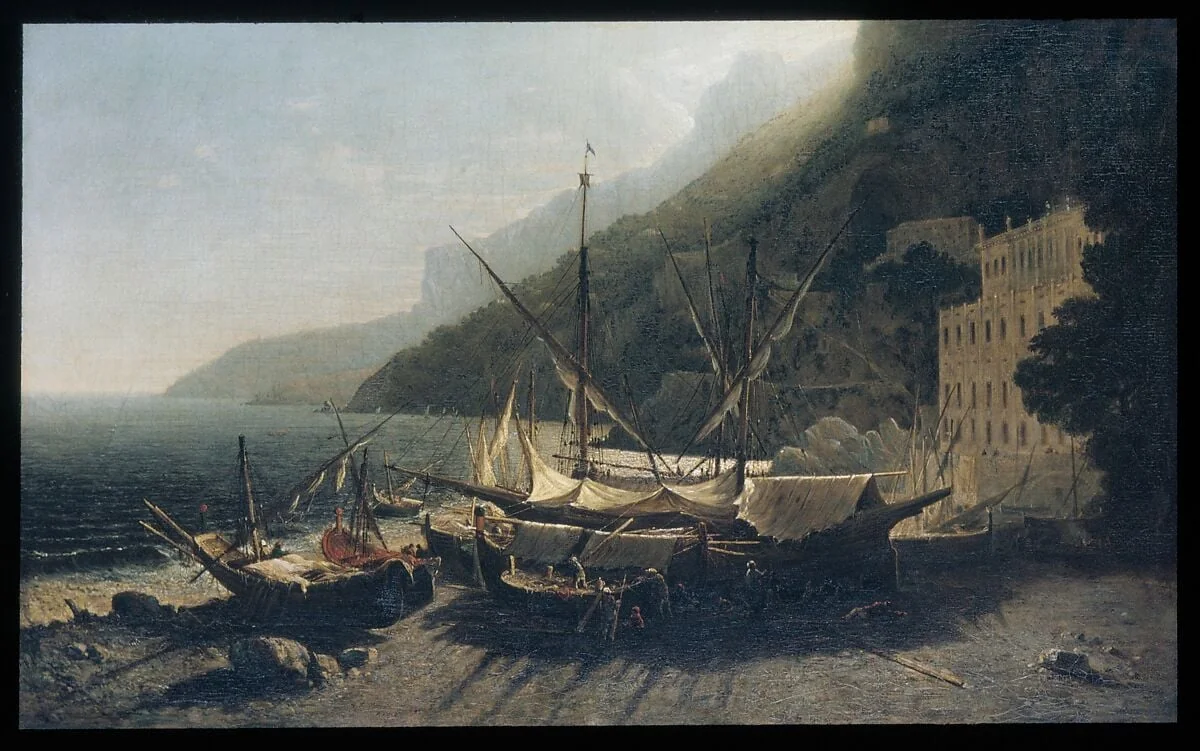
The landscape painter George Loring Brown has spent more than a century filed under a heading that flatters and diminishes him at once: the American who learned to paint sunlight the way the old classical masters built it, golden, glazed, and arranged. The label is not wrong. Brown did absorb the inherited grammar of the ideal harbor scene, the framing trees at one edge and the sun set low so the whole sheet of water turns to brass. He sold that grammar well, and for the rest of his life it followed him around like a maker's mark. But a painter is most interesting at the seam where the formula starts to fail him, and Brown has more seams than his reputation admits.
This essay argues one thing, and carries it work by work. Brown matters formally at the point of the break. When the Italian coast or the New England shore put real light in front of him, his compositional scaffolding loosens, his paint thickens and roughens, and the obedient golden glaze gives way to something observed. Read his pictures that way, plane by plane, and the standard story inverts. The canvases that look most like exercises in a borrowed style are the least alive. The ones where the recipe cracks, where a headland crowds the frame or the foam stands up off the surface in dragged pigment, are where George Loring Brown becomes a painter worth looking at slowly. The break is not a failure of technique. It is the only place his eye gets ahead of his training.
An engraver's discipline, a colorist's haze
Brown was born in Boston in 1814 and came to painting by an unusual road. He trained first as a wood engraver under Alonzo Hartwell, cutting tonal blocks for the reproductive trade, and only afterward studied painting under Washington Allston, the most ambitious American Romantic of the older generation (biographical record, Wikipedia). Those two apprenticeships pull in opposite directions, and the tension is legible across his whole career. Engraving teaches you to think in tone before color, to build a scene out of graded blacks and whites, to keep every passage legible at thumbnail scale. Allston taught the reverse lesson, that a landscape could be a vehicle for mood, a warmed and unified atmosphere that dissolves edges rather than cutting them. Brown spent forty years negotiating between the cutter's clarity and the colorist's haze, and you can usually tell, within the first minute in front of a canvas, which side is winning.
He spent long stretches abroad, and Italy gave him his subjects. The Getty's union list of artists records him plainly as an American painter, illustrator, landscapist, and etcher, born in Boston (Getty ULAN). The etcher's credential belongs to the same engraver's instinct that never left him, the habit of reducing a view to its line and its tonal armature before any color goes down. In Italy he painted the campagna around Rome, the falls at Tivoli, the harbors of the south. The National Gallery of Art still holds his Falls of Tivoli and a View near Rome among the canvases from those years abroad. What the country supplied was not only motifs but a quality of light he could not have invented in a Boston studio, a clear southern brilliance that lit water and stone differently than New England ever would. The best of his Italian pictures are the ones where that observed light overrides the studio formula instead of submitting to it.
The recipe, and where it cracks
Brown's commercial reputation rested on pictures that delivered the formula intact. The market wanted Italy seen through a golden scrim, and he supplied it well enough that his Bay of New York of 1869 was bought by the future King Edward VII while the prince was touring America. A royal sale is a useful fact, because it tells you exactly what audiences prized: the reassuring, finished, glazed surface, the harbor composed like a stage set, the sun obediently low. That taste is also the trap. The more completely Brown satisfied it, the more a given canvas risks settling into a competent recitation of a grammar somebody else wrote a century or two before him. His patrons were buying comfort, and comfort is the enemy of the thing this essay is after.
Spotting the break is a matter of attention to three things, and in Brown they tend to move together. Watch the composition first. In the formulaic pictures the framing is symmetrical and the eye is led down a central corridor to the light. Where Brown is working from the motif, the framing goes lopsided, a headland crowds one side, the horizon sits a little too high or too low for comfort. Watch the paint next. The glazed manner wants thin, blended, invisible strokes; the observed manner lets the brush show, drags a dry load across a wave, leaves a ridge of pigment standing in for foam. Watch the light last, and hardest. The studio light is uniform honey, the same temperature everywhere. The observed light is particular. It has a direction, a temperature, a time of day you could almost put a clock to.
Amalfi, and the argument the picture makes
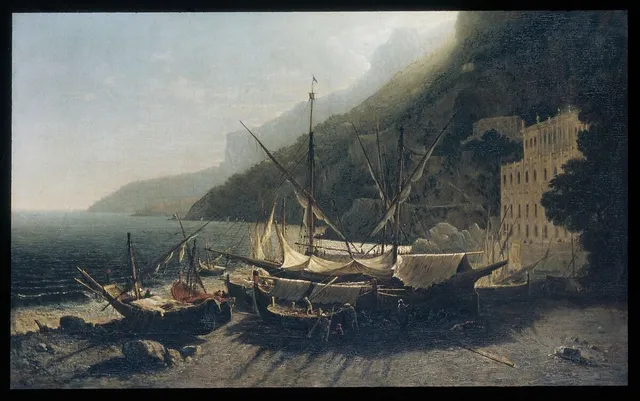
Take the picture that carried Brown furthest into the public collections, the View at Amalfi, Bay of Salerno. By 1905 it hung in the Metropolitan Museum of Art, listed in that year's printed catalogue in Gallery 12 with his dates given as 1814 to 1889 (1905 Met catalogue, Internet Archive). The museum still holds it. On the surface it is exactly the kind of southern coast view the market wanted, and at first glance it behaves itself. Then you look longer, and the obedience comes apart.
The bay opens across the center in a long horizontal sheet, and Brown sets the town of Amalfi against the cliffs at the right, stacked up the rock so the architecture reads as pale geometry pressed into shadow. A dark mass of foreground vegetation weights the left edge, the old framing device, but he overplays it until the picture tips off its axis. The composition is not centered on the sun. It is centered on the gap of bright water between the headlands, and the eye is pulled past the framing growth rather than held by it. That is an observed decision, not an inherited one. The far water runs cooler than the warm shore, and where the two temperatures meet Brown lets the paint go granular, scumbling a broken pale film over the blue so the surface reads as glare instead of glaze. He is recording what the bay actually does to light at that hour, not what a formula says a bay should do.
The handling tells the same story as the composition. Up in the sky Brown stays smooth and thin, the inherited honey still doing its quiet work. Down at the waterline the brush changes character completely. The strokes shorten, the pigment sits up off the canvas, the reflections are built from separate touches rather than a single continuous wash. To paint how light breaks on moving water he has to abandon the seamless surface his buyers loved most. So the Amalfi canvas ends up arguing with itself. The top half is a borrowed ideal, calm and glazed and saleable. The bottom half is a thing seen, rough and exact. The whole career is in that one frame, and the frame is worth standing in front of for a while.
Palermo and Venice: composition under pressure
The Sicilian and Venetian pictures push the same break in different directions. In Monte Pellegrino at Palermo, Italy the subject is a single great mass of rock rising over the bay, and a mountain that large is hard to make polite. Brown lets it dominate, a heavy diagonal of stone that refuses to recede on schedule, and the composition has to organize itself around an obstacle rather than around a clear vista to the light. The sun flattens against the rock face in the middle distance, killing the modeling the way real noon light does, and the foreground shipping is laid in with a quicker, coarser touch than a careful town would have earned in a studio set piece. The picture is built around weight, not around the corridor to the sun, and the weight is what makes it convincing.
The Venetian view, his View of the Ducal Palace and Grand Canal and Church of Santa Maria della Salute, sets him a different problem. Venice is all architecture and reflection, and the city does not allow the framing-tree formula at all. Here the engraver's training pays its long debt. The Salute's dome and the palace front are drawn with a cutter's precision, every cornice legible, while the water carries their inverted weight in long vertical smears of broken color. The composition is frankly horizontal, a band of stone over a band of water under a band of sky, and it holds together because the draftsman in him keeps the architecture from dissolving into the colorist's haze. Venice forced the clarity back to the surface, and the result is one of his least sentimental pictures. The hand that once cut tonal blocks is the hand steering it.
Home ground: Boston light and a beached hull
When Brown turned to American subjects the formula had even less to lean on, and that scarcity is good for him. The Public Garden, Boston is a civic scene with no classical harbor to borrow and no ruin to lend it grandeur. It shows him handling a flat, particular New England light, cooler and grayer than anything in the Bay of Salerno. The greens are local greens, the sky is a working sky with weather in it, and the framing is casual, organized by paths and plantings rather than by a stage set of trees. It is a modest picture. Its modesty is exactly why the observed light comes through so cleanly, with nothing borrowed standing between the painter and the park in front of him.
If there is a single canvas that strips the stylist away and leaves the painter, it is Beached Vessel. The motif could hardly be simpler, a hull run up on the shore, and the handling carries the whole interest. The wet sand takes the sky's light in a long low reflection. The hull is built from loaded, dragged strokes that describe rough, salted timber, and the palette has gone sober, the honey drained out of it down to grays and ochres and a cold blue. Nothing here is arranged to flatter a buyer. The picture is a study in how light sits on a wet surface at the edge of the tide, and it is far closer to direct painting than to the inherited classical recipe his market expected from him. Put it beside one of his golden Italian harbors and you would be forgiven for doubting they share a hand.
Even the one overt narrative picture in this group, Leatherstocking Kills the Panther, is finally a landscape problem in disguise. The literary subject, drawn from American frontier fiction, gives Brown an excuse for a wild wooded setting, and the real drama lives less in the figures than in the broken light falling through the trees onto the struggle below. He uses the foliage to steer the eye, a dense dark canopy opening to a single shaft on the action. The handling of light through leaves is freer and more broken here than his polished harbors ever permitted, the brush jabbing rather than gliding. A narrative commission became, in his hands, another excuse to paint observed light in motion.
What the archive holds
Set against the great public collections, our own holdings are small and instructive. Artifact World Gallery holds fourteen paintings by Brown across three institutions, a single artist's run that brackets close to half a century, from the early 1830s to about 1880. That span is the useful thing. It lets you watch the same painter approach the break again and again, on the Grand Canal and on a New England beach, and it confirms what the larger museums imply by keeping him on their walls: that Brown's value is not any one masterpiece but the consistency of the tension across a working life. The Getty lists him as painter and etcher, the National Gallery keeps his Roman views, the Metropolitan kept his Amalfi hanging into the new century. Across all of them, the live passages are the observed ones, and the dead passages are the borrowed ones. A small archive can still settle an argument when it covers enough years, and ours covers enough to show that Monte Pellegrino and the Boston park were made by the same restless eye.
Works discussed in this article
The reputation will probably never change much. Brown will stay the American who painted golden Italy, and the glazed harbors will go on selling the easiest version of him to admire. That is fine. But stand close to the waterline of the Amalfi canvas, where the pigment sits up off the surface and the glare is built one dry touch at a time, and you are looking at a second painter living inside the first, one who set the recipe down the moment the real light got interesting. That painter is the one our fourteen canvases keep returning to. He is in the corpus, plane by plane, waiting for anyone who will look at the bottom half of the picture.
Sources & further reading
- George Loring Brown — Wikipedia
- Catalogue of the Paintings in the Metropolitan Museum of Art (1905) — Internet Archive
- George Loring Brown, ULAN ID 500022733 — Getty Research Institute
- George Loring Brown (American, 1814-1889) — National Gallery of Art
- View at Amalfi, Bay of Salerno — The Metropolitan Museum of Art