The myth and the ledger
Abstract Expressionism is remembered as the moment American painting went feral. Pollock circling a canvas on the floor. Rothko's hovering curtains of color. De Kooning slashing a figure into a storm of pink and ochre. That picture flatters the brush and forgets the bank. The movement did not climb to the center of the art world on nerve alone. It climbed because a compact network of collectors, dealers, museum directors, and magazine editors chose to underwrite a downtown coterie and then sell it, hard, to the rest of the planet.
So this essay follows the money. The question is not only who held the brushes but who could afford to keep painting canvases that nobody yet wanted, and who paid to frame them, ship them, hang them, and reproduce them until New York took the address that Paris had held for a century. The painters supplied the risk. The patrons supplied the runway. Pull either one out of the story and the other collapses. A movement that prized the look of total freedom turned out to be one of the most carefully financed episodes in the history of American art.
What the word actually covered
The label arrived late and from outside the studio. The critic Robert Coates first applied the phrase to American painting in 1946, borrowing a term that had floated around European art for decades and pinning it to a loose group of New Yorkers (Wikipedia). Tate's working definition keeps the umbrella wide: new forms of abstract art developed by painters such as Jackson Pollock, Mark Rothko, and Willem de Kooning across the 1940s and 1950s (Tate). Underneath it sat two temperaments that barely shared a method. The action painters went at the canvas with their whole arm and left the record of the attack on the surface. The color field painters did the opposite, soaking large fields of a single hue until the picture stopped being a gesture and became a weather system you stood inside.
Calling all of this one movement was always a marketing convenience more than a fact about the paint. The artists themselves preferred the cooler, geographic name that historians now favor: the New York School, after the few square miles of lower Manhattan where the work took shape. The point worth holding onto is that the title was authored by writers and curators, not by the people making the pictures. That detail is the whole argument in miniature. From the first, Abstract Expressionism was a thing said about the work by people positioned to pay for it and promote it.
The archive's long fuse
The drip canvases did not detonate out of nothing. They sit at the end of a long fuse that runs back through European abstraction and through a quieter American line that rarely gets the credit. Our own holdings lean toward that lineage rather than the famous 1950 canvases, and the spread tells a story. Artifact World Gallery holds 504 works tied to Abstract Expressionism across 36 venues by 313 artists, dated across a long arc from roughly 1910 to 2004. That range is the tell. A movement Tate frames as a phenomenon of the 1940s and 1950s actually reaches back four decades in the archive, because the painters who broke through after the war were standing on a generation of earlier abstraction.
Look at Wassily Kandinsky's Improvisation 27 (Garden of Love II), a canvas a young New York painter could study in person at the Museum of Non-Objective Painting, the Guggenheim's first incarnation. The forms slide off any fixed reading. Bodies dissolve into bands of rose and blue, line cuts loose from the things it once described, and color carries the emotional charge that subject matter used to carry. That permission, paint that means without naming, is the inheritance Pollock and Rothko spent. The American branch of the same idea runs through Arthur Dove, whose Clouds and Water and The Inn pulled abstraction out of landscape years before the term existed, and through Marsden Hartley and Paul Klee, whose small, sign-laden surfaces taught a later generation that a private mark could be a public language.
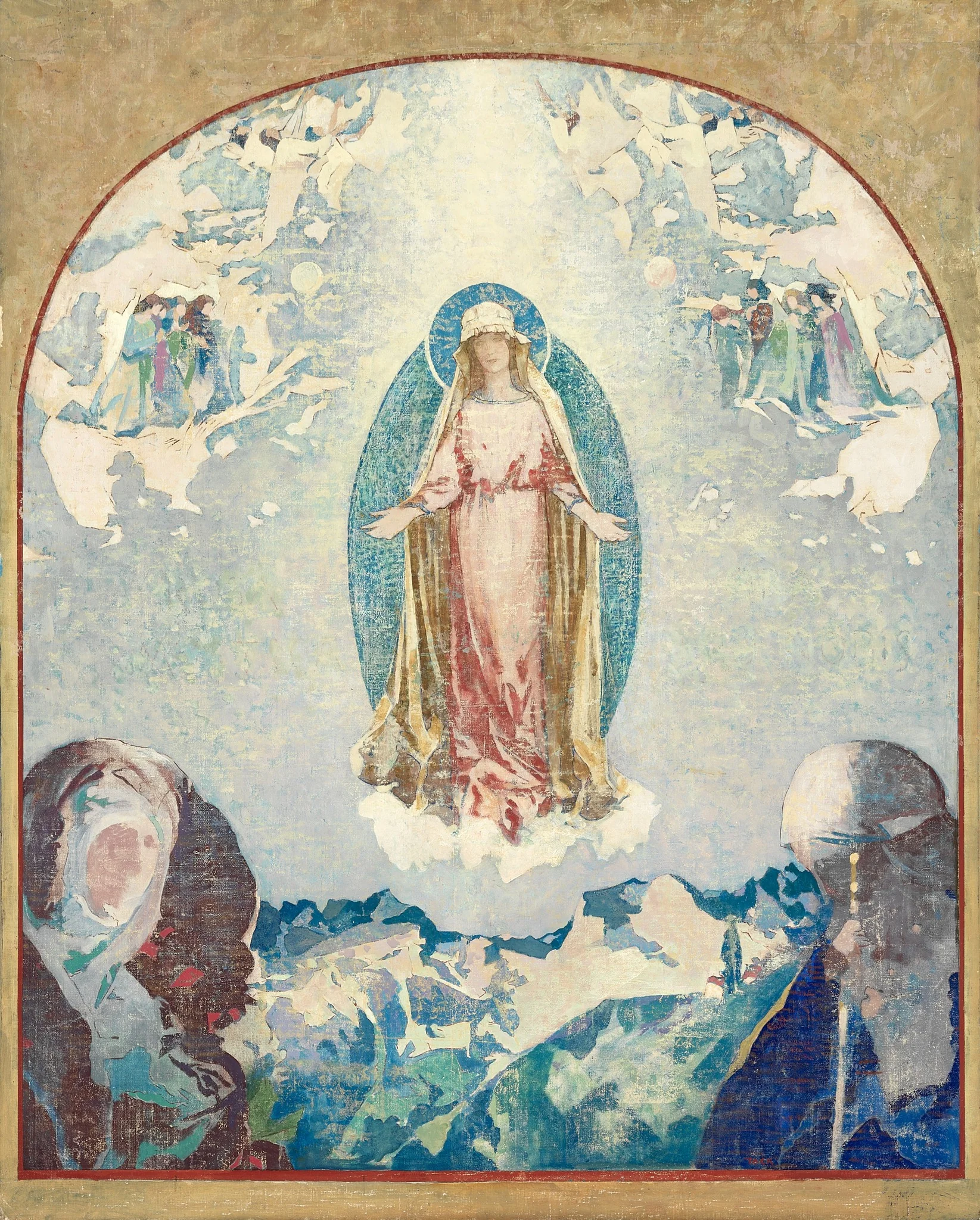
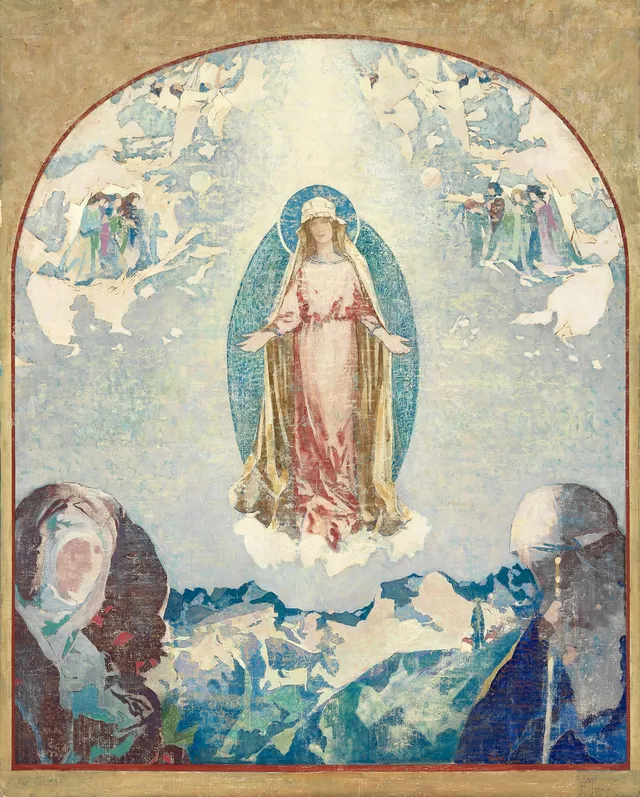
The clearest forerunner in our walls, and the one with the cleanest patronage story, is Augustus Vincent Tack. His Rosa Mystica is, in plain terms, a color field painting made a generation early. Stand in front of it and the first thing to go is the horizon. There is no ground line, no near and far, only soft ridges of cream, ash, and a bruised rose folding upward as if a mountain wall had been dissolved into vapor and asked to hold a chord. The forms read as cloud and as stone at once, and Tack lets the color pool and thin so that the eye keeps trying to land and keeps sliding off. He took the shape of a Western mountainside and drained the literal weather out of it until what was left was a devotional field, a thing to stand before rather than read. Two decades later Rothko would arrive at the same address by a different road. The difference is that Tack got there first and almost nobody noticed, because almost nobody was paying.
Who painted it
The people who eventually carried the name were, for most of the 1930s, broke. Pollock, de Kooning, Rothko, Arshile Gorky, and Lee Krasner were all kept alive at one point or another by the same employer: the federal government. The Works Progress Administration's Federal Art Project put painters on a modest weekly wage to make murals and easel pictures for public buildings, and for a stretch of the Depression it was the closest thing American art had to a salary. That program mattered far past the paychecks it cut. It gathered a scattered set of young abstractionists into the same studios and breadlines, gave them years to paint without a buyer in sight, and quietly established the radical premise that a society might pay an artist to do nothing but find out what painting could become.
When the federal money dried up, the freedom it had bought did not. Pollock made the leap that defined the action wing of the movement in 1947, when he stopped brushing pigment onto a primed canvas at an easel and started pouring and flinging thinned enamel onto raw canvas laid flat on the floor, walking around all four sides of the picture as he worked (The Met). The method looks like pure abandon. It was not. A poured line cannot be reworked, so each pass had to be committed and read in the same instant, the arm deciding while the paint was still in the air. That is a discipline disguised as a tantrum. The same is true across the wing of the movement that went the other way. Rothko's luminous rectangles took dozens of thin, scrubbed layers to reach the point where the color seemed to breathe on its own. Behind both extremes stood the same economic fact. These were painters who had learned, courtesy of the WPA, how to work for years on faith.
Who paid for it
Faith does not pay rent forever. The transition from struggling downtown abstraction to the dominant style of the West rested on a short list of patrons who took the bet early. The pattern was set decades before the war by Duncan Phillips, the Washington collector who built the country's first museum of modern art. Phillips found Tack's abstractions baffling to almost everyone around him and bought them anyway, year after year, until a body of work that the market had no idea how to price had a permanent home on his walls. He is the prototype of the figure the New York painters would need: a believer with money who buys ahead of consensus rather than behind it.
Pollock found his version of Phillips in Peggy Guggenheim. Her gallery, Art of This Century, gave him his first solo show, and her contract gave him something rarer than a sale: a monthly stipend against future paintings, which let him quit the day job and paint full time. She also handed him the wall-sized commission that pushed him toward the all-over field he would later pour. Around that anchor a small commercial scaffolding assembled itself. Betty Parsons took on Pollock, Rothko, and others when their work was close to unsellable, and Sidney Janis later moved the same artists into a more openly commercial frame and proved that the pictures could command serious prices. Dealers do not appear in the heroic version of this story. They should. They were the ones converting reputation into rent.
The institutions came next, and they came with intent. The Museum of Modern Art under Alfred Barr collected the New York painters and, just as importantly, lent them the prestige of a museum that had spent two decades teaching Americans that European modernism was serious. The older, more conservative museums followed once the prices and the press made the risk look small. The Met acquired Pollock's monumental Autumn Rhythm (Number 30) in 1957, the year after he died in a car crash, a purchase that ratified the drip canvas as a national possession rather than a downtown rumor (The Met). The National Gallery now holds Number 1, 1950 (Lavender Mist), one of the works where the poured technique reached full pitch and action painting found its high-water mark (National Gallery of Art). A style that began as unsellable ended in the two most heavily endowed art collections in the United States.
There was one more patron, less obvious than a check. The critics and the magazines paid in attention, which converts to money slower but compounds harder. Clement Greenberg built a whole theory of where painting had to go and placed Pollock at the front of it. Harold Rosenberg supplied the phrase that branded the action wing, in an essay on the American action painters that ran in the December 1952 issue of ARTnews (ARTnews, December 1952). His idea was simple and it sold: the canvas was no longer a surface to reproduce a scene but an arena in which to act, and the finished painting was the leftover trace of an event. Reframing a smear of paint as a heroic act of self-definition is exactly the kind of story that turns a niche style into a national one. Words were a form of capital, and the New York School had the best-capitalized critics in the world.
Works discussed in this article
The export
Domestic success was only the first act. Abstract Expressionism was the first specifically American movement to win genuine international influence, and it moved the capital of the Western art world to New York, a role Paris had held since the nineteenth century (Wikipedia). That did not happen by gravity. MoMA's international program packed the new American painting into touring exhibitions and sent them through the museums of postwar Europe, where audiences who had spent two generations assuming the New World imported its culture were shown enormous, confident, unmistakably American canvases. Historians have argued, with a good deal of evidence, that this export was useful to the United States in the cultural contest of the Cold War, a free and individualist art set against the state-mandated realism of the Soviet bloc. Whether the painters knew it or wanted it, their work was conscripted as a kind of soft power, and the touring shows were paid for accordingly.
None of this makes the paintings less serious. It makes them legible. The temptation with Abstract Expressionism is to treat the patronage as a stain on the purity of the gesture, as though knowing who wrote the checks cheapens what Pollock did on the floor or what Rothko built up in his thin glazes. The opposite is true. A working artist who never has to sell is the rarest creature in the economy, and the New York School produced a whole generation of them because a particular chain of patrons, public and private, decided to make it possible. The federal government bought them time. The collectors bought them confidence. The dealers bought them rent. The critics bought them a story. The work is what the painters did with all of it.
What the ledger shows
Run the lens back across our own holdings and the lesson sharpens. The same logic that carried Pollock from a WPA payroll to the National Gallery is visible, in a smaller key, in the forerunners we keep. Augustus Vincent Tack reached a color field decades early and is barely a footnote, because he had one Duncan Phillips and no movement around him. I. Rice Pereira, whose White Lines pushed geometric abstraction onto layered glass at the same moment the men downtown were being hauled into history, is filed as a minor figure for reasons that have far more to do with who promoted whom than with what is on the surface. The talent was distributed widely. The patronage was not. That gap is the difference between a name in a textbook and a name in a database.
So the next time a drip canvas is described as an act of pure, unsponsored freedom, look for the invoice underneath it. It is always there. The genius is real and the paint is real, and behind both stands a quiet column of people who decided, before the rest of the world agreed, that this was worth funding. The interesting history of Abstract Expressionism is not the splatter. It is the question of who in any era gets handed the years and the rent to find out what comes after the last good idea, and how many Tacks and Pereiras are still waiting on their Duncan Phillips.
Sources & further reading
- Abstract expressionism, Art Term — Tate
- Abstract expressionism — Wikipedia
- Abstract Expressionism (Heilbrunn Timeline of Art History) — The Metropolitan Museum of Art
- Jackson Pollock, Autumn Rhythm (Number 30), 1950 — The Metropolitan Museum of Art
- Jackson Pollock, Number 1, 1950 (Lavender Mist) — National Gallery of Art
- The American Action Painters (ARTnews, December 1952, Vol. 51 No. 8) — Internet Archive / ARTnews
- Abstract Expressionism, an introduction — Smarthistory