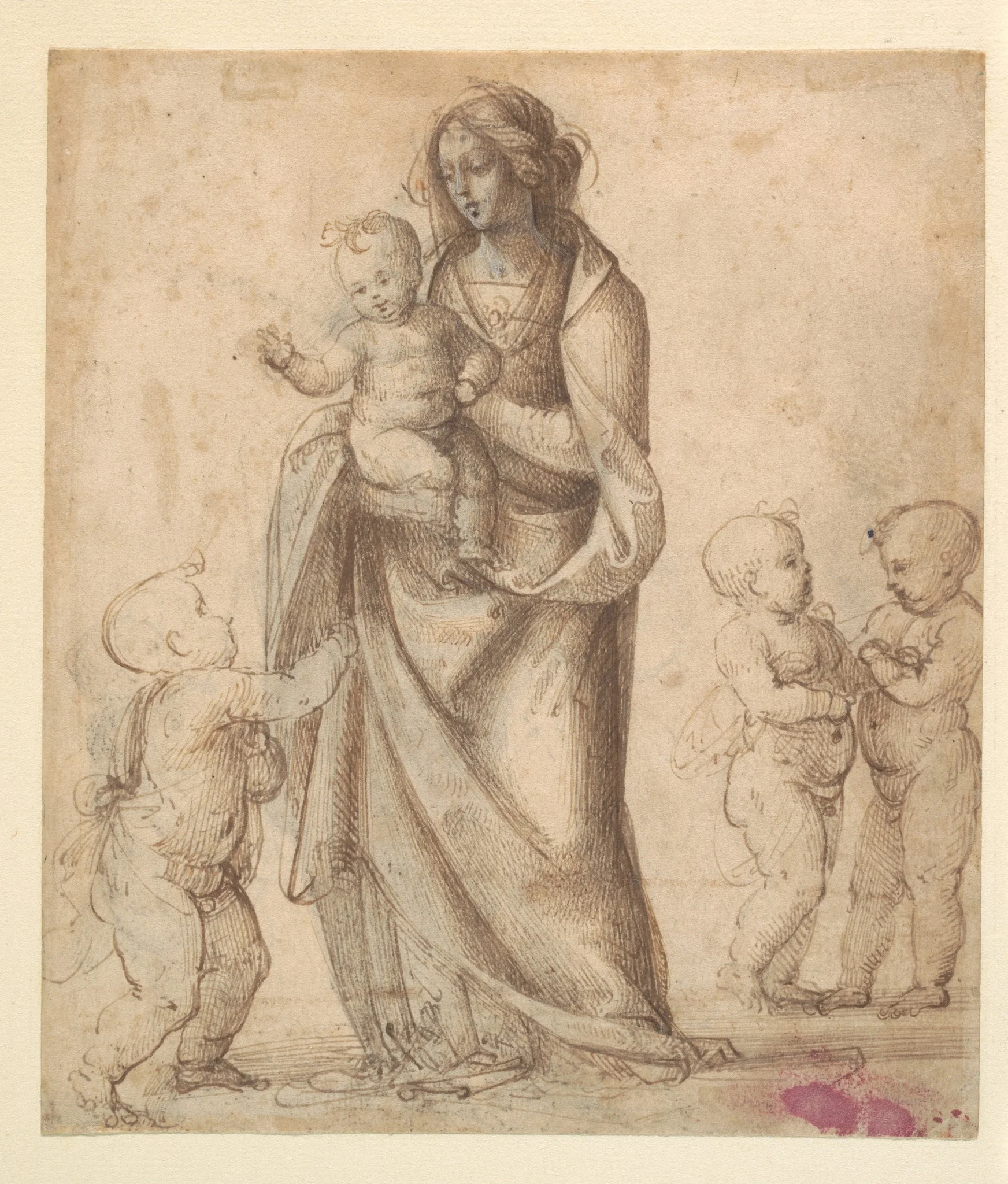
To understand Fra Bartolomeo, the Dominican painter of San Marco, begin not with his piety but with his workbench. The calm that everyone praises in his altarpieces, the way a Madonna sits dead-center and the saints fan out around her in a measured arc, looks like serenity of temperament. It was something closer to engineering. He arrived at that balance by building each picture the way a joiner builds a cabinet: he posed a jointed wooden mannequin, drew the fall of cloth over it again and again, squared the result, and transferred it to the panel by a grid. The style is the residue of the procedure.
That is the argument of this essay, and it is a contestable one. The standard account treats Fra Bartolomeo as a man of feeling who absorbed Leonardo's softness and Raphael's poise and quietly synthesized them into the High Renaissance manner. He did absorb those things. But the synthesis was made of tools, not moods, and the tools are visible if you look at the drawings rather than the finished surfaces. A painter who renounces his craft for four years on religious grounds, then comes back and produces some of the most rationally constructed compositions of the century, is telling you that for him painting was a discipline to be relearned, not an instinct to be indulged. Material and method are where his style was actually decided.
Baccio della Porta, before the habit
He was born Baccio della Porta on 28 March 1472 at Savignano di Prato, and he died in Florence on 31 October 1517, according to the standard biographical record. The nickname came from where he lived, near the Porta San Pier Gattolini. His training ran through the busy, conservative shop of Cosimo Rosselli, one of the Florentine masters who had frescoed the Sistine Chapel walls, and it put a solid late-Quattrocento grammar into his hands before the new century loosened everything up. From that grounding he formed a working partnership with Mariotto Albertinelli, a collaboration so close that the two men sometimes split the labor on a single panel and shared a single account book.
Around him in Florence were painters working out the same problem from different angles. Piero di Cosimo, inventive and strange, pushed toward odd light and mythological reverie; later, Ridolfo del Ghirlandaio would carry the polished Ghirlandaio shop manner into the new style. Baccio's instinct was different from both. He wanted weight, clarity, a body that holds its ground. That instinct is what made him susceptible to the most disruptive influence of his early adulthood, which was not a painter at all.
The vow, the silence, and the return to the panel
Girolamo Savonarola took over the moral life of Florence in the 1490s, and Baccio was among the friar's true believers. He fed his own profane drawings into the famous bonfires of vanities. When Savonarola was hanged and burned in 1498, the painter's world cracked. Under that pressure he took the Dominican habit in 1500 and entered the convent of San Marco, and for several years he gave up painting altogether, resuming only in 1504. This is the pivot the method argument depends on. A man does not casually walk away from a craft for four years and then return to it at the highest level by luck. He returns by rebuilding his procedure from the ground up.
The re-entry is documented. His first commission on resuming came on 18 November 1504, from Bernardo del Bianco, for an altarpiece destined for the Badia Fiorentina; the picture, the Vision of Saint Bernard, now hangs in the Uffizi. Look at how that re-entry painting behaves and you already see the system. The Virgin descends on a diagonal that is answered by the saint's recoiling body, the kneeling attendant saints are placed like ballast, and the architecture is reduced to a few load-bearing verticals. Nothing is improvised. The friar had come back not with a vision so much as with a method for staging one.
The lay figure and the architecture of cloth
The single most concrete fact about how this style was made comes from Vasari, who knew people who had known the friar and wrote his life within a generation of his death. Vasari records that Fra Bartolomeo worked from a large jointed wooden model, a lay figure with movable limbs, which he dressed in real fabric so that he could study the way cloth gathers, breaks, and casts shadow over a body that stays perfectly still for as long as he needed. The mannequin is the hidden machine behind the serenity. Living models tire and shift; a wooden one holds a contrapposto for a week.
Once you know the lay figure is there, you read the drapery differently. The deep, architectural folds that wrap his seated Virgins are not transcriptions of an instant. They are designed cloth, arranged on an armature, lit from one consistent source, then refined across multiple chalk studies until each fold does structural work. A heavy fold drops from the knee to anchor the figure to the ground. A counter-fold lifts the eye back toward the head. The fabric becomes a set of forces holding the composition in equilibrium. This is why his saints feel monumental at any scale: the cloth was engineered before the face was ever considered.
Close looking: the double-sided Madonna sheet
Nowhere is the method more naked than in his drawings, and Artifact World Gallery holds one that shows the whole engine running. The sheet catalogued as Madonna and Child with the Infant Saint John the Baptist and Two Putti carries one version of the group on the recto and a reworked version on the verso. That is the point of it. This is not a finished image; it is a man thinking on paper, twice, about the same cluster of bodies.
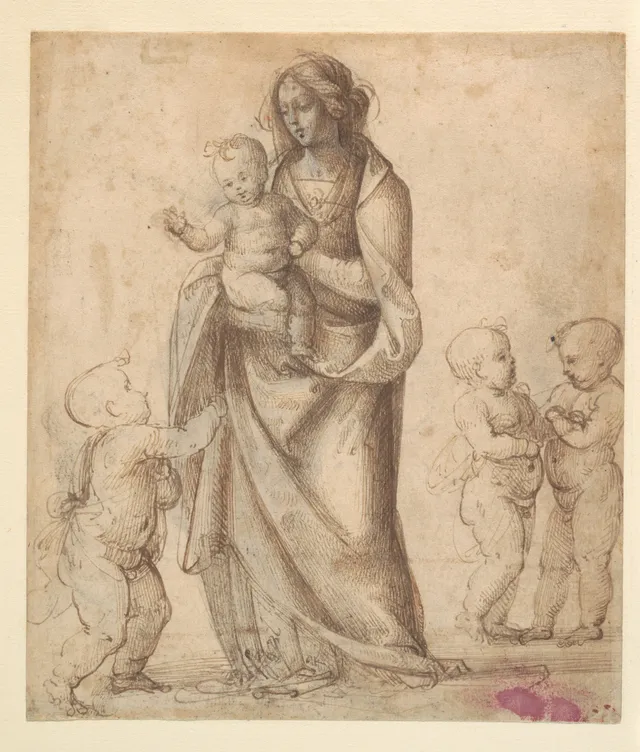
On the recto the Virgin's mass is established first, a broad pyramid built from her lap and shoulders, and the Child is set across her knee on a diagonal that the infant Baptist answers from below. The putti are not decoration. They close the top corners of the pyramid and keep the composition from leaking upward. The chalk does two jobs at once: a soft, searching line where the artist is still hunting for a contour, and a firmer, decided line where he has found it. You can see him commit. Then he turns the sheet over and does it again, shifting weights, tightening the interval between the two children, testing whether the group reads better with one putto or two. The verso is the recto's argument, restated. The serenity of his painted Madonnas is built out of exactly this much trial. By the time the design reached a panel, every relationship on it had already survived a second draft on the back of a piece of paper.
The same controlled tenderness, with the labor sanded off, is what you get in the small devotional panels. In a piece like The Holy Family with the Infant John the Baptist, the figures lock into a stable group whose stability you can now trace back to sheets like the one above. Nothing is accidental about where a hand falls or how a head tilts. The drawing decided it.
Drawing the land from the window
The method was not only about figures. Fra Bartolomeo was one of the first Italian artists to draw pure landscape, with no holy story laid over it, simply because he wanted to know how the land behaved. The Metropolitan Museum holds one of these sheets, a pen-and-ink study of a wooded approach to a town, which once sat in an album of his landscape drawings assembled around 1730 by the Florentine collector Niccolò Gabburri. The Getty has another, three studies of trees from about 1508, worked in black chalk with the point of a brush and brown ink. These are not throwaways. They are research.
Consider what the Getty sheet tells you about the man's hand. Black chalk lays in the bulk of the foliage as a soft mass; then the brush, loaded with diluted ink, comes in to clot the shadow side and to flick out the few twigs that catch the light. He is studying how a tree reads as a single tonal body before it reads as a thousand leaves. That habit, of resolving a thing into its large value first and its detail second, is the identical discipline he applied to a draped saint. The landscape drawings are the figure method run on a different subject. When trees and hill towns later appear behind his Madonnas, they sit convincingly in deep space because he had gone outside and learned the rule, not because he had memorized a formula for distant blue.
The squared cartoon and the shop at San Marco
Between the trial sheet and the painted panel sat one more instrument: the squared cartoon. Once a composition was settled in chalk, the friar's shop ruled a grid over the design and a matching, scaled grid over the panel, then copied the drawing square by square. This is why his big altarpieces preserve, at full size, the proportional decisions made on a small sheet. The grid is a translation device that refuses to let the design drift as it grows. It also explains the slightly impersonal perfection of his finished surfaces. A great deal of the creative risk had been spent already, on paper, by the time pigment was mixed.
San Marco mattered here too, because the convent ran the painting operation as a workshop with a head and assistants. Fra Bartolomeo designed; trained hands helped carry the design to scale and lay in passages of drapery and ground. The division of labor is not a scandal. It is the reason a relatively contemplative friar could produce monumental commissions at all. It is also why his manner could be transmitted. A method that lives in drawings, mannequins, and grids can be taught to an assistant in a way that pure instinct never can. The style was reproducible because it was procedural.
The portraits show the other side of the same coin. His likeness of Savonarola became the standard image of the reformer, copied and recopied for centuries; it survives even in later reproductions, such as a mid-nineteenth-century photograph of a drawing made after the painting, now in the Rijksmuseum. The friar's Portrait of a Man in our own holdings carries the same plain frontal weight, a head built as solidly as one of his draped saints, with no flattery in the modeling. He treated a face the way he treated cloth: as a structure to be understood in the round before it was made to charm.
What the holdings show
The shape of his surviving output is itself an argument about method. Artifact World Gallery holds twenty-two works under his name, spread across fourteen separate venues and running from roughly 1498 to 1516, which is to say the whole arc from before the vow to the last full years of his life. That spread is telling. A painter whose pictures were one-off acts of inspiration tends to leave concentrated bodies of work; a painter whose designs were portable, gridded, and shop-transmittable leaves a diffuse trail, because his manner traveled on paper and through assistants to wherever a commission called. The catalog also leans toward the intimate Madonna and Holy Family format rather than the giant public altarpiece, which is exactly the genre where the design system shows most plainly.
Set two of these holdings side by side and the procedure surfaces again. The Presentation of Christ in the Temple organizes a crowd around a strict architectural center, the figures distributed like counterweights on either side of the altar. The Adoration of the Child collapses the same instinct into a few kneeling bodies whose limbs interlock to make one stable group. And the small Madonna and Child reduces the whole apparatus to its irreducible core, a seated woman and a child, weight resolved, cloth doing its quiet structural job. Across grand and modest formats the underlying frame is one frame.
Works discussed in this article
The method as legacy
By the 1510s the procedure had matured into the thing later writers would call classic. The National Gallery of Art files him simply as an Italian painter of that high moment, the company of Raphael and the young masters who set the terms for the next two hundred years. A trip he made to Venice introduced him to color that breathed, and a likely exchange with Raphael during the latter's Florentine years sharpened his grasp of monumental grouping. He took both lessons and ran them through the same machine he had built after his vow: study on the mannequin, draw and redraw, square, transfer, distribute the labor. The influences changed the inputs. The method stayed.
This is the part of his story that the word serene tends to hide. The balance in a Fra Bartolomeo altarpiece is not the calm of a man who never had to try. It is the calm of a process that has removed, in advance, every reason for the eye to be anxious. He situates squarely within the Florentine High Renaissance and the broader Renaissance, but his particular contribution to it was less a look than a workflow, one solid enough to outlast him and to be picked up by hands that never met him.
Go back to the double-sided sheet once more and you can hold the whole thesis in one object. Recto and verso, the same group twice, the soft line and the committed line, the design earning its stillness through revision you are allowed to watch. The painted Madonna is the answer. The drawing is the work. If you want to see how this style was made, turn the paper over.
Sources & further reading
- Fra Bartolomeo — Wikipedia
- The Vision of Saint Bernard (Fra Bartolomeo) — Wikipedia
- Landscape (Wooded Approach to a Town) — The Metropolitan Museum of Art
- Three Studies of Trees (about 1508) — The J. Paul Getty Museum
- Lives of the Painters, Sculptors and Architects (Giorgio Vasari) — Internet Archive
- Fra Bartolommeo, artworks — National Gallery of Art
- Reproduction of a drawing after Fra Bartolomeo's portrait of Savonarola — Rijksmuseum