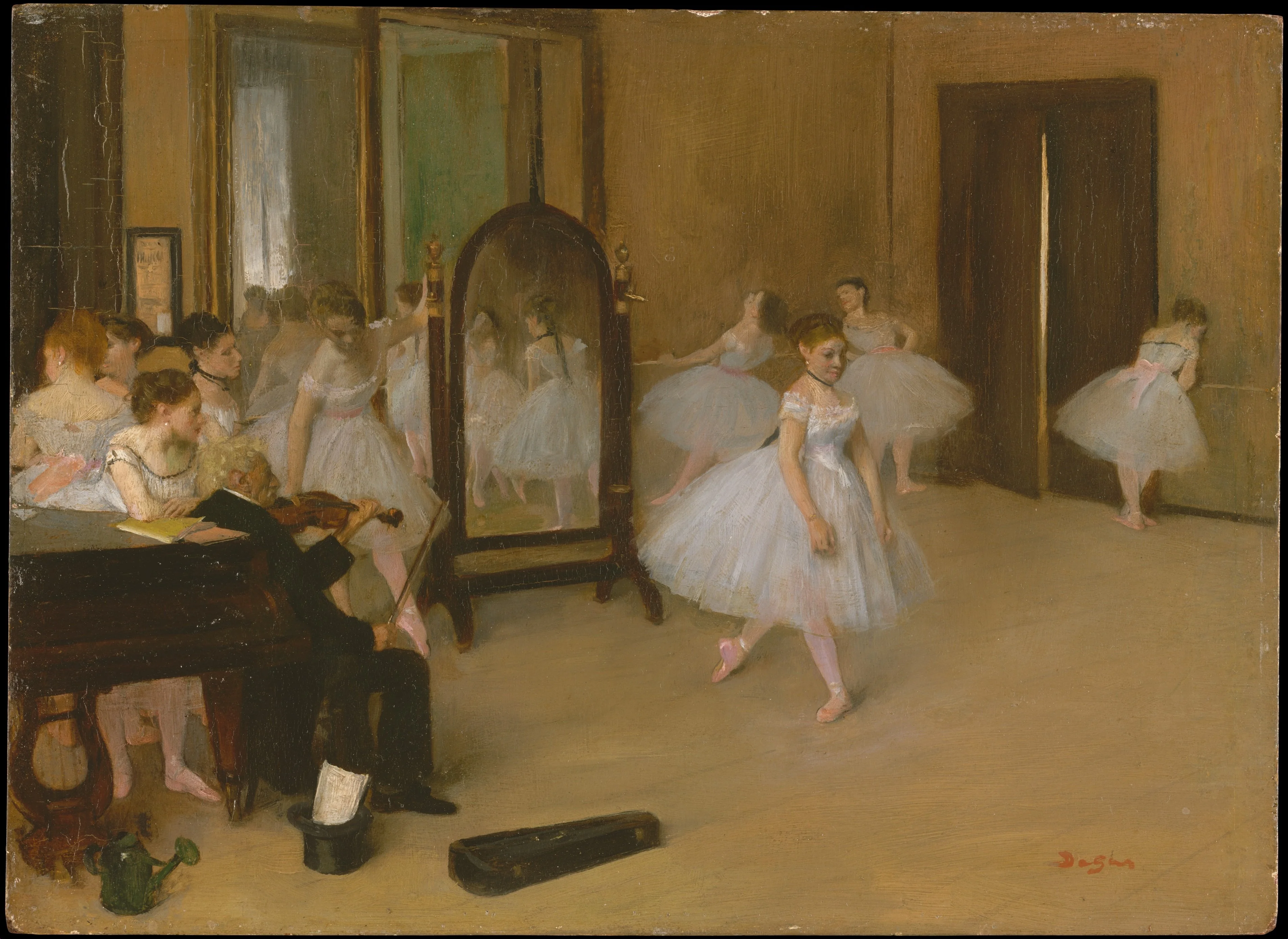
Edgar Degas painted a Paris his first audiences could read the way they read the morning paper. Stand in front of his rehearsal rooms and racecourses and you are not looking at exercises in pure design, whatever the survey books taught afterward. You are looking at social types, each one carrying a charge of economic and moral knowledge that a Parisian of the 1870s absorbed at a glance. The ballet girl was a working-class adolescent whose body was understood to be for sale as much as for art. The man at the racecourse was money and class on parade. The woman pausing in a parlor was a problem of marriage, money, or mood that the viewer was invited to solve.
That is the claim this essay defends. Degas's iconography was contemporary and legible, and the meaning his pictures held for their first viewers lived in the subjects as much as in the handling. He has been canonized as a master of cropping, of the tilted floor and the off-center glance, and he was. But the people who first met these works at the group shows of the 1870s and 1880s did not stop at composition. They recognized the milliner, the laundress, the chaperone-mother, the racing gentleman, the abonné lurking in the wings. Recover those readings and the cool formal intelligence everyone admires starts to look sharper, almost journalistic: a sustained report on how modern people performed, sold, and watched one another.
The man who refused the label
Begin with what Degas called himself, because it tells you how he wanted the pictures read. He was a founder and tireless organizer of the exhibitions we now file under Impressionism, and yet he disliked the word and preferred Realist or Independent, as the Metropolitan Museum's account of his painting and drawing notes (Met, Heilbrunn Timeline). The distinction matters. The Impressionist program, as the public came to understand it, was about sensation: the eye catching weather, water, the trembling of light on a surface. Degas wanted the opposite reputation. He drew indoors, under gaslight and studio lamps, from memory and from posed models, and he built his scenes from line. His subjects were not landscapes dissolving into shimmer but figures fixed in the act of working or waiting. Where a Monet asked you to feel a morning, a Degas asked you to identify a person and guess their circumstances.
The numbers behind the movement frame the point. The first group exhibition opened in Paris in 1874 and included Monet, Renoir, Degas, and Cézanne, as Tate's glossary records (Tate, Impressionism). Degas went on to take part in six of the eight Impressionist exhibitions held between 1874 and 1886, more than almost anyone, even as he kept his distance from the doctrine, according to the National Gallery of Art (NGA biography). He was, in other words, the loyal manager of a club whose name he rejected. That tension is visible in every canvas. He shows up at the Impressionist hang with pictures that argue for drawing, for the figure, for subjects pulled from the social machinery of the city. He cared which wall a canvas hung on and how high, because he understood the exhibitions as the place where his argument would either land or be lost in the crowd of landscapes. He fought over the hanging, recruited and quarreled with fellow exhibitors, and treated the shows less as a manifesto about light than as a venue where his kind of modern subject could be seen plainly and argued about.
What a dancer meant
More than half of Degas's output depicts dancers, a proportion the standard biographies underline (Wikipedia, Edgar Degas). Our own holdings track that obsession. Artifact World Gallery carries 252 works under his name, gathered from 34 separate collections and spanning roughly 1844 to 1907, and the ballet recurs through them like a refrain that will not resolve. He painted the first of these dancers around 1873, the Getty notes, and never let the subject go (Getty Museum). The repetition was not laziness or market calculation alone. It was the iconography he found most charged. Across those 34 collections the dancers cluster in the late 1870s and 1880s, exactly the years he was hanging at the Independent shows, which tells you the ballet was his public argument as much as his private fixation.
Here is what a first viewer knew that we have to be taught. The young dancers of the Paris Opéra were overwhelmingly girls from poor families, sent into training as wage earners, their pay a real contribution to a household. The rehearsal rooms and the wings were open, by subscription, to wealthy male patrons, the abonnés, who came to look and to arrange. A ballet picture in 1874 was therefore a picture about adolescent labor and about a barely concealed sexual marketplace, dressed in tulle. The mothers along the wall were not spectators. They were guardians of an investment, negotiating on behalf of daughters whose careers could lift a household or sink it. Degas does not preach this. He stages it. He puts the working body in the frame, exhausted and adjusting a strap, and he lets the social knowledge do the rest. The viewer brings the scandal; the painter supplies only the unflattering facts of the room.
Look hard at The Dancing Class. The floor tilts up toward us, steep and bare, so that the room reads less like a stage than like a slope the eye slides down. Almost no one is dancing. The girls are scattered, not arranged: one twists to scratch her back, another fusses with a sash, one sags against the wall with the dead weight of a body that has been on its feet for hours. The ballet master stands among them with his stick, the only still vertical in a room of slumping diagonals. Against the far wall the dark shapes of waiting mothers anchor the scene, chaperones and managers of their daughters' careers. Degas paints the interval, the moment between exertions, and that choice is the whole argument. He refuses the spectacle the Opéra sold to its patrons and gives us instead the unglamorous truth of the trade: the practice, the boredom, the supervision, the body as instrument being maintained. Notice how little of the canvas is given to grace and how much to fatigue and waiting. A buyer in 1875 would have understood the picture as candor, even as gentle exposure.
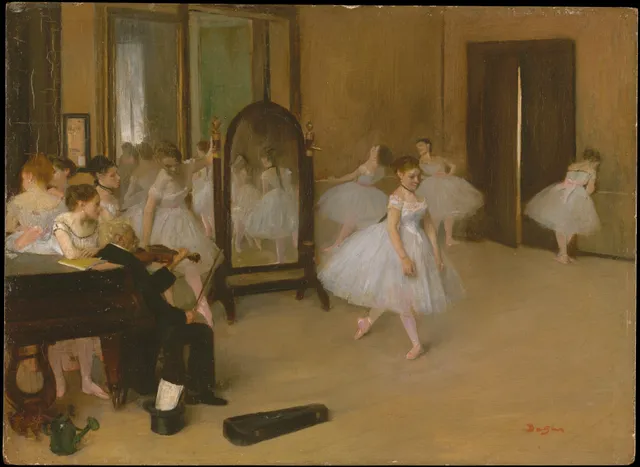
Its near-twin, The Dance Class, carries a small piece of exhibition history that sharpens the reading. Smarthistory records that the 1874 canvas was meant for the very first Impressionist show but did not actually appear until two years later (Smarthistory, The Dance Class). The delay is a reminder that these pictures were made for a public event, timed and positioned to be seen and discussed, not painted into a vacuum. Degas was composing for a room full of critics who would name his types out loud. He revised, withheld, and re-staged the same rehearsal subject more than once, treating the motif as a problem to be reworked rather than a scene to be transcribed.
The street, the parlor, and the unspoken story
Outside the rehearsal room the same instinct governs the work: take a recognizable modern situation and crop it so the viewer has to read the social cues. Place de la Concorde is the clearest case. It is a portrait disguised as a street scene, or a street scene disguised as a portrait. A top-hatted gentleman strides across the empty square with a cigar, his daughters facing opposite directions, a dog clipped at the bottom edge, a single stranger pushed to the far margin. The figures barely overlap. Each occupies a separate pocket of the canvas, joined by nothing but the same grey ground, and that isolation is the picture's quiet thesis about the crowd. The vast paved foreground is given over to nothing. To a first viewer this was the new urban experience itself: the man of leisure crossing public space, the family unit slightly fractured, the modern habit of not quite looking at one another. The composition borrows the accidental framing of the snapshot and the print, but the content is a sociology of the boulevard. Even the emptiness reads as social fact, the wide swept square of a remade Paris in which the individual is small and unobserved.
Move indoors and the readings turn psychological. Sulking plants a man and a woman in a cramped office, a desk heaped with papers between them, and withholds the plot. He hunches, turned inward; she leans toward us with an expression that refuses to settle. The desk between them does the work a caption would. Ledgers and loose sheets pile up where a Salon painter would have placed a clarifying gesture, and Degas leaves the ledger unread. Is this a quarrel over money, a domestic standoff, a transaction at a betting office? Degas keeps it ambiguous on purpose, and the ambiguity is the subject. His first audiences, raised on the moralized genre painting of the Salon, expected a picture to tell them who was right. Degas hands them a scene with all the props of a story and no caption, and lets the discomfort sit. The picture is about reading people, and about how often the reading fails.
His portraits work the same seam between likeness and type. James-Jacques-Joseph Tissot shows a fellow painter not as a posed dignitary but as a man caught mid-thought in a studio dense with pictures, a hat still on, a cane in hand, framed paintings stacked and hung around him so that the room itself characterizes the sitter. One canvas behind him tilts at an angle no careful hang would allow, and the clutter of art on the walls makes the studio a portrait of a profession as much as of a face. Degas paints Tissot as a modern professional, a colleague in the trade of looking. A Woman Seated beside a Vase of Flowers goes further still. The huge bouquet seizes the center, and the woman is shoved off to the right, half cut by the frame, her gaze sliding away from both the flowers and us. A conventional flower piece would center its blooms and make them mean abundance or vanity. Degas decenters everything and turns the picture into a study of distraction, of a person occupying the edge of her own portrait. First viewers, expecting a tidy hierarchy of figure and still life, met an image that had quietly rearranged the rules of attention.
Works discussed in this article
Where the meaning came from
Degas did not invent the legibility of his pictures from nothing. He trained on the line of the Italian quattrocento and on the great French draftsmen, and his early religious and history pieces show a young man steeped in Ingres and the classical figure. The pious frescos and disciplined contours of a painter like Hippolyte Flandrin stand for the academy he absorbed before he turned it against itself. What he did was take that hard-won command of drawing and aim it at the café, the laundry, and the wings. The landscape tradition he largely refused: the silvery, atmospheric world of Camille Corot was everything Degas's indoor, figure-bound art was not. Among the painters near him in temperament, Berthe Morisot shared his appetite for modern domestic life and the unguarded private moment, and she exhibited alongside him in the same insurgent group. The contrast is instructive: the academic line gave him precision, the modern subject gave him something worth being precise about.
The other source of meaning was technique itself, because for Degas the medium carried social temperature. Japanese prints taught him the high viewpoint and the bold cut at the frame. Photography taught him the frozen, accidental instant. Both pulled his pictures away from Salon staging and toward the look of something glimpsed rather than arranged. When a first viewer felt that a Degas seemed caught, half-seen, peripheral, that feeling was the iconography too: it told them the scene was real, ongoing, indifferent to being watched. The formal devices were never decoration. They were how he made modern life feel like something you had stumbled into, a door left ajar onto a room that did not know you were there.
The late work pushes the iconography to its limit. For roughly his last twenty years Degas worked nearly blind, and as his sight failed he turned increasingly to pastel, laid down in broad, free strokes that the Getty describes as some of his most daring handling. The pastel of these years is built in hatchings laid over hatchings, color dragged across color until the surface seems to vibrate, and yet the pose underneath stays exact. The bathers and dancers dissolve toward pure color and gesture, and it is tempting to read them as the abstraction the twentieth century wanted to find in him. Resist that a little. Even half-blind he kept choosing the same subjects: the woman drying herself, the dancer adjusting a shoe, the body absorbed in a private task. The meaning he had fixed on in the 1870s held to the end. Bodies at work, observed without flattery. The strokes loosened, but the gaze did not soften.
So when you next meet one of these pictures, try standing where its first audience stood. The dancer is a girl on wages. The gentleman in the square is class and capital out for a walk. The couple in the office are a story the painter declines to finish. Degas spent fifty years teaching Paris to look at itself without the usual moral handrails, and he did it by drawing better than anyone and pointing his draftsmanship at the least flattering hours of the day. Keep the milliner, the chaperone, and the abonné in view, and the line stops being decoration and becomes evidence. The next viewer who follows his tilted floor down into a rehearsal room will read it the same way, if we keep the social knowledge attached to the line.
Sources & further reading
- Edgar Degas (1834-1917): Painting and Drawing — The Metropolitan Museum of Art, Heilbrunn Timeline of Art History
- Edgar Degas, Artist Biography — National Gallery of Art
- Edgar Degas, The Dance Class — Smarthistory
- Edgar Degas — Wikipedia
- Impressionism (art term) — Tate
- Edgar Degas, Collection — The J. Paul Getty Museum
- Degas (1911) — P.-A. Lemoisne, Librairie centrale des beaux-arts, Paris