Artwork
James-Jacques-Joseph Tissot (1836–1902)
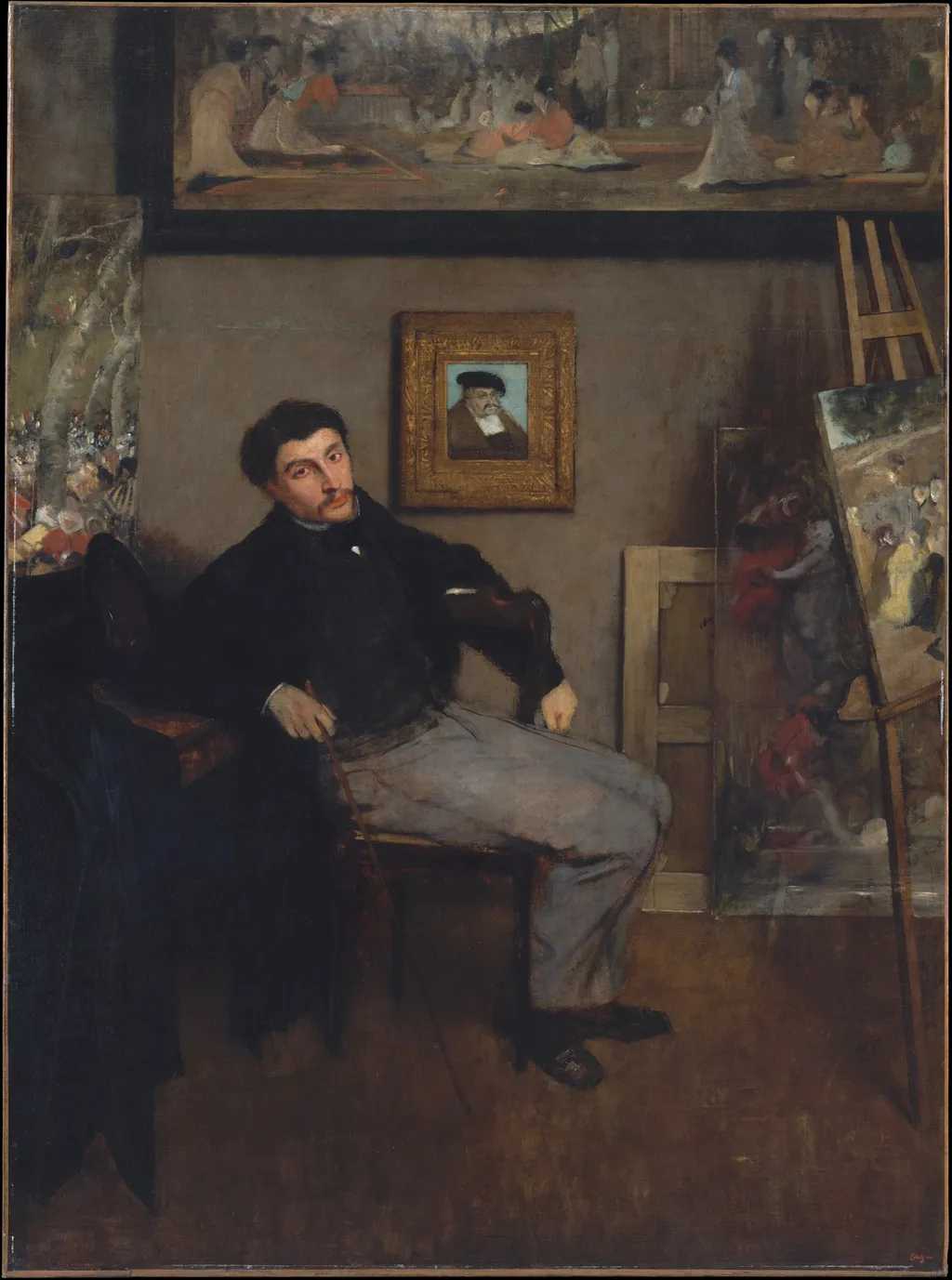
James-Jacques-Joseph Tissot (1836–1902) is an oil painting by the Impressionist artist Edgar Degas. It dates from 1867 and is held in the collection of the Metropolitan Museum of Art.
About this work
Top hat and satin-lined cape rest at his side as James Tissot leans back in a studio chair, surrounded by canvases that map the tastes he shared with Edgar Degas. Degas painted this large portrait around 1867 of his friend and fellow painter, setting a Japanese-style picture and a copy after Cranach's Frederick the Wise behind him.
Subject & Meaning
Together these elements transform the portrait into a declaration of intent, situating Tissot within the contemporary artistic currents that Degas championed.
The painting is a portrait of James-Jacques-Joseph Tissot, presented by Edgar Degas as a refined Parisian dandy seated in his studio. Tissot rests one elbow on a piece of furniture while his walking stick points toward the floor, conveying a posture of elegant ease. The reconstructed studio setting is laden with objects that articulate Tissot's personality, artistic interests, and profession.
On the wall hang a blue-toned canvas attributed to Lucas Cranach and above it a monumental painting with an orientalist character, the latter alluding to the East Asian influence that transformed Western perspective and color perception and contributed to the rise of Impressionism. To the right, an easel supports an unfinished canvas, with two further paintings resting on the floor behind it, one turned to the wall and another bearing a Venetian subject of the fifteenth or sixteenth century. Together these elements transform the portrait into a declaration of intent, situating Tissot within the contemporary artistic currents that Degas championed.
History & Provenance
The portrait is held by the Metropolitan Museum of Art, New York, where it is recorded as accession number 39.161. Executed in oil on canvas in 1867, the painting has remained in the museum's collection since its acquisition. No exhibition history beyond permanent display at the Metropolitan Museum of Art is documented in the cited sources.
Context
Edgar Degas's 1867 portrait of James Tissot serves as a significant document of their close friendship and shared artistic sensibilities during the Second Empire. Degas considered Tissot aligned with the emerging Impressionist group due to their mutual focus on contemporary themes, going so far as to invite him to exhibit at the first Impressionist exhibition in 1874, though Tissot ultimately declined. The painting functions as a manifesto of their aesthetic values, depicting Tissot as a refined Parisian dandy within a studio setting filled with symbolic objects.
These include a work attributed to Lucas Cranach and an Orientalist piece, highlighting the influence of East Asian art on Western perspective and color perception, which was important to the development of Impressionism. By incorporating an unfinished canvas and a Venetian-style work, Degas emphasized Tissot's professional identity and their shared commitment to modern subject matter.
Overview
Edgar Degas painted this full-length oil portrait of his friend and mentor, James Tissot, around 1867–68. The work captures Tissot seated within an artist's studio, surrounded by various canvases that reflect the shared artistic interests of both painters. This significant early piece showcases Degas's realist approach before his later embrace of Impressionistic techniques and subjects. The Metropolitan Museum of Art acquired the painting in 1939.
Technique & Style
Executed on a substantial scale, this oil painting exemplifies Edgar Degas's early artistic phase. Its meticulous, realist rendering distinguishes it from the fragmented brushwork and modern urban themes that would characterize his later Impressionist period. The precision in depicting Tissot and the studio environment demonstrates Degas's command of traditional portraiture, marking a point of artistic maturity before his stylistic evolution.
Own this work as a print
Artist & collection
Artist
Born Hilaire-Germain-Edgar De Gas on 19 July 1834 in Paris, Edgar Degas came from an affluent banking family with aristocratic roots and spent his childhood among the cultivated circles of the French capital.