The question Cole could not stop asking
Stand in front of enough of Thomas Cole's American landscapes, and you start to notice that the painter is not answering a question so much as refusing to stop asking one. The question is plain, and it makes people uneasy: what happens to a wild continent once settlers arrive to improve it? Cole, the English emigrant who founded the Hudson River School, spent a short career circling that problem from every angle, and he never resolved it into a single picture. He kept the wound open on purpose.
Here is my claim. Cole is usually filed as the artist who loved the American wilderness and mourned its destruction. That is half true. The other half, the half that makes him worth more than a calendar of handsome valleys, is that he could not decide whether the destruction was a catastrophe or the price of building a republic worth having. Each canvas is him taking the argument up again from a fresh position. One question, several answers, and none of them final. That irresolution is the achievement, not a failure of nerve. A painter sure of his verdict would have made one good picture and repeated it. Cole made strange, mismatched pictures because the doubt was real.
The biography sharpens the point. Cole was born in 1801 in Bolton, in the smoke of industrial Lancashire, and he had watched what mills and furnaces did to English hills before he ever crossed the Atlantic in 1818. By the time he was sketching the Catskills in the mid-1820s, he already knew how the story tended to end. The Met's Heilbrunn essay on the artist frames his whole output between 1801 and 1848, a working life of barely two decades, and the brevity matters. He was racing a frontier that moved faster than any one painter could record it. A man who has already seen one green country turned to soot does not paint the next one innocently.
Our own holdings register the same compression. Artifact World Gallery keeps 74 works by Cole, drawn from thirteen separate venues and falling roughly between 1801 and 1847, which is to say the entire arc of one man's looking sits inside a single lifetime of dates with no successor in his own hand. A catalogue that tight forces a reader to confront the painter as an argument rather than as a survey of nice weather. Spread thirteen venues' worth of Coles on one table and the repetitions become visible: the same blasted tree, the same far blue ridge, the same small human figure dwarfed by ground that does not need it. He was not painting many places. He was painting one anxiety, many times.
One picture, two halves
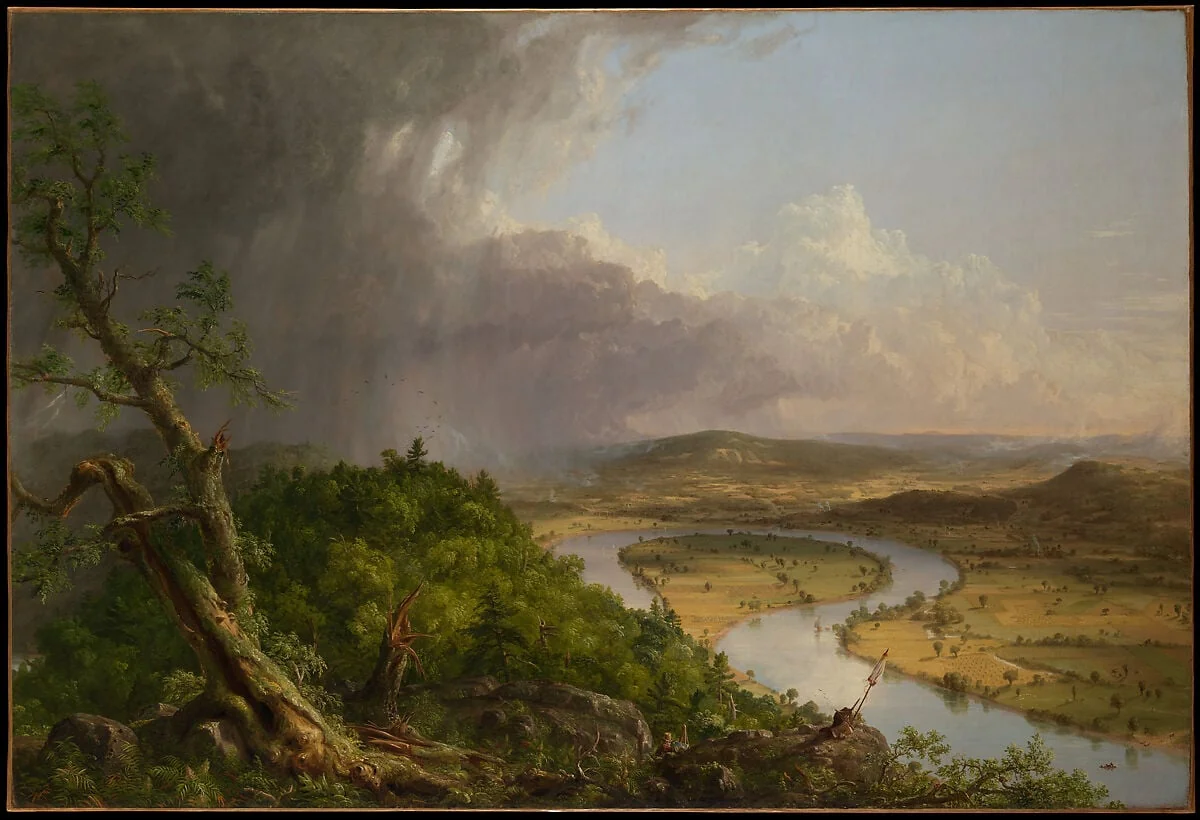
Look hard at the View from Mount Holyoke after a thunderstorm, the picture everyone calls the Oxbow, painted in oil in 1836. Cole splits the canvas along a diagonal and dares you to choose. On the left the storm still holds the ground. A blasted tree snaps forward out of the foreground, its trunk broken and clawing at the air, the sky bruised slate, the slope tangled and dark and uncomposed. The paint there is thick and restless, the foliage scratched in with a loaded brush so the leaves seem to thrash. On the right the same valley lies under clean sun. The Connecticut River loops into its lazy ox-bow, the fields are parceled into tidy greens and golds, thin smoke rises from small farms, and the whole right side is calm to the point of docility, the brushwork suddenly smooth and patient. Down in the middle distance, almost hidden in the grass, Cole paints himself at his easel, a tiny figure with an umbrella, turning back to look at us. He is the only person in the picture who can see both halves at once.
That self-portrait is the whole argument in miniature. The painter sits exactly on the seam between wilderness and cultivation, and he refuses to step to either side. Smarthistory reads the diagonal as a staged debate between untouched nature and the cultivated land that progress demands, and the reading holds; but notice that Cole declines to tilt the verdict. The storm half is more thrilling to paint, and the farm half is where you would actually want to live. He grants the sublime its terror and the pastoral its comfort, then leaves the bill unpaid. A lesser patriot would have let the sun win outright. Look at how he scales the figure: the man is a smear of pigment no larger than a thumbnail, while the broken tree above him fills a quarter of the sky. The thing that worries is enormous; the witness is almost nothing. That ratio is the painting's actual subject.
This is the engine of his best pictures. The handling is conventional enough to read as a topographical view, the kind a touring gentleman might commission, and into that decorous frame Cole smuggles a moral problem with no exit. The Smarthistory essay treats the work as the central American statement on wilderness and improvement, and once you have seen the umbrella'd painter on the seam, you cannot unsee how deliberately he refuses to resolve the scene he has so carefully built. The picture is a trap baited with prettiness. You come for the view and you leave holding a question you did not bring.
Several answers
When the landscape in front of him refused to yield a verdict, Cole invented one. The Titan's Goblet of 1833 is the strangest object he ever made, and his clearest attempt to answer his own question by leaving the earth entirely. An enormous stone chalice rises hundreds of feet above an ordinary plain, and the rim of the cup holds a complete inland sea with its own shoreline, its own little classical temples, its own ships under sail. A whole miniature civilization perches on the lip of a vessel abandoned by vanished giants. Cole keeps the lower world ordinary on purpose: a normal horizon, normal light, normal small trees, so that the goblet's impossible scale lands as a fact rather than a fantasy. The picture says the thing the Oxbow only hinted at: every culture is a temporary settlement on top of something far older and far larger that will outlast it. The answer here is geological time, and it is not consoling.
In 1831 and 1832 Cole was in Italy, and Italy handed him the one thing the Hudson Valley could not supply: ruins that were already finished. The Italian Coast Scene with a Ruined Tower sets a broken medieval shaft against a soft Mediterranean bay, the masonry crumbling at its edges while fishermen go about a day that no longer remembers what the tower defended. The tower is dark and weighty, the water behind it pale and indifferent, and the contrast does the talking. His View of Florence from the hills above the Arno is steadier and more confident, the dome of the cathedral floating in a golden haze over a city that survived its own decline and simply kept living. Cole stacks the distance in warm receding bands, foreground grove to middle river to far dome, so the eye walks into the haze the way memory walks into the past. Italy let him rehearse the end of the American story on a stage where the end had already arrived and proved survivable. That was a second answer, and a gentler one. Empires fall, and people still fish in the morning.
The allegorical urge reached its climax in The Voyage of Life, the four-canvas sermon that follows a single soul from infancy to death down a darkening river. The National Gallery of Art holds the second full-size set, and its opening canvas, Childhood, shows the voyager's gilded boat sliding out of a dark cavern into flowered light, an angel at the helm, the water still untroubled. The cavern mouth is painted as pure shadow, the meadow beyond it lit like a stage, and the boat crosses from one to the other while we watch. Here Cole gives a frankly religious answer. The wilderness becomes the terrain of the soul rather than of the nation, and the river that carried the question now carries a Christian biography toward its sea. It is the most popular thing he ever made, and the least argumentative, because for once he had decided. The pictures people love best from him are the ones where he stopped doubting, which tells you something about audiences and very little about the painter.
And then there is the answer he gave when he stopped arguing and simply painted what he loved. View on the Catskill, Early Autumn of 1837 is almost defiantly peaceful: a screen of warm trees, a small stooping figure, the soft blue wall of the mountains behind, a river doing nothing in particular. The color is the argument here, the maples already turning, so the calm is shot through with the first signal of the season's end. He painted it partly in protest. The railroad was about to cut through that exact stretch of the Catskill valley, and Cole wanted the place on record before the surveyors arrived to price it. The Study for "Catskill Creek" shows the same ground worked out in the open air, the bones of a composition he returned to the way a man revisits a friend he expects to lose. You can read the larger picture's serenity backward into the study and see how much labor went into making something look effortless and safe. The answer in these pictures is the simplest one available: look now, while it is still here.
Works discussed in this article
It helps to remember that Cole wrote as fluently as he painted. His collected essays and prose sketches survive in print, and the best known of them, the Essay on American Scenery, argues in plain English the thing the canvases argue in paint: that the American wild was a kind of national scripture, and the axe was already at work erasing it. The man who would not resolve the Oxbow in oil was perfectly willing to take a side on paper. That gap between the prose and the pictures is worth sitting with. In words he is a preacher; in paint he is an honest doubter. The pictures keep the question open because the pictures are where he was honest about not knowing.
The school that inherited the question
Cole founded a movement, and a movement is a machine for taking a master's question and dividing it among heirs. The Tate's definition gathers the Hudson River School painters who worked the Hudson Valley and the Catskills from the 1820s into the 1870s, and almost every one of them inherited one half of Cole's argument while quietly dropping the other. The doubt was harder to sell than the grandeur, so the grandeur is mostly what survived him. Buyers wanted the cliff and the light. Nobody commissions their own unease.
His own pupil, Frederic Edwin Church, kept the spectacle and let the worry go. Church's continental panoramas turned the sublime into something close to a national advertisement, vast and unworried, painted with a precision that left no room for a tiny painter sitting on a seam, unsure. Where Cole hesitated, Church declared. Every leaf is in focus, every distance accounted for, and the effect is awe without the ache underneath it. The result is thrilling, and it is also the moment the question begins to close.
Jasper Francis Cropsey took a different fragment. He fastened onto the burning autumn color Cole had used to signal mortality, the reddening maples of the Catskill pictures, and made it the entire subject, until the season that once meant decline came to mean only decoration. The same red that warned of an ending in the Catskill view becomes, in Cropsey, a reason to smile. The melancholy drained out, and a brand was born. This is how influence usually works. The follower keeps the surface and forgets the unease that produced it.
The impulse was not only American. In the Alps, Alexandre Calame was building the same kind of moralized mountain at very nearly the same moment, the storm-struck pine and the open abyss carrying a weight that no Swiss valley strictly required them to carry. Cole had European company in the conviction that a landscape could be an argument and not merely a backdrop. The Hudson River School reads as American to the bone, yet its founding question belonged to a wider nineteenth-century anxiety about what industry would do to the ground people stood on. The same furnaces that scarred Lancashire were lighting up on two continents, and the painters felt it before the historians named it.
Cole died in 1848, at forty-seven, with the Catskill railroad built and the frontier already past the places he had painted. The heirs resolved his question in their separate directions, and that resolution is exactly what makes his own canvases feel modern. He is the painter in the group who never decided, and a viewer in our own century, watching a different set of valleys vanish, recognizes the posture immediately. He left the verdict to us, sitting on the seam with an umbrella, looking back.
Sources & further reading
- Thomas Cole — Wikipedia
- Thomas Cole (1801-1848) — The Metropolitan Museum of Art
- View from Mount Holyoke, Northampton, Massachusetts, after a Thunderstorm, The Oxbow — The Metropolitan Museum of Art
- Thomas Cole, The Oxbow — Smarthistory
- The Voyage of Life: Childhood — National Gallery of Art
- Hudson River School — Tate
- The Collected Essays and Prose Sketches — Internet Archive