The engraver Hendrik Goltzius spent the better part of two decades proving that a line cut into copper could carry as much weight and light as anything laid down in oil. Then, around the turn of the seventeenth century, he set himself the harder task: proving that the same hand could do it with a brush. The most useful way to understand him is to refuse the tidy split that art history usually imposes between the celebrated printmaker and the late, less-loved painter. The intelligence behind both is one intelligence. What changes is the tool, and the friction the new tool drags in with it. A man who has organized form by the swelling and tapering of an engraved stroke does not stop seeing that way when you hand him a loaded brush. He sees that way harder, and the results are stranger for it.
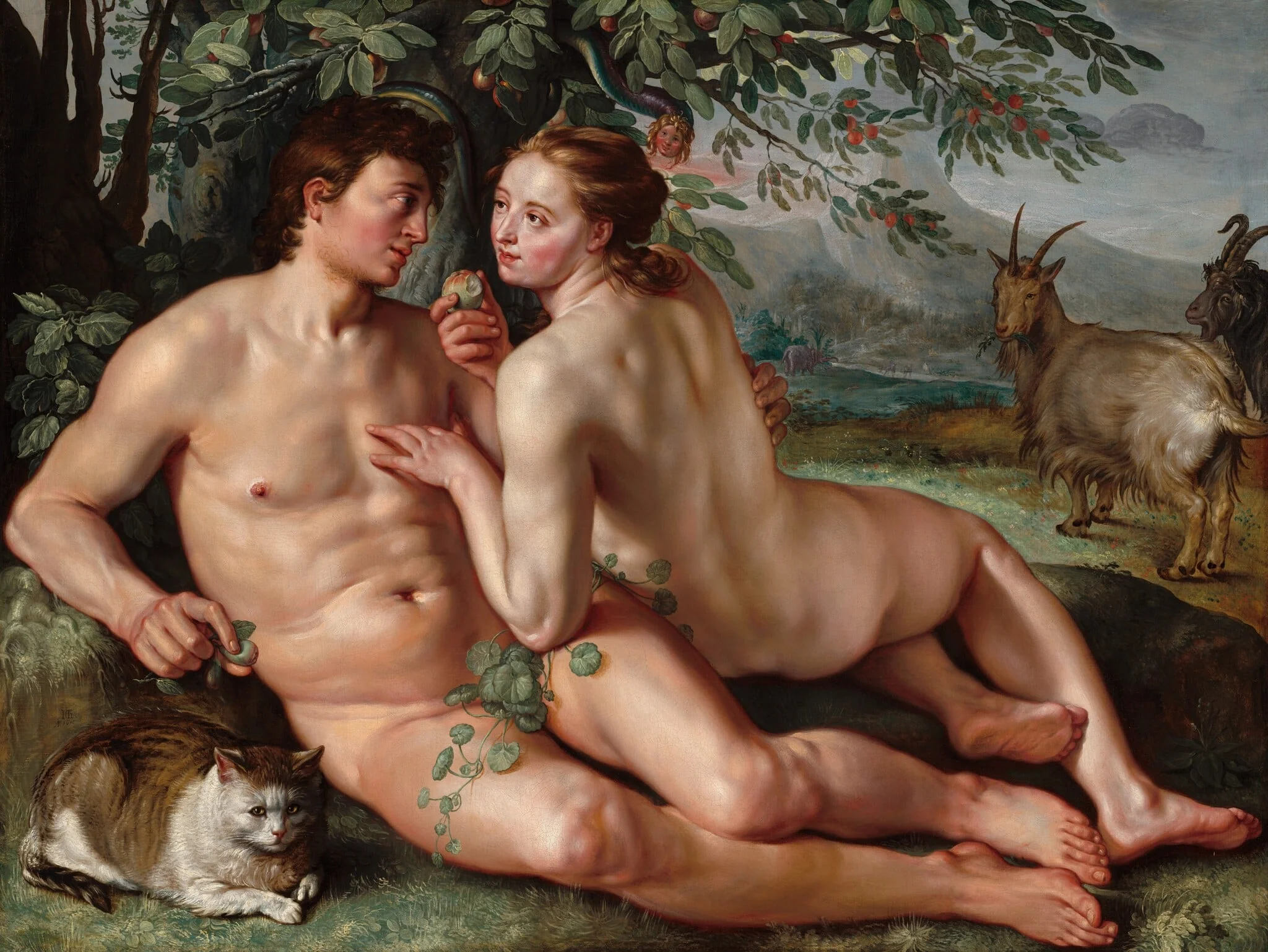
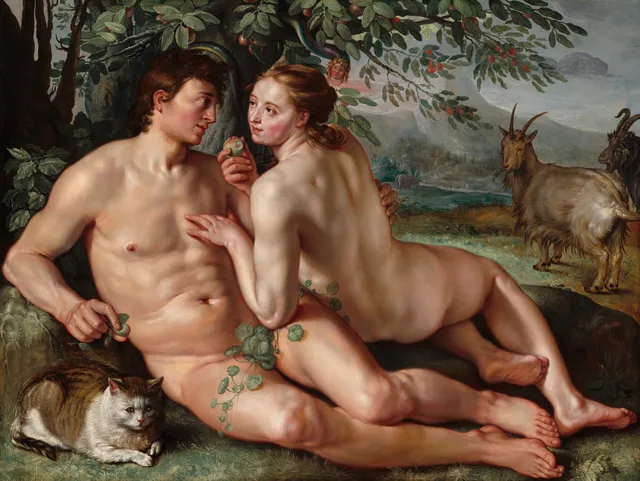
That continuity shows most clearly in a single picture, so I will hang the whole essay on it: the large Fall of Man he painted near the end of his life. It is a work made by someone who thought in lines for thirty years and then had to learn, late and in full public view, to think in flesh. Looked at closely, it carries the engraver's reflexes and the painter's ambitions in the same frame, and the two never entirely agree with each other. That disagreement is my subject. It tells us more about Goltzius than any smooth account of a master at the height of his powers, because it shows the powers being remade in real time. The thesis, plainly: Goltzius is best read not as a printmaker who later dabbled in paint, but as one continuous draftsman whose late pictures record the cost and the daring of trading the burin for the brush.
The hand that learned to swing
Goltzius was born in the first weeks of 1558 in Bracht, in the Duchy of Jülich, and died on the first day of 1617 in Haarlem, the city that became his base. The bare dates are well attested in the surviving biographical record. The fact that matters most for his art happened in childhood. He fell into a fire, and burning coals scarred his right hand so badly that the fingers never again fully extended. A lesser draftsman might have been ended by that injury. Goltzius turned the deformity into a method. Unable to flex the small muscles of the fingers, he engraved from the forearm and shoulder, driving the burin in long, controlled arcs rather than the short scratching strokes most engravers used. The result is the quality his contemporaries prized above everything else, the swing of the line: a stroke that swells from a hair's width to a broad ribbon and tapers back to nothing, modeling a thigh or a bank of cloud without a thicket of crosshatching fighting against it. His infirmity is, quite literally, the signature of his style.
He learned the trade from Dirck Volckertsz Coornhert, a printmaker and humanist, and followed him from Xanten to Haarlem shortly after 1576, as the National Gallery of Art records. Within a decade of arriving he ran the most ambitious print workshop in the northern Netherlands, a business that trained engravers and shipped sheets across Europe. The output is staggering on paper. Hollstein's catalogue assigns 388 prints directly to his hand, with a further 574 cut by other engravers after his designs. That second figure deserves as much attention as the first. It means Goltzius was not only an artist but a publisher of his own invention, a man whose drawings became other men's labor and other men's profit. He understood, earlier than most, that a great design is a thing that can be multiplied, and that authorship and execution can be prized apart.
His fame rests on the Mannerist engravings the shop poured out between 1585 and 1589, sheets of twisting, over-muscled gods and martyrs in the high international style, whose admirers reached as far up as the Holy Roman Emperor Rudolf II, as the Metropolitan Museum's account of his career sets out. These prints are performances before they are anything else. A drawing of strained, spiralling figures would arrive in the workshop and leave as an engraving in which the burin work itself becomes the spectacle, the line so confident that you watch the cutting as much as the subject. Goltzius could also impersonate. He cut prints in the manner of earlier masters so convincingly that knowledgeable collectors were fooled, which was partly the joke and partly the boast. A hand that can counterfeit any style has, in a certain sense, no style left to lose, only technique to spend. That freedom is what he carried, eventually, toward paint.
It is worth pausing on what the swing actually does, because the whole later story depends on it. In ordinary engraving, shadow is built by laying parallel lines close together and crossing them. The line is a unit of darkness, and the form emerges from accumulated marks. Goltzius's line is different in kind. A single stroke models a whole rounded surface by changing its own thickness as it travels, so that the contour and the shading are one event rather than two. This is closer to drawing with light than to hatching, and it is the engraved equivalent of a brush charged with paint, pressed hard and then lifted. When he finally took up oil, he already owned the gesture the medium rewards. What he did not yet own was the patience the medium demands, the willingness to let an edge go soft.
Close-looking: The Fall of Man
Stand in front of the Fall of Man and the first thing you register is scale. Adam and Eve fill the foreground almost edge to edge, pressed so close to the picture plane that the landscape behind them reads as a thin green afterthought. Eve sits and turns toward Adam, her body open to him and to us. The forbidden fruit is in play between them, and the whole moral pressure of the scene compresses into the small distance between a hand and a mouth. Above, the serpent threads through the branches with a face too knowing for any animal. That almost human face turns the temptation into a conversation rather than an ambush, and the painter wants us to feel that Eve is being reasoned with, not simply tricked. At their feet the painter has set the emblems of appetite he wants us to read: a cat watching, a goat, a still passage of leaves and ripe fruit handled with a jeweler's patience. Nothing here is accidental. Every object is an argument about desire.
Now look at how the two bodies are made, because that is where the engraver gives himself away. The contours are drawn. There is no softer word for it. The outline of Eve's shoulder and the long edge of Adam's flank are continuous, confident curves of exactly the kind Goltzius spent a working life cutting into copper. He cannot help it. The eye that learned to define a form by its swelling boundary still defines form that way, even with a brush in hand. Inside those contours the modeling is smooth and even, the light rolling across the torsos in measured gradients, and the anatomy is correct to the point of pedantry, every muscle accounted for and slightly overstated. This is a printmaker's nude, built from the edge inward, the body conceived as a beautifully closed line and then filled.
Where the picture becomes genuinely a painting is in its surfaces. The flesh holds a faint warmth no engraving can carry, a pinkness in the knees and the knuckles that only oil allows. The leaves at the lower edge catch a wet highlight that sits on top of the paint rather than inside the design. The dark behind the figures is a real, breathing dark, not the woven black of crossed lines. And here is the honest judgment, the thing a survey would hedge: the two languages never quite fuse. The drawn contour and the painted flesh sit side by side, the one insisting on the boundary, the other trying to dissolve it. The painting is more compelling for that unresolved seam than it would be if Goltzius had simply pulled it off. We are watching an old master unlearn his single greatest skill in order to acquire a lesser one he wanted more, and the strain is visible in every limb.
From the burin to the brush
The change of direction was deliberate, not a decline. Around 1600, at the age of forty-two, Goltzius gave up printmaking and turned to painting, which he held to be the more prestigious art, a point the Met essay states plainly. He did not let go of his old craft all at once. For a few years he made what are called pen-paintings, drawing with a pen directly onto prepared canvas or panel in order to mimic an engraving at the scale of a picture, a technique the National Gallery singles out as one of his real inventions. These are the strangest objects in his work, paintings that openly pretend to be prints, the hand reluctant to surrender the line even as it commits to a painted surface. They are the literal hinge of his career. The fully painted mythologies and religious scenes followed, and with them the problem the Fall of Man dramatizes so well: what to do with a contour you can no longer cut, only describe. The pen-paintings answer it one way, by keeping the line and abandoning the brush's softness. The Fall of Man answers it the other way, by keeping the brush and refusing to give up the line. Neither answer is final, and that is why both reward looking.
What the archive holds
Set against that biography, our own holdings tell a small story of their own. Artifact World Gallery catalogues 262 works under the name of Goltzius across 13 venues, dated, loosely, between about 1550 and 1616. The early end of that range says more about the looseness of attribution than about the man, who was not born until 1558. Most of the 262 are prints, his own sheets and the reproductive engravings cut after his designs, which is exactly what you would expect from an artist whose graphic output Hollstein numbered close to a thousand items in total. A collection of Goltzius is, by its nature, mostly a collection of lines. The paintings are the rare exceptions, and they are the more precious for it, because they are where the line had to learn to behave like something else. The proportion is itself the argument of this essay made in inventory form: a few painted bodies floating in a sea of engraved ones, each painting a place where the swing met a surface it could not simply cut.
Among the painted and drawn works the gallery does hold, the range is instructive. The Venus and Adonis gives us the mythological Goltzius, the body carrying the whole argument of the picture. The Entombment of Christ and the Baptism show the sober religious vein of his later years, where the Mannerist spiral finally relaxes into something close to gravity. A second Fall of Man lets you set two attempts at the same charged subject against each other and watch the choices repeat. And the Portrait of Hendrick Jansz. Spijcker as Flag Bearer reminds us that this inventor of gods could also fix a single Haarlem citizen in his finery, the banner curling behind him with the same swung line that once described a thundercloud.
Works discussed in this article
Goltzius did not work alone, and the gallery's neighboring holdings map the world he anchored. Jacob de Gheyn II came up through his orbit before building a large reputation of his own. Jan van de Velde, an engraver of the next Haarlem generation, carried the descriptive line forward into landscape, where the swing learned to make weather and distance instead of muscle. Werner van den Valckert and Pieter de Grebber belong to the painters who came after, once Haarlem had become a center serious enough to keep its talent at home. Look further afield and the company is grander still. The Bologna of Lodovico Carracci and the meticulous nature studies of Jacopo Ligozzi were chasing, by very different routes, the same reconciliation of drawing and observation that Goltzius spent his last years failing and half-succeeding at.
The early prints repay attention because they show the swing already fully formed. The Getty Museum holds his 1585 Mars and Venus Surprised by Vulcan, a sheet thick with incident in which the same hand orchestrates a crowd of figures and a thrown net without ever losing the clarity of a single contour. The bodies tumble and twist in the high Mannerist fashion, yet each one stays legible because its boundary is drawn with a stroke that never wavers. Set a plate like that beside the late Fall of Man and the through-line is unmistakable. The young engraver who could marshal a dozen straining figures into one coherent surface is the same old painter who could not stop drawing the edge of a single thigh. What grew between the two was not the skill but the medium, and the medium fought back. You can see, in hindsight, why paint would eventually feel to him like a frontier worth the risk: it offered the one thing the burin could never give, a body that breathed at its own edges.
What he left
It is tempting to file Goltzius under virtuosity and move on. That would miss the more difficult thing he did. Plenty of engravers could dazzle. Few would risk a towering reputation, at past forty, by picking up an instrument they had not mastered, in front of an audience that already considered them the best alive at something else. The pen-paintings and the late nudes are the record of that gamble. They are imperfect in the most interesting possible way, the work of a hand caught honestly between two crafts and unwilling to fake the join. That refusal to fake it is the quiet integrity of the late work, and it is why these pictures keep their hold long after slicker ones have let go. His grammar outlasted him by more than the paintings did. When you next see a reproductive engraving from the seventeenth century, the kind that translates an oil painting into a field of swelling and tapering strokes, you are reading a sentence in Goltzius's language, still being spoken a hundred years after he set it down with a ruined right hand.
Sources & further reading
- Hendrick Goltzius (1558-1617) — The Metropolitan Museum of Art, Heilbrunn Timeline (Nadine M. Orenstein)
- Hendrick Goltzius — Wikipedia
- Hendrick Goltzius — National Gallery of Art, Washington
- Hendrick Goltzius — The J. Paul Getty Museum
- Verzeichnis des graphischen Werks von Hendrick Goltzius, 1558-1617 — Otto Hirschmann, 1921 (Klinkhardt & Biermann), via Internet Archive